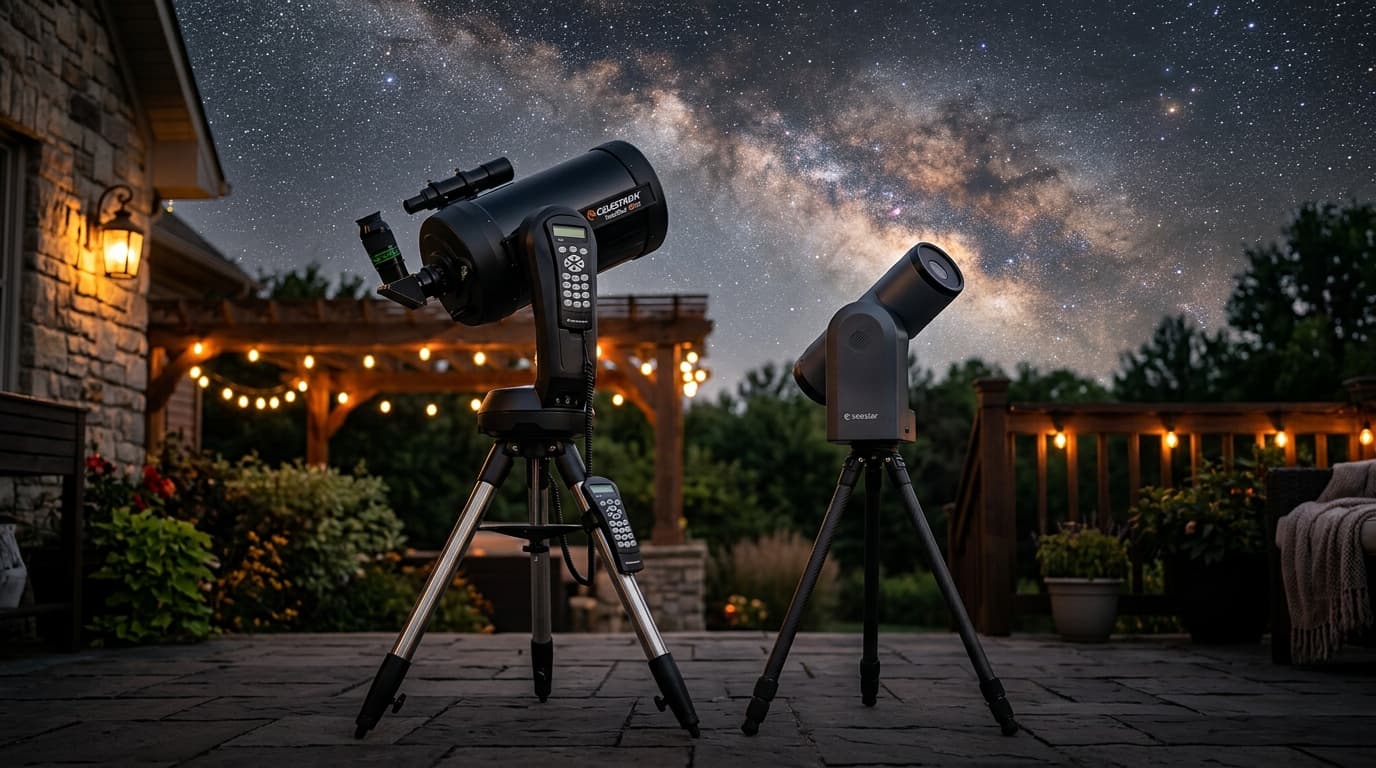

Under $1,000 is where telescopes get serious. GoTo mounts, smart imaging, 150-200mm of aperture, and a first step into astrophotography are all within reach. The two highest-scoring telescopes still in stock at this price are both smart scopes: the Unistellar eVscope Equinox (85), which Amazon has down to a single unit, and the DWARFLAB DWARF 3 (83) at $549, which is the one we would order. The best traditional telescope is the Celestron NexStar 127SLT, a GoTo Maksutov with almost 1,200 reviews, and the best value is the Sky-Watcher Virtuoso GTi 150P, which puts 150mm of parabolic aperture on a GoTo base for $402.31.
Two housekeeping notes. Our previous top pick, the ZWO Seestar S50, and its sibling the S30 have been out of stock on Amazon for months, as has the NexStar 130SLT that led the traditional picks; all three are out until they return. And our scoring engine now accounts for optical execution, so the Celestron 114LCM, a Bird-Jones design with a spherical mirror and a Barlow lens hidden in the focuser, dropped from 82 to 68 and is no longer a pick.
Quick Picks
| Telescope | Best For | Overall Score | Price |
|---|---|---|---|
| DWARFLAB DWARF 3 | Best smart telescope you can buy | 83 | $549 |
| Unistellar eVscope Equinox | Best premium smart | 85 | $925.95 |
| Celestron NexStar 127SLT | Best traditional scope, best for planets | 79 | $679.99 |
| Celestron NexStar 5SE | Best SCT | 78 | $899 |
| Celestron NexStar 4SE | Best compact GoTo | 75 | $649 |
| Sky-Watcher Virtuoso GTi 150P | Best value, best GoTo reflector | 76 | $402.31 |
| Celestron StarSense Explorer DX 130AZ | Best app-guided | 74 | $499.95 |
| Sky-Watcher Heritage 150P | Best manual Dobsonian | 68 | $309 |
| Sky-Watcher FlexTube 200P | Most aperture | 65 | $739 |
| Celestron AstroMaster 130EQ-MD | Cheapest motorized equatorial (with caveats) | 74 | $330.99 |
How We Chose These
Every telescope on WhichScope is scored across 7 dimensions: overall performance, value, beginner-friendliness, planetary capability, deep-sky performance, astrophotography potential, and portability. For this guide we filtered to active telescopes under $1,000 that are actually in stock, reviewed their scores, and curated 10 picks spanning the telescope types that compete at this price: smart scopes, GoTo Maksutovs and Schmidt-Cassegrains, a GoTo Dobsonian, an app-guided parabolic Newtonian, manual Dobsonians, and an equatorial starter. The order within each section is editorial, not a strict score ranking.
Since this guide was first written the engine gained an optical-execution factor: a spherical primary mirror is fine at f/8 or slower and progressively worse as it gets faster, and a Bird-Jones (a fast spherical mirror with a corrector lens in the focuser, sold as a long-focal-length Newtonian) is penalized outright. That is why the 114LCM is gone and why the AstroMaster 130EQ-MD now sits at the bottom of the table with a caveat rather than in the middle as a straight recommendation.
This is the most diverse price bracket in our database. Below $500, the options are largely manual reflectors and refractors. Above $1,000, you are in premium territory. The picks below are organized by type to help you narrow down.
Smart Telescopes
Smart telescopes handle alignment, tracking, and image stacking automatically. You control them from a phone app, and they produce processed deep-sky images in minutes. They are a fundamentally different experience from eyepiece observing. The ZWO Seestar S50 and S30 are the highest-scoring telescopes in our database (93 and 90), but both have been unavailable on Amazon for months, so the picks here are the two smart scopes you can order today.
1. DWARFLAB DWARF 3: Best Smart Telescope You Can Buy
DWARFLAB
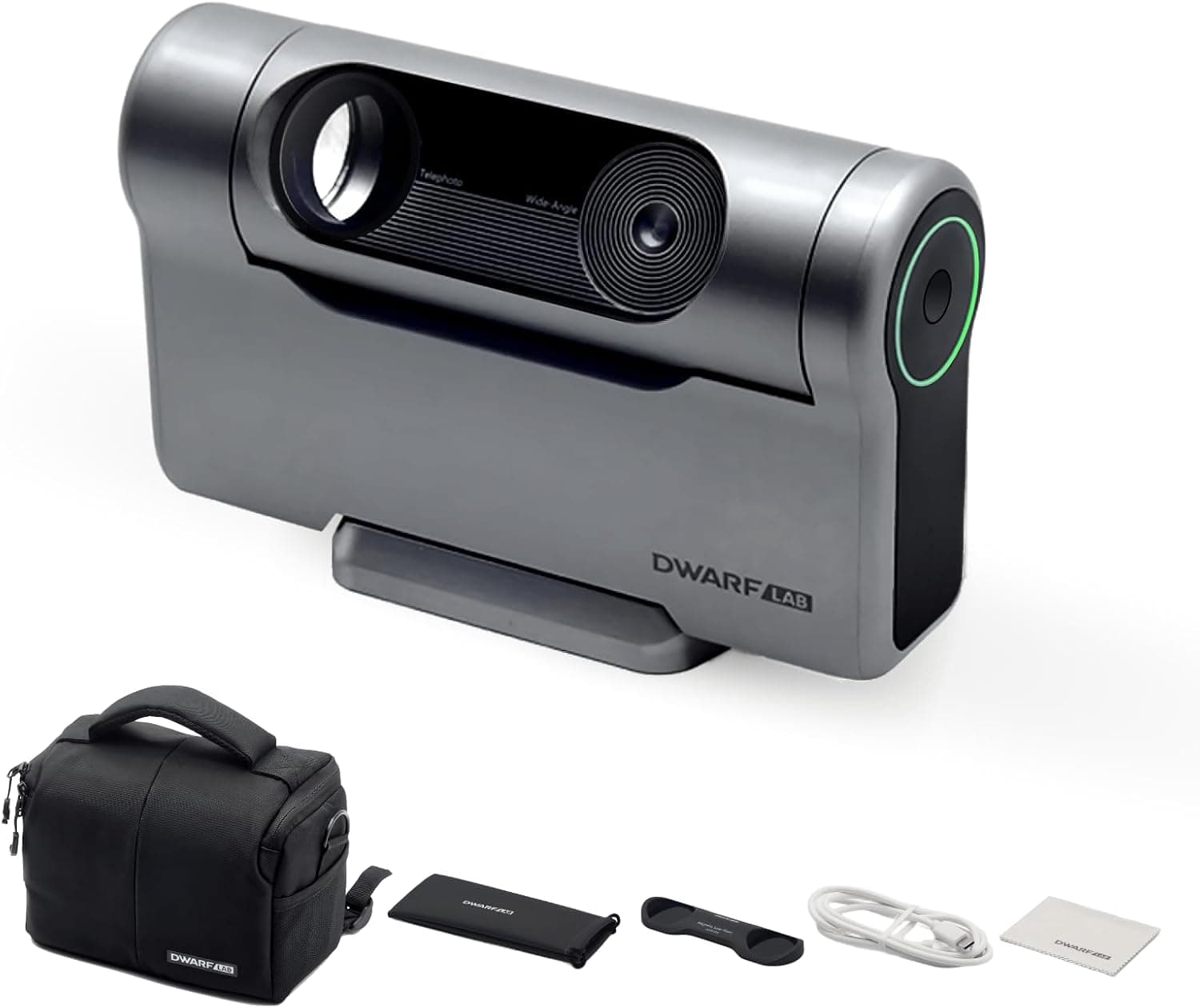
DWARFLAB DWARF 3Pocket-sized smart telescope with dual lenses, GoTo tracking, and live stacking for deep sky and daytime use
The DWARF 3 scores 83 overall, second only to the eVscope Equinox among in-stock telescopes under $1,000 and at well under two-thirds of its price, and it weighs 1.3kg. It pairs a telephoto lens with a wide-angle one, so it shoots deep-sky targets, the Milky Way and, with the included filter, the Sun, and it handles plate solving, tracking, stacking and processing in the DWARFLAB app. Set it on any flat surface, tap a target, and a color image builds on your phone over the next few minutes. For the full breakdown, read our hands-on DWARF 3 review.
139 Amazon reviews at 4.6 stars ties the Heritage 150P for the highest rating on this list. The form factor is the point: it is barely larger than a can of soda and goes in a jacket pocket, so it comes on trips that no other telescope here would.
Who it is for: Anyone who wants deep-sky images with almost no learning curve, travelers, and observers under light-polluted skies where visual observing is limited.
The tradeoff: No eyepiece. The aperture is tiny by telescope standards, so faint targets need long integration times and planets are small. The Seestar S50, if you can find one, images faster with its 50mm lens; the DWARF 3 is the one you can buy.
The smart telescope to buy under $1,000. 83 overall, 1.3kg.
2. Unistellar eVscope Equinox: Best Premium Smart Telescope
Unistellar
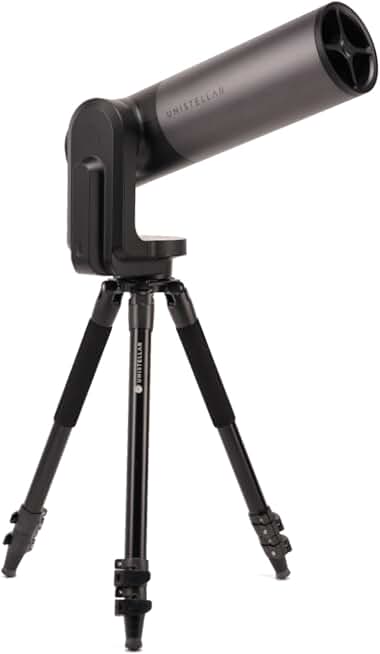
Unistellar eVscope EquinoxSmart, self-aligning, and ready to image in under a minute, the eVscope Equinox brings deep-sky observing to any backyard.
At $925.95, the eVscope Equinox is the most expensive pick on this list, but it has the largest aperture of any smart telescope here: 114mm at f/4. That translates to faster imaging and more detail on faint targets. It scores 85 overall with a 74 astrophoto score and 71 deep-sky score, the highest among the smart scopes in our database on those two dimensions.
The Equinox uses Unistellar's Enhanced Vision technology, which live-stacks short exposures and displays the result in real time through the app. Unistellar's citizen-science program, which lets owners contribute exoplanet transit and asteroid occultation data, is a genuine differentiator for the scientifically minded.
Who it is for: Observers who want the best smart-telescope image quality under $1,000 and are interested in contributing observations.
The tradeoff: 27 Amazon reviews at 3.6 stars is a small and lukewarm sample; Unistellar sells mostly direct, but the lower average is worth noting. At nearly twice the price of the DWARF 3 the jump in image quality is real but not proportional, and Amazon stock is thin.
114mm smart telescope. Best smart scope image quality under $1,000.
GoTo Compound Telescopes
Compound (catadioptric) telescopes fold a long focal length into a short sealed tube. Maksutov-Cassegrains and Schmidt-Cassegrains are the two designs, both never need collimation in normal use, and both excel on the Moon and planets. This bracket has three strong Celestron options on GoTo mounts.
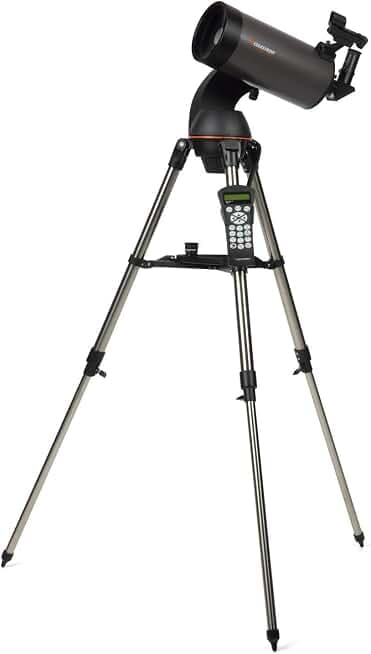
3. Celestron NexStar 127SLT: Best Traditional Scope, Best for Planets
Celestron
Celestron NexStar 127SLT127mm Maksutov-Cassegrain GoTo telescope that punches above its weight for planetary and lunar observing
The 127SLT is the highest-scoring traditional telescope you can buy under $1,000 at 79 overall, and it is built for the targets most people buy a telescope to see. The 127mm Maksutov-Cassegrain at f/11.8 has a 1,500mm focal length, which delivers high magnification and sharp, high-contrast images: Saturn's rings and the Cassini Division, Jupiter's Great Red Spot and moon shadows, Mars's polar cap near opposition. Its planetary score of 66 is the highest on this list.
The sealed Mak design needs no collimation, and Celestron's SLT GoTo mount finds and tracks 4,000+ objects after a SkyAlign on a few bright stars. With 1,185 Amazon reviews at 4.2 stars it is a well-proven platform. It also leads our best telescopes for planets and galaxies guide's budget planetary slot.
Who it is for: Observers focused on planets, the Moon and double stars who want GoTo convenience in a compact, low-maintenance package.
The tradeoff: The f/11.8 focal ratio gives narrow fields, so large nebulae and open clusters will not frame well, and 127mm is modest aperture for faint galaxies. At 8.21kg it is a one-trip carry. The Mak takes 20-30 minutes to reach thermal equilibrium on a cold night.
Best traditional telescope under $1,000. 127mm GoTo Mak for planets and the Moon.
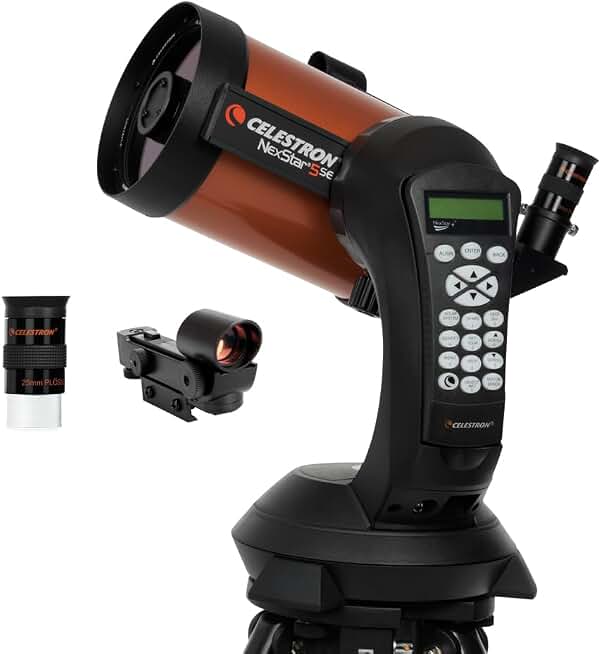
4. Celestron NexStar 5SE: Best Schmidt-Cassegrain
Celestron
Celestron NexStar 5SECelestron's iconic 5SE brings computerized GoTo precision and Schmidt-Cassegrain optics into a genuinely portable package
The 5SE is the smallest member of the family that includes the NexStar 8SE, and it shares the orange tube, the single-arm fork mount and the NexStar+ hand controller with its bigger siblings. The 125mm Schmidt-Cassegrain has a 1,250mm focal length at f/10, a touch faster and wider than the 127SLT's Mak, and the SCT optics accept Celestron's full accessory ecosystem: focal reducers, wedges for equatorial tracking, and camera adapters. It scores 78 overall. 526 Amazon reviews average 4.4 stars, the highest rating of any traditional GoTo scope on this list.
Who it is for: Observers who want a planetary-leaning GoTo scope with a real upgrade path, and who value the SE mount's build quality over the SLT's lighter tripod.
The tradeoff: At $899 it costs noticeably more than the 127SLT for essentially the same aperture; you are paying for the mount and the ecosystem. Like all f/10 compounds it is not a wide-field instrument, and the alt-az fork needs an optional wedge for long-exposure imaging.
The 8SE's little brother. 125mm SCT with GoTo and a real upgrade path.
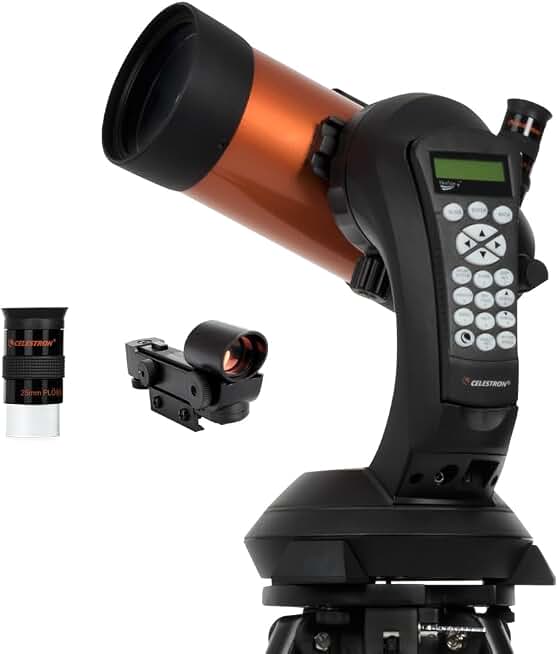
5. Celestron NexStar 4SE: Best Compact GoTo
Celestron
Celestron NexStar 4SECompact GoTo optics that find and track 40,000+ objects automatically, built for serious lunar and planetary views.
The NexStar 4SE is a 102mm Maksutov-Cassegrain on the same single-arm fork mount as the 5SE, and it is the most compact GoTo telescope on this list: the tube is about the length of your forearm and the whole kit weighs 10.4kg with the tripod. The f/13 optics give a 1,325mm focal length, making it a sharp lunar and planetary scope despite the modest aperture, and the built-in flip mirror lets you swap between the eyepiece and a camera without refocusing. It scores 75 overall, with 757 Amazon reviews at 4.3 stars.
Who it is for: Observers who want a proven GoTo platform in the smallest possible package, apartment and balcony observers, and anyone who wants the SE mount with room to put a bigger tube on it later.
The tradeoff: 102mm gathers less light than every reflector on this list; faint deep-sky objects are out of reach. At $649 it costs more than the 127SLT while offering less aperture. This is a scope you buy for the mount, the compactness and the build quality, not for the biggest views.
Compact 102mm Mak on Celestron's proven GoTo fork mount.

Reflectors and Dobsonians
Reflectors buy the most aperture per dollar, and aperture is what deep-sky observing needs. The picks here all have parabolic primary mirrors verified against the manufacturer's spec sheet; see the note on the AstroMaster at the end for why that matters.
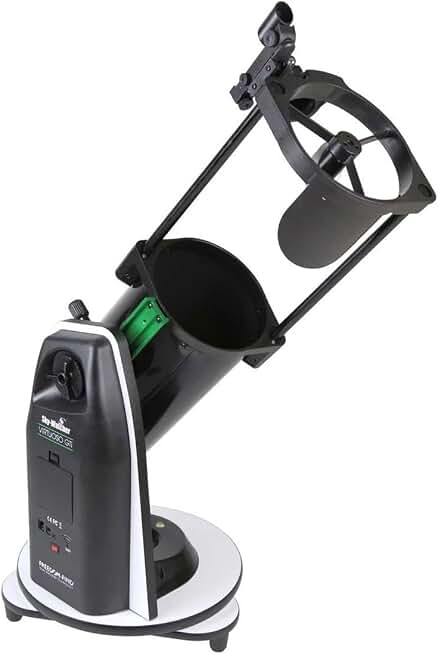
6. Sky-Watcher Virtuoso GTi 150P: Best Value, Best GoTo Reflector
Sky-Watcher
Sky-Watcher Virtuoso GTi 150PGoTo Dobsonian power in a tabletop package, with Wi-Fi control and the freedom to push around manually.
The Virtuoso GTi 150P is the best value on this list and the GoTo reflector we recommend. It puts the same 150mm f/5 collapsible optical tube format as the Heritage 150P on a motorized tabletop Dobsonian base with built-in WiFi. Align using one of four methods in the free SynScan Pro app, pick any of more than 10,000 objects, and it slews to and tracks them. Sky-Watcher's Freedom Find dual encoders let you push the tube by hand without losing alignment, so it behaves like a normal Dob when you want to sweep the Milky Way.
150mm of parabolic aperture gathers a third more light than a 130mm scope and 2.2 times as much as the 102mm Maks above. Galaxies that are smudges in a 130mm show hints of shape; globular clusters begin to resolve at the edges. It scores 76 overall and 57 deep-sky, the best deep-sky score of any traditional pick here. 52 Amazon reviews at 4.2 stars is a small sample, but the Heritage and Virtuoso lines have long track records in the community.
Who it is for: Visual observers who want maximum aperture with GoTo convenience for under $500. The Telescope Finder tool can compare it against other Dobs in our database.
The tradeoff: At 11.7kg it is the heaviest scope on this list bar the 8-inch below. Tabletop Dobsonians need a sturdy surface (a camping table works; a card table does not). It runs on 8 AA batteries or an external 12V supply. The open collapsible tube needs collimation and a shroud against dew, and alt-az tracking rules out long-exposure astrophotography.
150mm GoTo Dobsonian for under $500. The best value under $1,000.
7. Celestron StarSense Explorer DX 130AZ: Best App-Guided
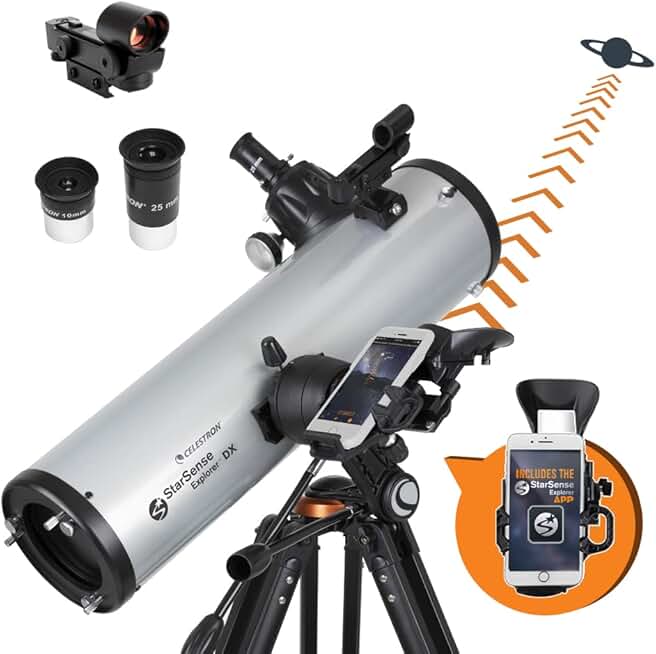
Smart phone-powered star finding meets a capable 130mm reflector, making the night sky genuinely accessible for beginners.
The StarSense Explorer system is the middle ground between manual and GoTo: dock your phone, and the app solves the sky through its camera and draws arrows to any target while you push the telescope. The DX 130AZ is the StarSense scope to buy because Celestron's spec sheet lists a parabolic primary mirror, 130mm at f/5 with a 650mm focal length in a 635mm tube, a real Newtonian with the right mirror. It scores 74 overall with 1,550 Amazon reviews at 4.1 stars. It leads our best telescopes under $500 guide.
Who it is for: Observers who want help finding objects but prefer moving the telescope themselves and learning the sky, at a lower price than GoTo.
The tradeoff: No motorized tracking, so objects drift and you nudge every minute or so; tiring at high power on planets. The app needs a recent smartphone. At 8.16kg it is a one-trip carry.
App-guided finding on a parabolic 130mm mirror.
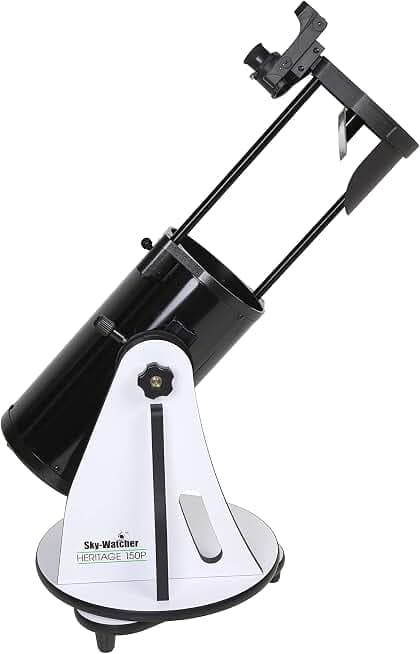
8. Sky-Watcher Heritage 150P: Best Manual Dobsonian
Sky-Watcher
Sky-Watcher Heritage 150PBig views, compact package: the Heritage 150P brings serious aperture to a tabletop Dobsonian under $400.
The Heritage 150P is the GTi's optics without the motors: 150mm of parabolic aperture on a collapsible tabletop Dobsonian for $309, the least expensive pick on this list. Push it to point at something and look. Amazon reviewers give it 4.6 stars across 74 reviews, the highest rating of any reflector here, and at 9.34kg it is a manageable one-piece carry.
Who it is for: Observers who would rather spend the GoTo premium on eyepieces and learn the sky with a phone app as a finder chart.
The tradeoff: No tracking, no electronics, and you need a table. Newtonians need occasional collimation, though it sounds harder than it is.
150mm parabolic Dobsonian. Maximum light per dollar.
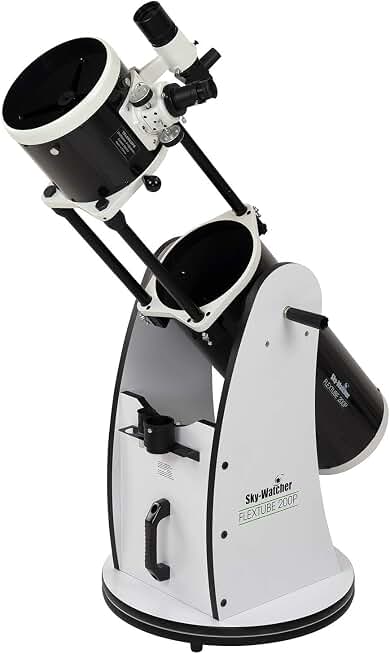
9. Sky-Watcher FlexTube 200P: Most Aperture
Sky-Watcher
Sky-Watcher FlexTube 200P8-inch portability meets serious light gathering, finally solved with a collapsible Dobsonian design
If aperture is the whole point, the FlexTube 200P is the only 8-inch telescope under $1,000 in our database. The 200mm f/6 parabolic mirror gathers 78 percent more light than a 150mm and 2.4 times as much as a 130mm: the Orion Nebula gains color, M13 resolves across its face, and the brighter galaxies show structure rather than presence. Sky-Watcher's collapsible truss shortens the tube for transport, and the f/6 focal ratio is gentler on cheap eyepieces than the f/5 tabletop Dobs.
It scores 65 overall, which looks low next to the GoTo picks because the engine rewards automation and portability and this scope has neither. On optics alone it is the most capable telescope here. 96 Amazon reviews at 4.0 stars.
Who it is for: Visual deep-sky observers with a car and a backyard who want the biggest mirror the budget allows and are happy to star-hop.
The tradeoff: It is a full-size floor Dobsonian: two heavy pieces, a two-trip setup, and a real storage footprint. No tracking, no GoTo, and the truss needs collimation before every session. Thermal equilibrium on a cold night takes 30-45 minutes.
The only 8-inch under $1,000. 200mm of parabolic aperture on a collapsible Dob.
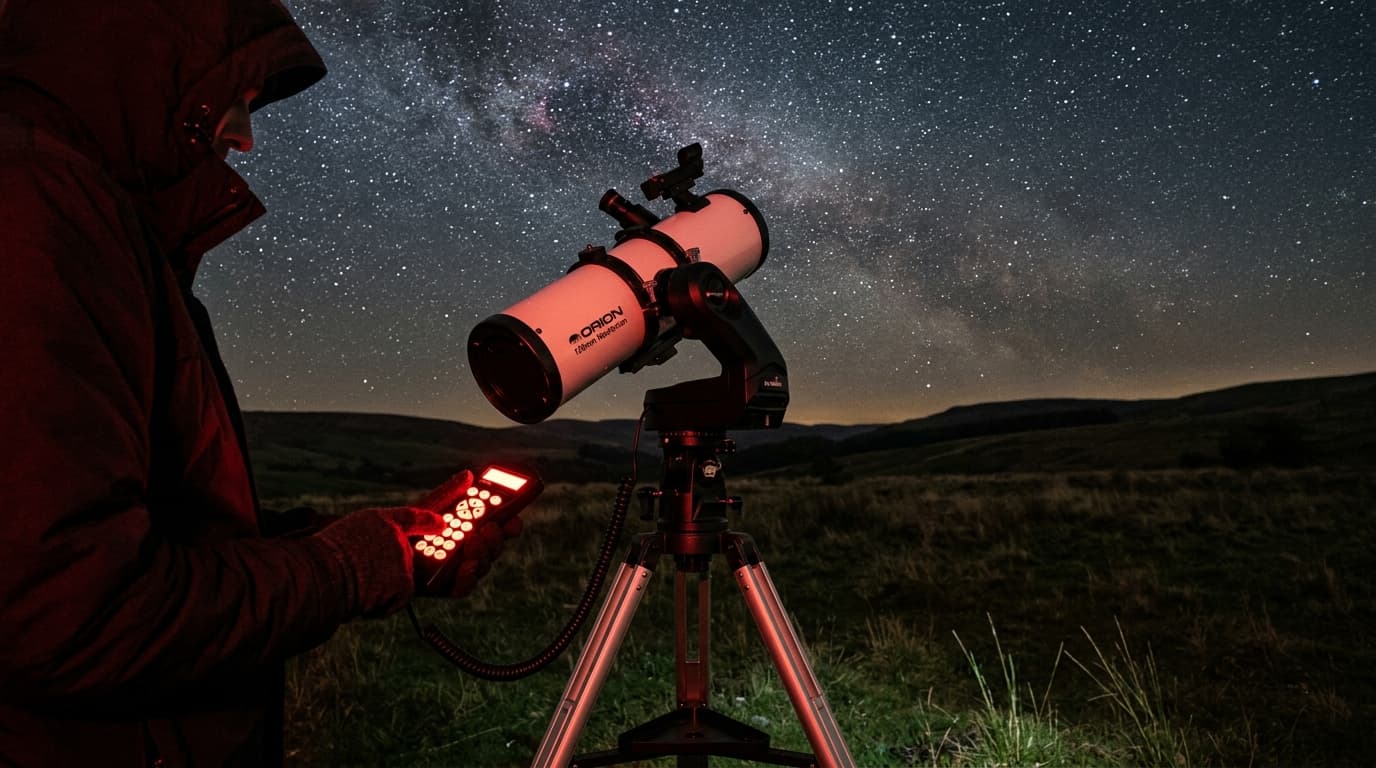
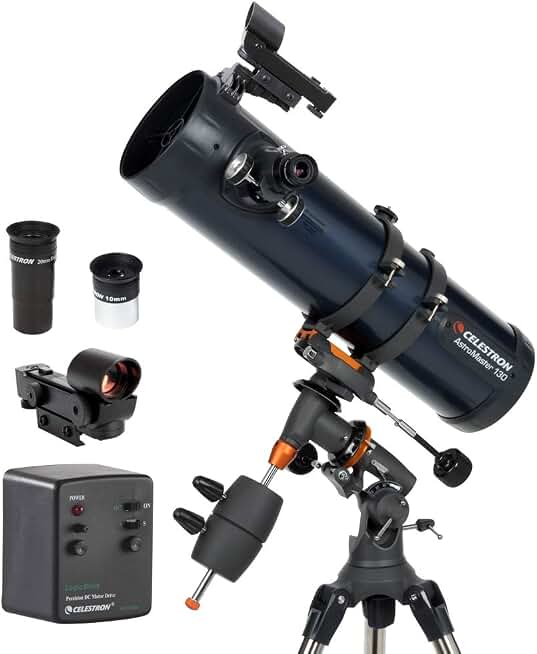
10. Celestron AstroMaster 130EQ-MD: Cheapest Motorized Equatorial, With Caveats
Celestron
Celestron AstroMaster 130EQ-MD130mm of light-gathering power with motorized tracking, built for beginners ready to go beyond the Moon
Read the caveats first. Celestron's spec sheet lists the AstroMaster 130's primary as a spherical mirror, and at f/5 a spherical mirror is fast enough that stars and planets never snap to focus the way they do in the parabolic Dobsonians above; our engine now scores it 74 with that penalty applied. Its 1,900 Amazon reviews average 4.0 stars, tied for the lowest of any traditional pick here, and the lightweight CG-3 equatorial mount is the usual complaint.
It is on this list for one reason: at $330.99 it is the cheapest telescope in our database with a motor-driven equatorial mount, and an equatorial mount that tracks is the minimum requirement for trying long-exposure astrophotography. If you specifically want to learn polar alignment and shoot your first 30-second exposures of the Orion Nebula without spending $1,200 on a proper mount, it does that. For visual observing, every reflector above it is a better buy.
Who it is for: Buyers who know they want to learn equatorial tracking and try basic imaging on a tight budget, and who understand the optical compromise.
The tradeoff: The spherical mirror. The mount. And the learning curve: polar alignment is not hard but takes practice, and the mount tracks but does not GoTo, so you find objects manually. At 7.71kg it is not grab-and-go.
The cheapest motorized equatorial in our database. Read the caveats first.
What $1,000 Gets You vs. Lower Budgets
Each price tier unlocks new capabilities. Here is what changes as you move up.
Under $200: Manual refractors with 70-80mm aperture and no automation; every reflector at this price in our catalogue is a Bird-Jones or a fast spherical design, and our best telescopes under $200 guide explains why we recommend the refractors instead. Good for the Moon, planets, and bright clusters.
Under $300: A 102mm refractor, app-guided finding on the StarSense LT 80AZ, and the first honest reflector, the parabolic Heritage 130P a few dollars over the line. See our best telescopes under $300 guide.
Under $500: GoTo arrives on the Virtuoso GTi 150P, the parabolic DX 130AZ brings app guidance to 130mm, and 150mm manual Dobsonians offer maximum aperture per dollar. Full breakdown in our best telescopes under $500 guide.
Under $1,000 (this guide): The full menu opens. GoTo Maksutovs and SCTs for planetary specialists, an 8-inch Dobsonian, smart telescopes, and a motorized equatorial for a first taste of imaging. This is the tier where you choose based on what you want to do rather than what you can afford.
