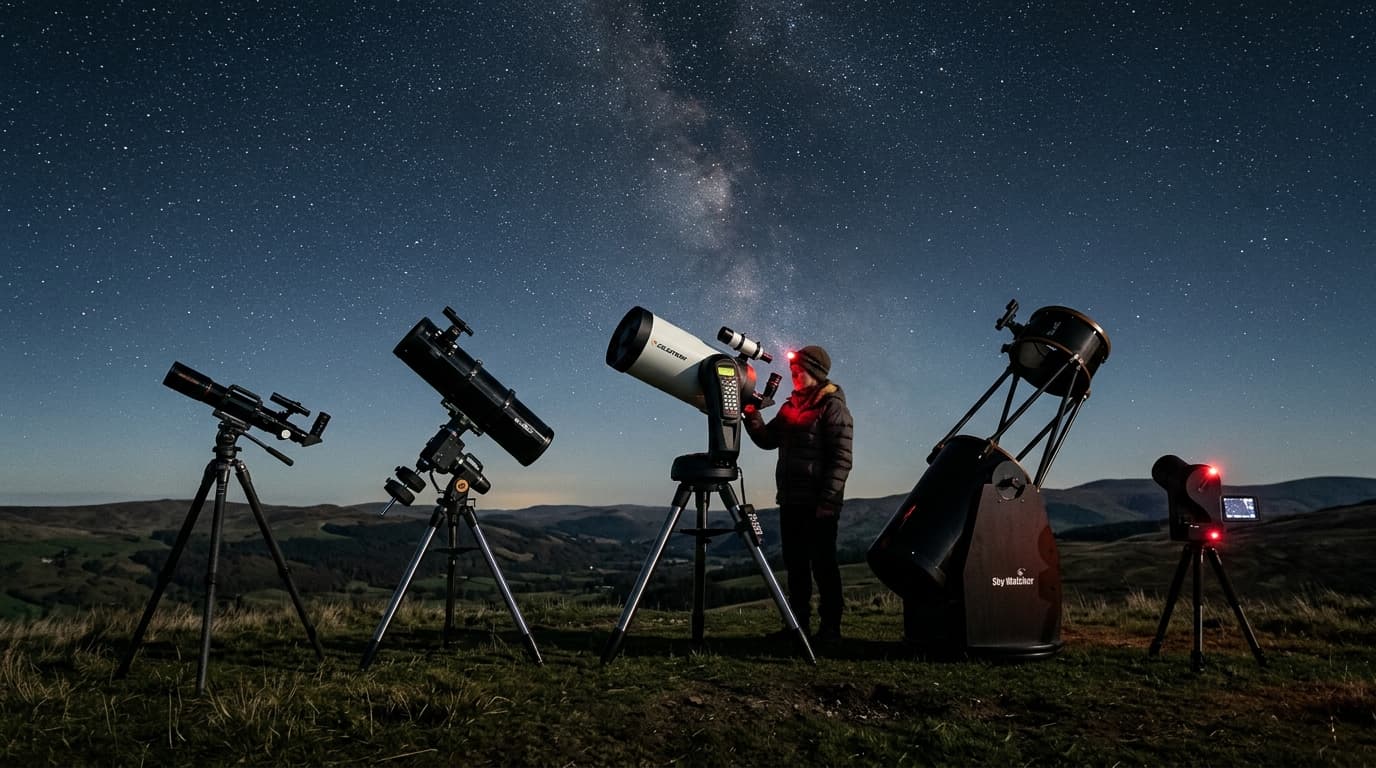

Every telescope falls into one of three optical families: refractors use lenses, reflectors use mirrors, and compound (catadioptric) telescopes use both. From those three designs, two important variants have earned their own categories: Dobsonians (reflectors on a specific type of mount) and smart telescopes (integrated camera systems with automated processing). This guide covers all five types using real data from the 152 telescopes in our database, so you can figure out which design fits your goals, budget, and experience level.
The Five Types at a Glance
| Type | How It Works | Count in DB | Avg Price | Avg Aperture | Avg Score | Best For |
|---|---|---|---|---|---|---|
| Refractor | Lens bends light | 57 | $405 | 80mm | 61 | Portability, lunar/planetary, low maintenance |
| Reflector | Mirror reflects light | 21 | $580 | 149mm | 68 | Aperture per dollar, deep sky, beginners |
| Compound | Lens + mirror | 42 | $2,328 | 187mm | 63 | Astrophotography, compact large-aperture |
| Dobsonian | Mirror + rocker mount | 17 | $1,420 | 213mm | 67 | Visual deep sky, max aperture per dollar |
| Smart | Sensor + software | 15 | $2,288 | 92mm | 78 | Beginners, astrophotography, light-polluted skies |
All scores are from WhichScope's scoring methodology, rated 0 to 100 across seven dimensions.
Refractor Telescopes
Refractors are the classic telescope design. Light enters through an objective lens at the front of the tube, bends (refracts) as it passes through the glass, and converges at a focal point where the eyepiece magnifies the image. No mirrors, no alignment needed, no open tube collecting dust.
How refractors work
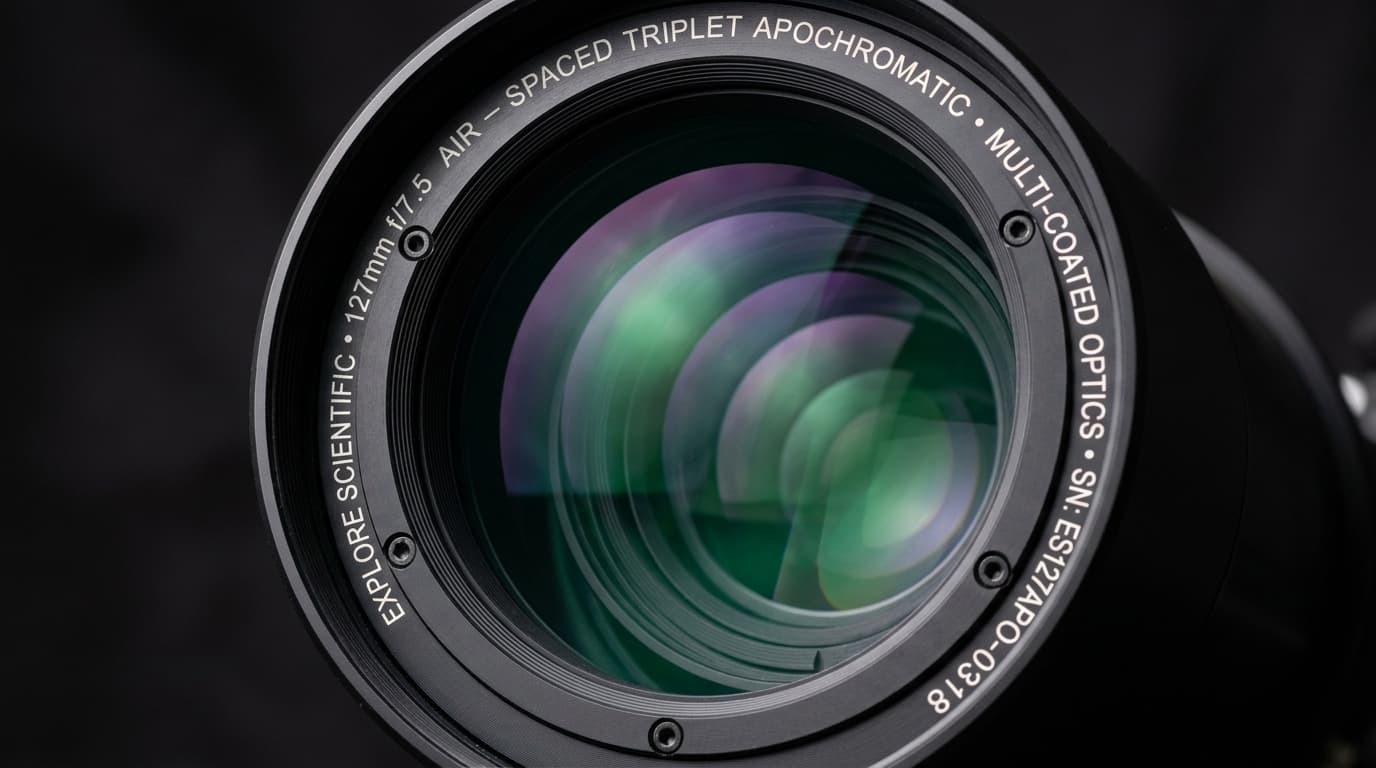
A refractor's objective lens does all the heavy lifting. Light passes through two or more glass elements that bend it to a focus. In an achromatic (achromat) refractor, two glass elements correct most color fringing. In an apochromatic (APO) refractor, three or more elements nearly eliminate it, but at a significant price premium.
The focal length of a refractor is roughly equal to its tube length, which means long focal lengths mean long tubes. A 102mm f/6.5 refractor like the Celestron AstroMaster 102AZ has a tube around 660mm long, which is still manageable. But larger apertures with long focal ratios get unwieldy fast.
Pros and cons
Strengths:
- Zero maintenance. No mirrors to align (collimate), no coatings to degrade from exposure.
- Sharp, high-contrast images, especially on the Moon and planets.
- Sealed tube keeps dust and moisture out.
- Compact at smaller apertures. A 70mm refractor like the Gskyer 70AZ weighs just 2.6kg (5.7 lbs) and costs under $100.
Weaknesses:
- Aperture gets expensive. A quality 150mm APO refractor costs several thousand dollars; a 150mm reflector costs a few hundred.
- Achromat refractors show color fringing (chromatic aberration) around bright objects, especially at fast focal ratios.
- Long tubes at longer focal lengths reduce portability.
Who refractors are for
Refractors are ideal if you want a grab-and-go telescope that's ready in minutes with no fussing. They're the top choice for lunar and planetary observing on a budget, and smaller models make solid travel scopes or first telescopes for kids. If you're primarily interested in deep-sky objects and need large aperture, a reflector or Dobsonian will give you more for your money.
Top refractors in our database
| Telescope | Aperture | Price | Overall Score | Best Dimension |
|---|---|---|---|---|
| Gskyer 70AZ | 70mm | $97 | 81 | Value: 95 |
| Celestron AstroMaster 102AZ | 102mm | $273 | 74 | Value: 78 |
The Gskyer 70AZ scores 95 for value, the highest in the refractor category. It's not going to resolve faint galaxies, but for the Moon, Jupiter's bands, and Saturn's rings from a suburban backyard, it punches well above its $97 price point. The AstroMaster 102AZ steps up to 102mm of aperture with a sturdy alt-az mount, scoring 74 overall with over 4,400 Amazon reviews.
Browse all 57 refractors in our database on the refractor telescopes page.
Reflector Telescopes
Reflectors use a curved primary mirror at the bottom of an open tube to gather and focus light. A small secondary mirror near the top of the tube redirects the focused light to an eyepiece mounted on the side. This design, invented by Isaac Newton in 1668, remains the most cost-effective way to get large aperture.
How reflectors work
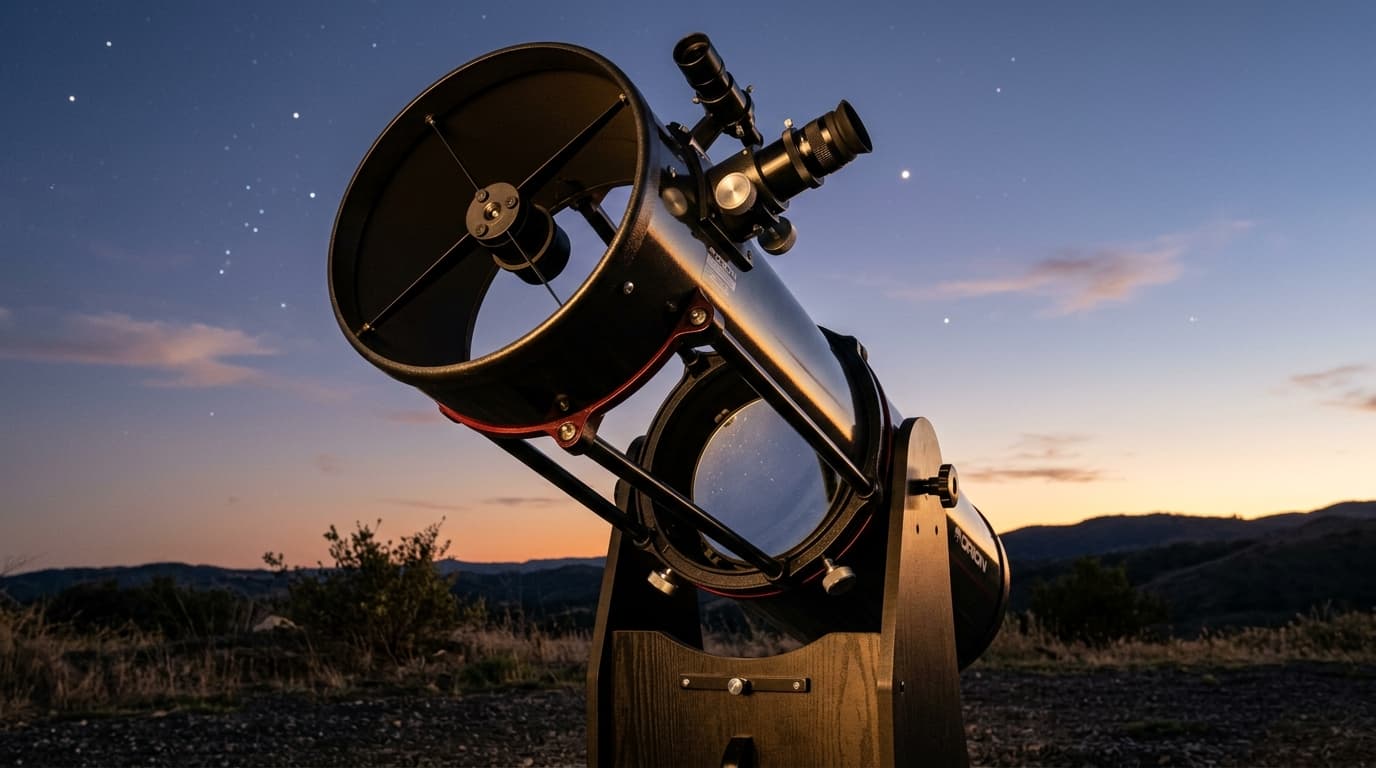
In a Newtonian reflector (the most common type), light travels down the open tube, hits a parabolic primary mirror, and bounces back up to a flat secondary mirror angled at 45 degrees. The secondary directs the light out the side of the tube to the focuser and eyepiece.
Because mirrors don't split light into colors the way lenses do, reflectors are free from chromatic aberration entirely. The tradeoff is that the mirrors need to be precisely aligned, a process called collimation. It sounds intimidating, but with a collimation cap or laser collimator, it takes about five minutes once you've done it a few times.
Pros and cons
Strengths:
- Most aperture per dollar of any telescope type. A 150mm reflector like the Sky-Watcher Heritage 150P costs $309; in our database, no refractor under $500 exceeds 102mm.
- No chromatic aberration.
- Excellent for both deep-sky and planetary observing at moderate apertures.
- The 26 reflectors in our database average 179mm of aperture; the 16 refractors average 70mm.
Weaknesses:
- Open tube design collects dust on the mirrors over time.
- Requires periodic collimation (mirror alignment).
- The secondary mirror and its support (spider vanes) cause diffraction spikes on bright stars, and slightly reduce contrast compared to an unobstructed refractor.
- Coma (a type of optical distortion) at the edges of the field in fast focal ratios.
- Budget reflectors are not all made properly. Several best-selling 114-127mm models are Bird-Jones designs, a spherical mirror with a Barlow lens hidden in the focuser to fake a 1000mm focal length in a short tube, and others use a spherical mirror at f/5 where only a parabola works. Check the manufacturer's spec sheet for "parabolic" before buying; our reflector vs refractor guide explains the trap.
Who reflectors are for
If you want the most capability for your budget, reflectors are hard to beat. They're the go-to recommendation for beginners who want to see more than just the Moon and planets, with one condition: buy one with a parabolic mirror. The Sky-Watcher Virtuoso GTi 150P scores 76 overall and 62 for beginners, with app-controlled GoTo finding more than 10,000 objects on a 150mm parabolic mirror. If you want a finding aid without motors, the Celestron StarSense Explorer DX 130AZ pairs a parabolic 130mm with phone-guided pointing for under $450, and the manual Sky-Watcher Heritage 150P is the same 150mm optics as the GTi without the motors. For a deeper comparison of these designs, see our reflector vs refractor guide.
Top reflectors in our database
| Telescope | Aperture | Price | Overall Score | Best Dimension |
|---|---|---|---|---|
| Sky-Watcher Virtuoso GTi 150P | 150mm | $402.31 | 76 | Beginner: 62 |
| Celestron StarSense Explorer DX 130AZ | 130mm | $499.95 | 74 | Portability: 64 |
| Sky-Watcher Heritage 150P | 150mm | $309 | 68 | Value: 64 |
Browse all reflectors on the reflector telescopes page.
Compound (Catadioptric) Telescopes
Compound telescopes, also called catadioptric telescopes, use both lenses and mirrors. A corrector plate (lens) at the front of the tube fixes optical aberrations, while a primary mirror at the back and a secondary mirror bounce the light path back and forth inside the tube. This folded optical path produces a long focal length in a very short, compact tube.
The two main compound designs
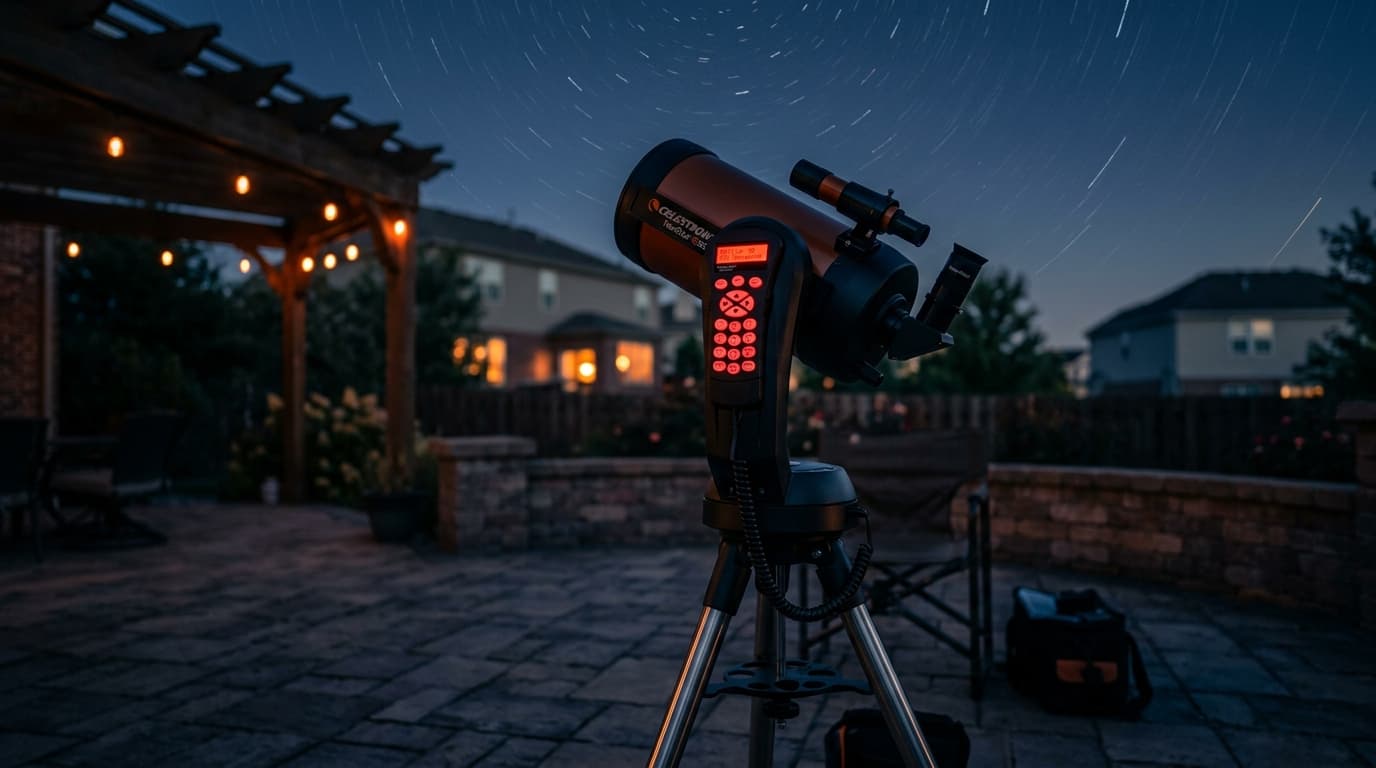
Schmidt-Cassegrain (SCT): Uses a thin corrector plate with a spherical primary mirror. The most popular compound design. The Celestron NexStar 8SE, a classic SCT, packs 203mm of aperture and a 2,032mm focal length into a tube barely 430mm long; our full 8SE review covers what that design delivers in practice. SCTs are versatile, handling planets, deep sky, and astrophotography reasonably well.
Maksutov-Cassegrain (Mak-Cas): Uses a thick, curved corrector lens (meniscus) instead of a flat plate. Mak-Cas telescopes like the Celestron NexStar 127SLT tend to have longer focal ratios (f/12 to f/15), making them especially sharp on planets and the Moon. They're typically heavier per inch of aperture than SCTs and slower for astrophotography.
Pros and cons
Strengths:
- Extremely compact for their aperture. An 8-inch SCT is about the size of a large thermos.
- Sealed tube (like refractors) keeps optics clean.
- Long focal lengths deliver high magnification for planetary detail.
- The 42 compound telescopes in our database average 187mm of aperture, the second-highest after Dobsonians.
Weaknesses:
- Expensive. The average compound in our database costs $2,328, the most of any category except smart telescopes.
- Slower focal ratios (f/10 to f/15) mean longer exposure times for astrophotography without a focal reducer.
- Longer cool-down time. The sealed tube traps warm air that needs to reach ambient temperature for sharp views.
- Heavier than reflectors of the same aperture due to the corrector plate and dense optical assembly.
Who compound telescopes are for
Compound telescopes are for observers who want large aperture in a portable package, and who are willing to pay for that convenience. They're the most popular choice for serious astrophotography because they pair well with equatorial mounts and cameras. If you're a visual observer on a budget, a reflector or Dobsonian gives you more aperture for less money. But if storage space or portability is a constraint and you want 8+ inches of aperture, a compound is the way to go.
Top compound telescopes in our database
| Telescope | Aperture | Price | Overall Score | Best Dimension |
|---|---|---|---|---|
| Celestron EdgeHD 800 OTA | 203mm | $1,699 | 81 | Planetary: 69 |
| Celestron NexStar 127SLT | 127mm | $552 | 80 | Value: 67 |
| Celestron NexStar 8SE | 203mm | $1,699 | 80 | Planetary: 71 |
The NexStar 127SLT stands out as the value entry point into compound telescopes at $552, with a Mak-Cas design that scores 66 for planetary observing. For serious work, the EdgeHD 800 and NexStar 8SE both deliver 203mm of aperture with different strengths: the EdgeHD has a flat-field corrected design optimized for imaging, while the 8SE's iconic single-fork mount is more beginner-friendly.
Browse all 42 compound telescopes on the compound telescopes page.
Dobsonian Telescopes
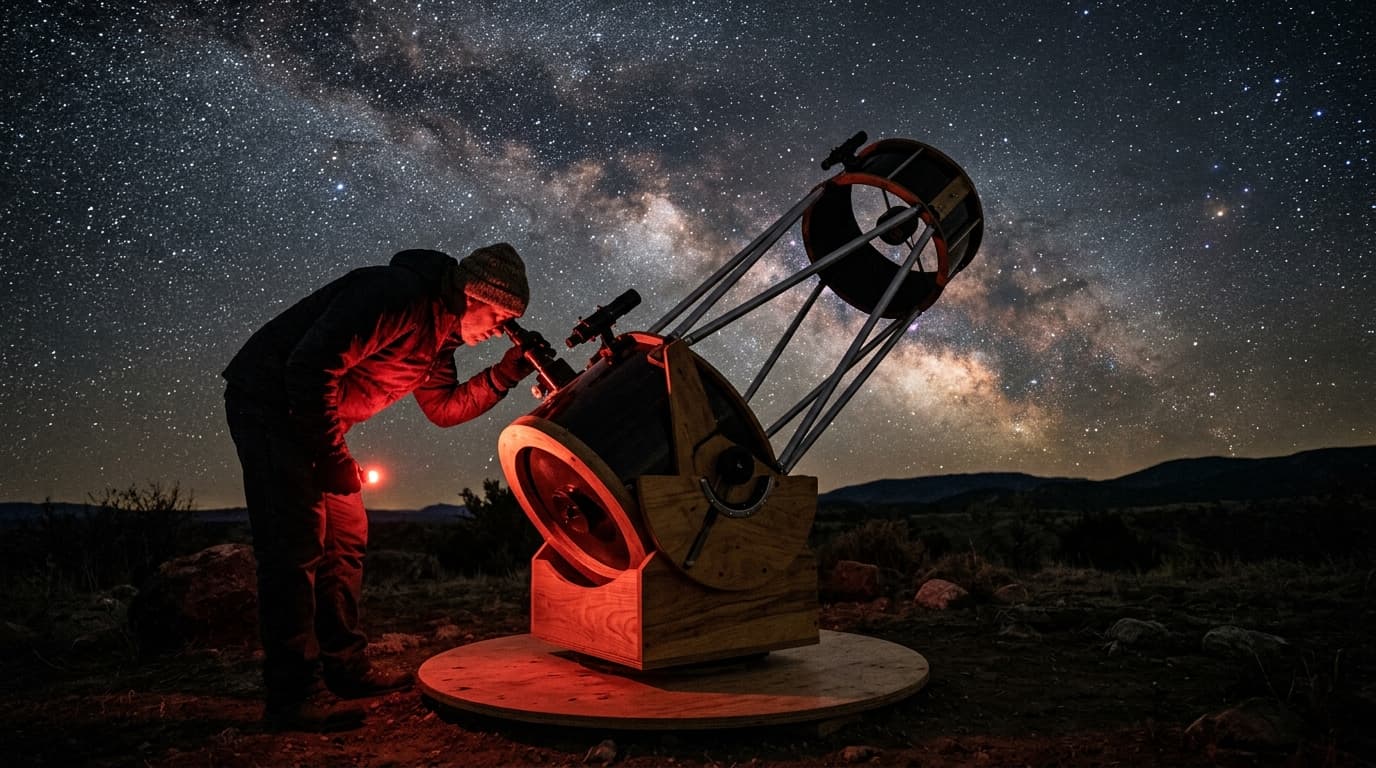
A Dobsonian is not a different optical design. It's a Newtonian reflector mounted on a simple, low-to-the-ground alt-azimuth platform called a rocker box. The design, popularized by amateur astronomer John Dobson in the 1960s, eliminates the expensive equatorial mount and tripod, directing all your budget toward the optics. The result: more aperture per dollar than any other telescope type.
Why Dobsonians are their own category
While optically identical to Newtonian reflectors, Dobsonians differ enough in use, setup, and target audience to warrant a separate category. The rocker-box mount is intuitive (push the tube to point it) and incredibly stable for visual observing. You don't need to learn equatorial alignment or balance a counterweight system. Set it on the ground, look up, and start observing.
The 17 Dobsonians in our database average 213mm of aperture, the largest of any category, and 55 for planetary observing, also the highest among non-smart categories. That aperture advantage matters: a 12-inch (305mm) Dobsonian like the Sky-Watcher FlexTube 300 SynScan gathers over 5 times more light than a 130mm reflector.
Collapsible (FlexTube) Dobsonians
One of the biggest innovations in modern Dobsonians is the collapsible truss-tube design. The Sky-Watcher FlexTube 300P packs 305mm of aperture into a tube that collapses to roughly half its observing length, making it possible to fit a 12-inch telescope in the back seat of a car. Some models, like the FlexTube SynScan series, add GoTo and tracking to the Dobsonian platform, combining the aperture advantage with modern convenience.
Pros and cons
Strengths:
- The most aperture per dollar, period. A 200mm Dobsonian costs roughly the same as a 130mm reflector on an equatorial mount.
- Intuitive push-to operation. Point the tube, observe.
- Extremely stable. The low center of gravity and ground-level base eliminate vibration.
- Large apertures (200mm to 400mm+) reveal faint galaxies, nebulae, and star clusters that smaller telescopes simply cannot show.
Weaknesses:
- Not designed for astrophotography. The alt-az rocker mount doesn't track the sky (unless you buy a GoTo model), and even then, field rotation limits long exposures.
- Big Dobsonians are heavy. The FlexTube 300P weighs 15.9kg (35 lbs) for the tube alone.
- Requires collimation, just like any Newtonian reflector.
- Tall eyepiece position at high magnification can require a step stool for larger models.
Who Dobsonians are for
If visual deep-sky observing is your primary goal, a Dobsonian is almost certainly the right choice. They're also a strong beginner recommendation, scoring 43 average for beginners in our database, comparable to reflectors and refractors. The intuitive mount eliminates the learning curve of equatorial setups. For observers in dark-sky areas who want to hunt galaxies, resolve globular clusters, and see planetary nebulae with their own eyes, nothing else comes close for the money.
Top Dobsonians in our database
| Telescope | Aperture | Price | Overall Score | Best Dimension |
|---|---|---|---|---|
| Sky-Watcher FlexTube 300 SynScan | 305mm | $2,299 | 86 | Planetary: 77 |
| Sky-Watcher FlexTube 300P | 305mm | $1,895 | 85 | Planetary: 77 |
The FlexTube 300 SynScan leads the category at 86 overall, with GoTo tracking and a collapsible design. If you don't need GoTo, the FlexTube 300P saves $400 for the same optics.
Browse all 17 Dobsonians on the Dobsonian telescopes page.
Smart Telescopes
Smart telescopes are the newest category and the fastest-growing segment of the market. Unlike traditional telescopes where you look through an eyepiece, smart telescopes use a built-in camera sensor to capture light, then stack and process multiple exposures in real time. The result is a live image on your phone or tablet that reveals nebulae, galaxies, and star clusters that would be invisible through a traditional eyepiece, especially from light-polluted locations.
How smart telescopes work
A smart telescope combines a small optical tube (typically 50mm to 114mm aperture) with an integrated camera sensor, a motorized GoTo mount, plate-solving software (which identifies stars in the image to determine where the telescope is pointing), and live stacking (which combines dozens or hundreds of short exposures to build up a detailed image). All of this is controlled through a smartphone app.
The result is a fundamentally different observing experience. You don't align a finderscope or learn star-hopping. You tap a target in an app, the telescope slews to it, and within seconds to minutes, a color image of that object appears on your screen. For deep-sky objects like the Orion Nebula or Andromeda Galaxy, the view on a smart telescope's screen often surpasses what you'd see through the eyepiece of a much larger traditional telescope.
Pros and cons
Strengths:
- The highest average overall score of any category (78), and the highest average beginner score (58). They genuinely make astronomy accessible.
- Effective from light-polluted suburban and urban locations where traditional telescopes struggle with deep-sky objects.
- No learning curve for finding objects. Plate-solving and GoTo handle everything.
- Built-in astrophotography. Every observation produces a shareable image.
- Average deep-sky score of 59 despite an average aperture of just 92mm, demonstrating how software processing compensates for smaller optics.
Weaknesses:
- You're looking at a screen, not through an eyepiece. For many astronomers, that direct-light experience is the whole point.
- Expensive for the aperture. The average smart telescope costs $2,288 for 92mm, while a $580 reflector averages 149mm.
- Dependent on batteries, WiFi, and app software. Firmware updates, app bugs, and battery life are real concerns.
- Limited or no planetary viewing. Most smart telescopes lack an eyepiece and their sensors aren't optimized for bright, high-contrast objects like Jupiter or Saturn.
- Processing artifacts. The stacked images are computationally enhanced, not raw optical views.
Who smart telescopes are for
Smart telescopes are ideal for beginners who want immediate results without a steep learning curve, astrophotography enthusiasts who want a dedicated imaging setup, and observers in light-polluted areas who can't easily travel to dark skies. They're not for purists who value the direct eyepiece experience, or for planetary observers who need high-magnification real-time views.
Top smart telescopes in our database
| Telescope | Aperture | Price | Overall Score | Best Dimension |
|---|---|---|---|---|
| ZWO Seestar S50 | 50mm | $499 | 93 | Portability: 86 |
| ZWO Seestar S30 | 30mm | $299.95 | 91 | Value: 84 |
| Unistellar Odyssey | 114mm | $2,599 | 85 | Astrophoto: 76 |
| Unistellar eVscope Equinox | 114mm | $925.95 | 85 | Astrophoto: 74 |
| DWARFLAB DWARF II | 24mm | $339 | 86 | Value: 80 |
The ZWO Seestar S50 is the standout performer, scoring 93 overall, the highest of any telescope in our database, with a 50mm apochromat lens, live stacking and GoTo in a 2.5kg package. The catch as of this update: the S50, the Seestar S30 and the DWARFLAB DWARF II have all been out of stock on Amazon for months. The smart telescope you can buy today is the newer DWARFLAB DWARF 3 at $549, which scores 83 overall and weighs 1.3kg with a dual-lens system; read our DWARF 3 review for the full assessment, and our best smart telescopes guide for the category.
Browse all smart telescopes on the smart telescopes page.
Which Type Is Right for You?
Use this decision matrix to narrow down your choice based on three factors: what you want to observe, how much you want to spend, and your experience level.
By primary use case
| Use Case | First Choice | Second Choice | Why |
|---|---|---|---|
| Moon and planets | Refractor or Compound | Dobsonian | High contrast and long focal lengths favor lunar/planetary detail |
| Deep-sky visual | Dobsonian | Reflector | Maximum aperture gathers the most light from faint objects |
| Astrophotography | Smart or Compound | Reflector (with EQ mount) | Tracking and sensor integration matter more than aperture alone |
| Casual/portable | Refractor | Smart | Refractors are light and maintenance-free; smart scopes are one-tap |
| Light-polluted skies | Smart | Compound with filters | Live stacking and processing cut through light pollution digitally |
By budget
| Budget | Recommended Type | What You Get |
|---|---|---|
| Under $150 | Refractor | 70mm lens, manual mount, lunar/planetary basics |
| $150 to $400 | Reflector | 114mm to 130mm mirror, GoTo optional, solid all-rounder |
| $400 to $800 | Reflector or Compound | 130mm+ with GoTo, or 127mm Mak-Cas for planetary |
| $800 to $2,000 | Dobsonian or Smart | 200mm+ visual powerhouse, or smart imaging system |
| $2,000+ | Compound or Smart | 200mm+ SCT for imaging, or premium smart telescope |
For budget-specific recommendations, see our guides: Best Telescopes Under $200, Best Telescopes Under $500, and Best Telescopes for Beginners.
By experience level
Complete beginner: Start with a refractor (under $200) or a smart telescope (if budget allows). Both have near-zero setup friction. If you want more aperture and don't mind a short learning curve, a GoTo Dobsonian like the Sky-Watcher Virtuoso GTi 150P is one of the most capable beginner scopes you can buy in our database (76 overall, 62 beginner score).
Intermediate observer: Consider a Dobsonian for visual observing or a compound telescope for astrophotography. You'll appreciate the aperture and optical quality after outgrowing a starter scope.
Advanced/astrophotography: Compound telescopes on equatorial mounts are the standard for long-exposure imaging. Smart telescopes offer a parallel path with less complexity but less control.
After You Pick a Design: Eyepieces
Whichever optical design you choose, the eyepieces bundled in the box are usually the weakest part of the package. Most telescopes ship with one or two basic Plossls, and swapping them is the cheapest meaningful upgrade you can make: a better eyepiece improves every object you point at, and it carries over to your next telescope. Our best telescope eyepieces roundup covers what to buy at each focal length, and the Celestron Luminos line review digs into one popular wide-field family in detail.
