

A Dobsonian IS a Newtonian. The optics are the same: a parabolic primary mirror at the bottom of the tube, a flat secondary mirror near the top, and a focuser on the side near the front. The only real difference is the mount the tube sits on. A "Newtonian telescope" on an equatorial mount and a "Dobsonian telescope" can use the exact same optical tube; what changes is how you point it.
That distinction sounds pedantic, but it determines almost everything about what you can do with the telescope: how easy it is to set up, how much it costs per millimeter of aperture, whether you can use it for astrophotography, and how heavy the whole package is. Here is what actually changes when you swap the mount.
The Short Answer
| Dobsonian | Newtonian on EQ | |
|---|---|---|
| Optical tube | Newtonian reflector | Newtonian reflector |
| Mount type | Simple alt-azimuth rocker box | German equatorial |
| Setup time | 1-2 minutes | 10-15 minutes (polar alignment) |
| Tracking | Manual push (or motorized in GoTo Dobs) | Motorized, follows celestial coordinates |
| Astrophotography | Poor (field rotation, no precise tracking) | Good (with practice) |
| Aperture per dollar | Excellent | 3 to 4x more expensive per mm |
| Weight (typical) | Lower (less mount overhead) | Significantly higher (counterweights, tripod) |
If you mostly want to look at things, get a Dobsonian. If you want to photograph deep-sky objects, get a Newtonian on an equatorial mount, or skip Newtonians entirely and consider a smart telescope or dedicated astrograph.
Newtonian Optics Explained
Sir Isaac Newton designed this telescope in 1668. The optical recipe is simple and has barely changed in 350 years:
-
A parabolic primary mirror sits at the bottom of an open tube. It is concave, with a precise parabolic shape that brings parallel light rays (from distant objects) to a single focus point.
-
A flat secondary mirror mounted on thin support arms (the "spider vane") near the top of the tube intercepts the converging beam and redirects it sideways, out of the tube.
-
A focuser on the side of the tube near the top end lets you mount an eyepiece (or a camera) at the secondary's redirected focal point.
That is it. No lenses for the light to pass through (so no chromatic aberration), no complicated correctors, no expensive low-dispersion glass. The mirrors do all the work. Because mirrors are cheaper to make than refractor lenses, Newtonians give you the most aperture per dollar of any telescope design.
The downside is collimation. The primary and secondary mirrors must be precisely aligned for sharp images, and they drift out of alignment with use, transport, and temperature changes. Collimation sounds intimidating but is a 5-minute task once you have done it a few times. Most beginners overestimate how often it needs to be done; for a stationary backyard telescope, once or twice a year is typical.
What Makes a Dobsonian a Dobsonian
The optics are identical to any Newtonian. What changed is the mount.
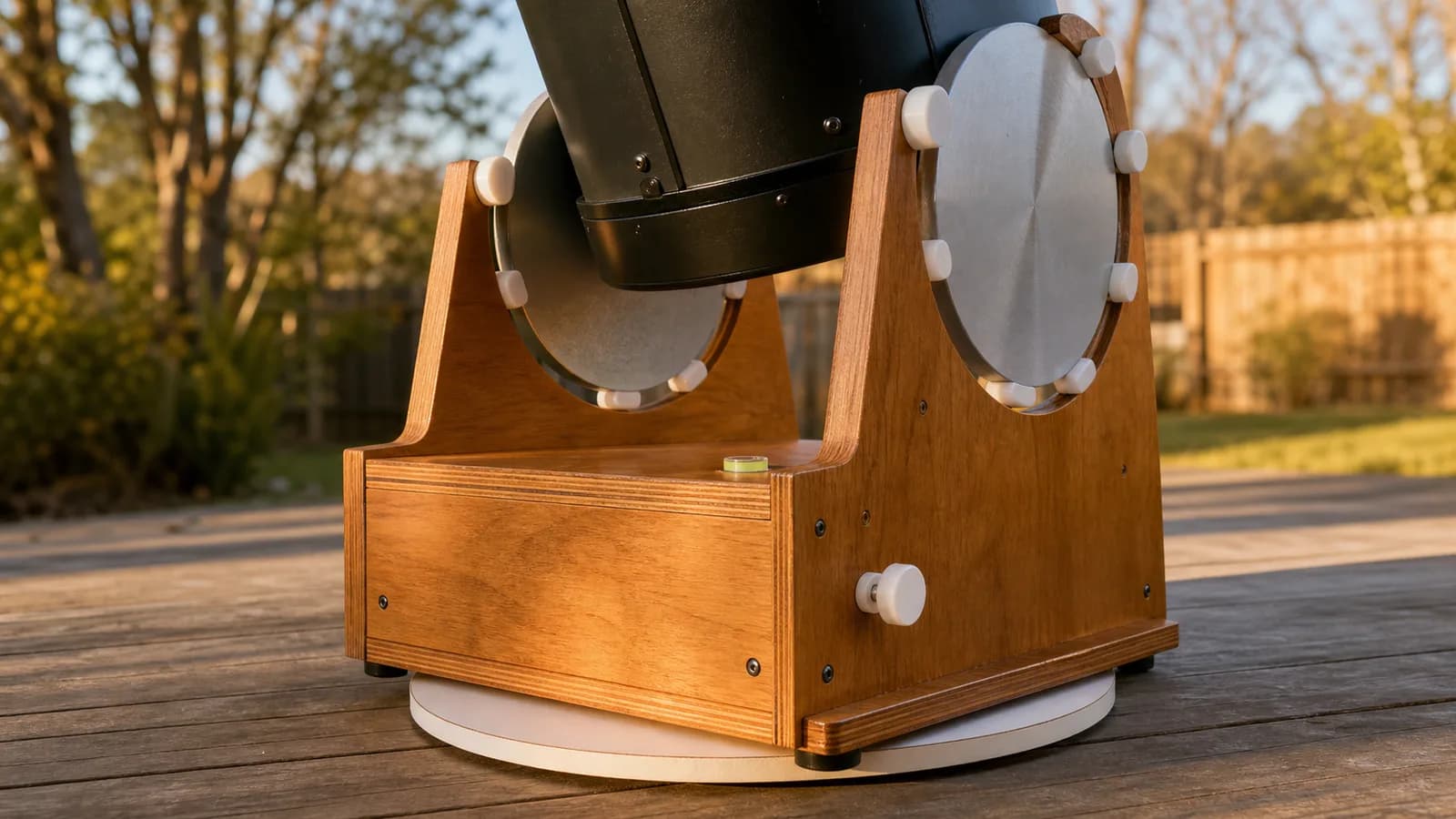
John Dobson, an amateur astronomer and former monk, popularized this design in the 1960s and 1970s. His insight: the standard equatorial mount most amateurs used was the most expensive, fragile, and complicated part of the telescope, and you did not need it for visual observing. So he replaced it with the simplest possible structure: a rocker box made of plywood, with two altitude bearings (the tube pivots up and down on these) and a single azimuth bearing (the whole rocker box rotates left and right on this).
That is a Dobsonian. The mount is called "alt-azimuth" because the two axes are altitude (up and down) and azimuth (left and right). To point at something, you push the telescope. To track an object as the Earth rotates, you push it again, a tiny bit, every minute or so.
This sounds primitive. It is. That is the genius of the design:
- Setup is one minute. Open the rocker box, drop the tube in, you are observing.
- The mount cost is near zero. A Dobsonian rocker box is plywood and Teflon pads.
- Aperture-per-dollar dominates. Because the mount is so cheap, you can spend almost all of your budget on the optical tube. A 12-inch Dobsonian costs about the same as a 5-inch Newtonian on a serious equatorial mount.
- It is stable. The rocker box sits flat on the ground. There is no tripod to vibrate, no counterweights to balance, no head to slip.
The price you pay: no precision tracking, no easy astrophotography, and a slightly less intuitive coordinate system if you are coming from equatorial-mount astronomy.
Newtonian on an Equatorial Mount
The other option for a Newtonian optical tube is a German equatorial mount. This mount is aligned with the Earth's rotation axis, so a single motor on one axis (right ascension) is enough to keep an object centered indefinitely. The other axis (declination) only moves when you change targets.
The benefits:
- Motorized tracking. Set it and forget it. Critical for astrophotography and useful for visual high-magnification planetary work where the target drifts out of view in seconds at 200x.
- Coordinate familiarity. Stars catalogs are listed in equatorial coordinates (RA and dec). An equatorial mount maps directly onto these.
- GoTo accuracy. Computerized equatorial mounts can locate thousands of objects with practiced alignment.
The costs:
- Setup time. Polar alignment takes 10 to 15 minutes even for an experienced user. Polar alignment is required every time you set up unless the mount is permanently installed.
- Weight. The mount needs counterweights to balance the optical tube, a substantial tripod to carry the load, and a head heavy enough to be stable at long focal lengths. A 6-inch Newtonian on an EQ mount weighs 35kg or more assembled.
- Cost. The same optical tube that costs $400 in a Dobsonian configuration costs $1,200 to $2,000 in a serious EQ-mounted package. The mount itself is the difference.
- Learning curve. Equatorial mounts confuse beginners because the axes do not map intuitively to "up" and "left/right."
For deep-sky imaging, that learning curve and weight are justified. For visual observing, they almost never are.
When to Choose Which
Choose a Dobsonian if:
- You want to look at things, not photograph them.
- Aperture matters most. You want a 10-inch or 12-inch telescope, not a 5-inch.
- You have storage space for a large optical tube (an 8-inch Dob is the size of a kitchen trash can).
- You value setup speed over tracking precision.
- You are budget-constrained and want the most telescope for your money.
Choose a Newtonian on an EQ mount if:
- You want to do astrophotography, even at the beginner level.
- You are okay with a 5-inch or 6-inch telescope rather than a 10-inch.
- You can dedicate 15 minutes per session to polar alignment and have the strength to assemble a 25-35kg system.
- You specifically want motorized tracking for high-magnification planetary observing.
For most first-time buyers, the right answer is a Dobsonian. The aperture-per-dollar advantage compounds: a $400 Dobsonian will show you more, more easily, than a $400 Newtonian on a wobbly EQ mount. If astrophotography becomes your main interest later, you will be buying a different telescope anyway (smart telescope or a small refractor on a proper imaging mount), so the EQ-mounted beginner Newtonian sits in an awkward middle ground.
Best Dobsonians in Our Catalog
For your shortlist, we picked three Dobsonians spanning entry, mid-range, and serious-observer tiers. All three use the same fundamental design; what scales is aperture, transport, and whether the mount adds GoTo automation.
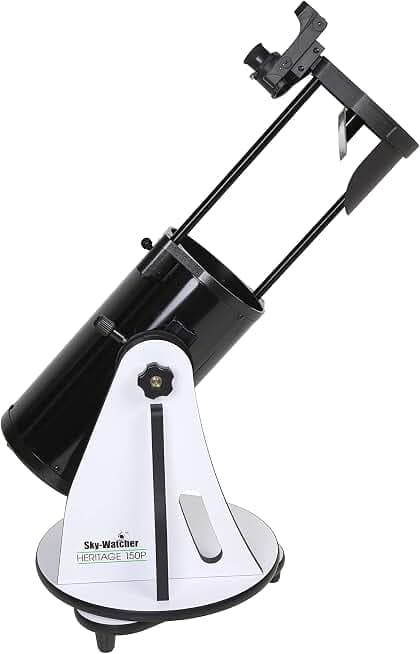
1. Sky-Watcher Heritage 150P: Best Entry-Level Dobsonian
Sky-Watcher
Sky-Watcher Heritage 150PBig views, compact package: the Heritage 150P brings serious aperture to a tabletop Dobsonian under $400.
The Heritage 150P is the best $309 in beginner astronomy. A 150mm (6-inch) parabolic primary on a collapsible-truss optical tube, mounted on a small tabletop Dobsonian rocker box. The collapsible truss means the tube shrinks for storage and extends to full operating length when you set up. The whole telescope weighs 9.3kg and fits on a sturdy patio table.
For visual observing of the Moon, planets, brighter nebulae, and most Messier objects, the 150mm aperture is the practical floor where the views get genuinely impressive. Below this aperture, deep-sky targets are dim; above it, you start needing a real Dobsonian floor base rather than a tabletop.
The tradeoff: No tracking, no GoTo, no electronics. You need a phone app like Stellarium or a printed sky atlas to find things, and you nudge the telescope to keep targets in the eyepiece. Requires a sturdy table.
The best $309 in beginner astronomy.
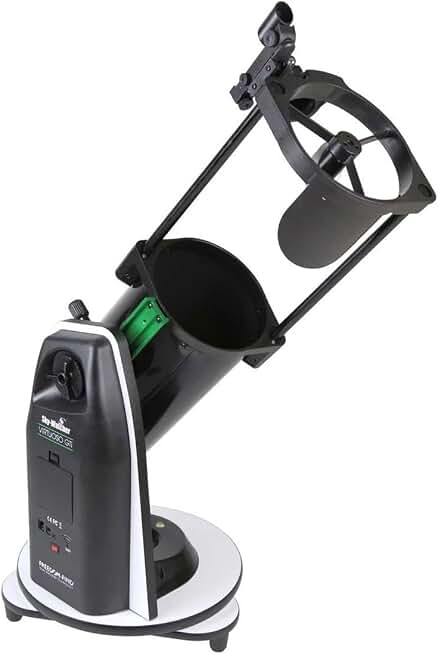
2. Sky-Watcher Virtuoso GTi 150P: Best Mid-Range Dobsonian
Sky-Watcher
Sky-Watcher Virtuoso GTi 150PGoTo Dobsonian power in a tabletop package, with Wi-Fi control and the freedom to push around manually.
The Virtuoso GTi 150P keeps the 150mm aperture but adds Wi-Fi GoTo motorization to the rocker base. You can push it manually like any Dobsonian, or hand off to the SynScan app and have it find and track objects automatically. At $469 it is roughly $150 more than the Heritage 150P, and the convenience is real: alignment takes a couple of minutes, and the telescope tracks targets indefinitely once locked.
The tradeoff: The motorized base adds weight (11.7kg total) and battery dependency. Still a tabletop design, so you need a stable elevated surface.
GoTo Dobsonian convenience at half the cost of full-size GoTo systems.
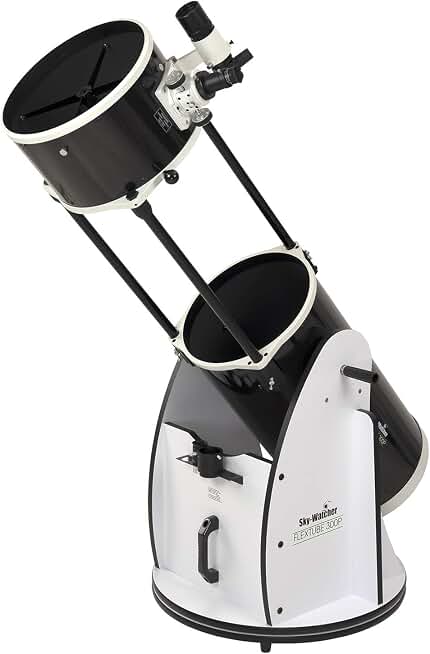
3. Sky-Watcher FlexTube 300P: Best Premium Dobsonian
Sky-Watcher
Sky-Watcher FlexTube 300P305mm of light-gathering power in a collapsible GoTo Dobsonian you can actually transport.
305mm (12-inch) of aperture in a collapsible-truss optical tube on a full-size rocker base, with GoTo motorization. This is what serious amateur astronomers buy when they want to see the kind of structure in nebulae and galaxies that smaller telescopes only hint at. The Cat's Eye Nebula shows obvious central detail. The Veil Nebula shows wisp structure. The Andromeda Galaxy's dust lanes are visible from a dark site.
At 15.9kg the optical tube alone is a serious carry. The full assembled system breaks down into manageable parts for transport. Aperture this big is genuinely night-changing if you have a dark observing site to use it from.
The tradeoff: $1,649. The bulk and weight make this a permanent or semi-permanent installation for most owners. Requires meaningful storage space.
12 inches of aperture in a transportable GoTo package.
A Note on EQ-Mounted Beginner Newtonians
For the sake of completeness: the Celestron PowerSeeker 127EQ at $199.99 and the Celestron AstroMaster 130EQ-MD at $389.95 are the most popular EQ-mounted "Newtonians" for beginners, and neither has the optics described at the top of this guide. Celestron's spec sheets list a spherical primary mirror for both. The 130EQ-MD is a true Newtonian with a spherical mirror at f/5, which is too fast for a sphere to focus sharply. The 127EQ is a Bird-Jones: a short spherical mirror with a Barlow lens built into the focuser to fake a 1000mm focal length, a design with its own dedicated warning subreddit, r/dontbuyapowerseeker. Our scoring engine now penalizes both (60 and 74 overall). On top of the optics, the cheap EQ mount becomes a frustration, which is why communities like Cloudy Nights recommend a parabolic Dobsonian at the same price instead, and why we do too. If you specifically want experience with an equatorial mount or plan to upgrade to astrophotography within a year, see our best telescopes for astrophotography guide for genuinely capable EQ-mounted options like the Celestron Advanced VX 6" Newtonian.
