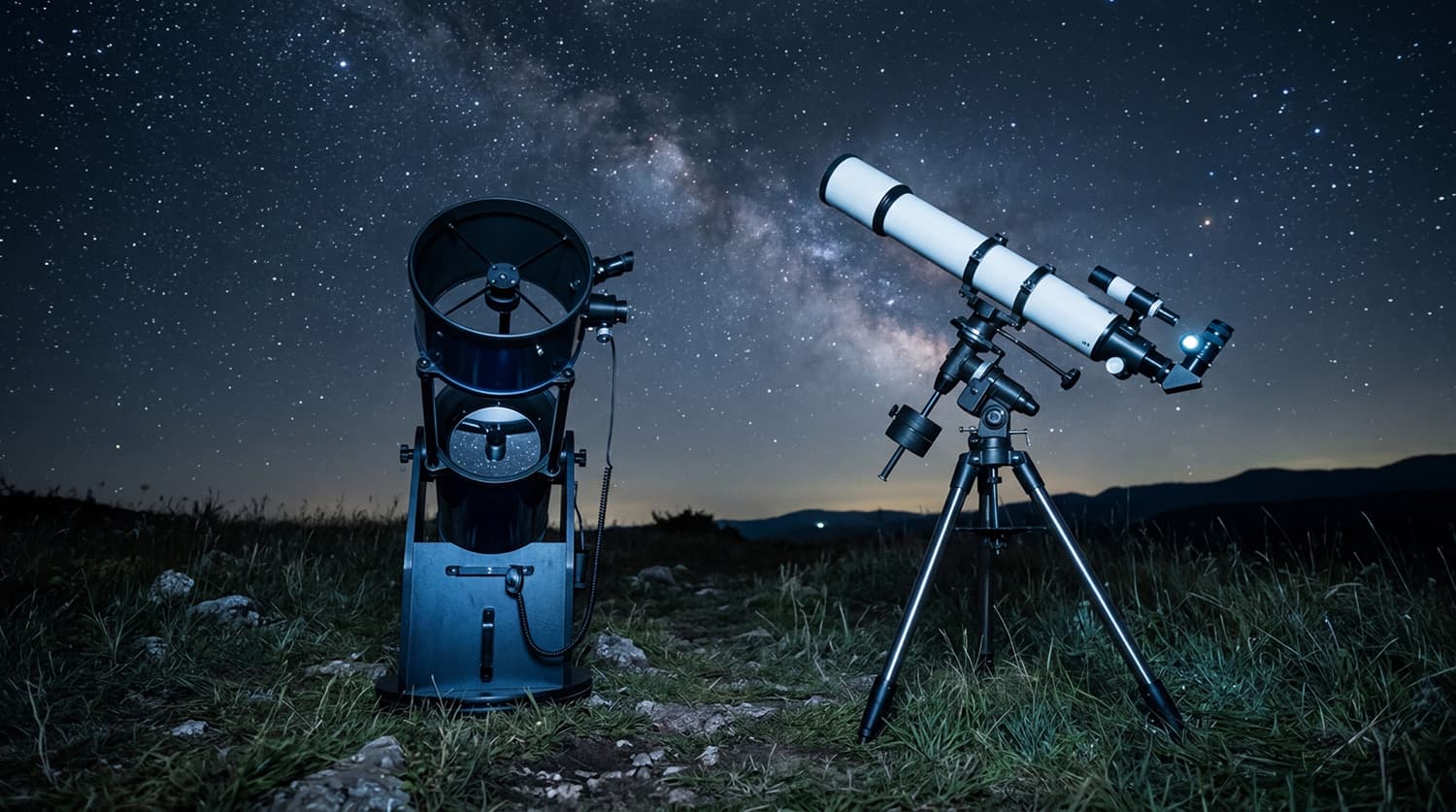

Reflector or refractor? It is the first real decision most telescope buyers face, and the answer depends on what you plan to observe, how much maintenance you tolerate, and your budget. The short version from our database: reflectors give you far more aperture per dollar (the active, Amazon-listed reflectors in our database average 179mm of aperture; the refractors average 70mm), while refractors are lighter, lower maintenance, and more portable (averaging 3.4kg against 14.1kg). There is one catch with reflectors that most comparison guides skip, and it matters more than the design choice itself at beginner prices: not every mirror is made properly. We cover that below.
Quick Answer
Choose a refractor if you want a grab-and-go telescope that requires zero maintenance, delivers sharp contrast on the Moon and planets, and you are comfortable with smaller apertures (typically 60-102mm in beginner price ranges).
Choose a reflector if you want the most light-gathering power for your money, plan to observe deep sky objects like galaxies and nebulae, do not mind occasional mirror alignment (collimation), and are willing to check that the mirror is parabolic before you buy.
How They Work
These two designs collect light in fundamentally different ways.
Refractors use a glass lens (the objective) at the front of the tube to bend incoming light to a focal point at the back, where you place the eyepiece. The tube is sealed, so dust and moisture stay out. This is the classic "pirate spyglass" design, and it has been around since Galileo's time.
Reflectors use a curved mirror at the bottom of an open tube to bounce light back up to a smaller secondary mirror, which redirects it to an eyepiece on the side of the tube. Isaac Newton invented this design in 1668 to avoid the color fringing that plagued early refractors. The Newtonian reflector remains the most common type for amateur astronomy, and a Dobsonian is a Newtonian on a simple wooden mount.
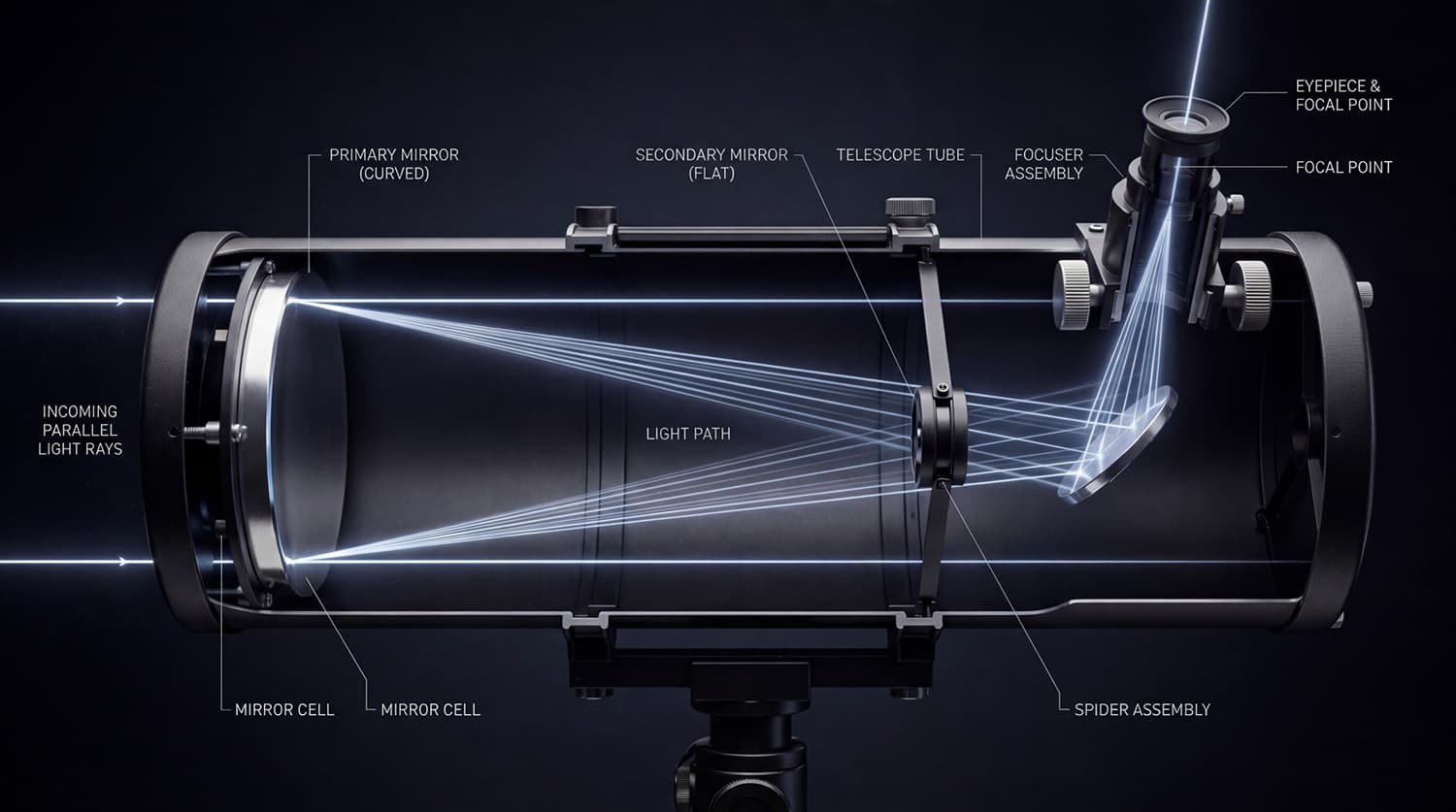
The design difference has practical consequences for everything from image quality to maintenance to price.
Head-to-Head Comparison
| Factor | Refractor | Reflector |
|---|---|---|
| Light collection | Lens (objective) | Mirror (primary) |
| Typical aperture | 60-102mm (beginner) | 114-200mm (beginner) |
| Most aperture under $500 (in stock) | 102mm | 150mm |
| Maintenance | None | Periodic collimation |
| Tube design | Sealed | Open (dust enters) |
| Chromatic aberration | Yes (achromats) | No |
| Central obstruction | No | Yes (secondary mirror) |
| Mirror figure to check | Not applicable | Parabolic good, spherical only at f/8+, Bird-Jones avoid |
| Average weight (our database) | 3.4kg (7.5 lbs) | 14.1kg (31 lbs) |
| Cooldown time | Minimal | Longer (larger mirrors) |
| Avg. deep sky score | 47 | 52 |
| Avg. planetary score | 45 | 49 |
By the Numbers: What Our Database Shows
We scored every telescope in our database across seven performance dimensions. The numbers below cover the active, Amazon-listed reflectors (26 Newtonians and Dobsonians, including the four Bird-Jones designs) and refractors (16, split evenly between achromats and apochromats).
Aperture: The average reflector in our database has 179mm of aperture; the average refractor has 70mm. That is not a subtle difference: it is 6.5 times the light-gathering area. Even restricting to entry-level scopes, the gap holds. Under $500, the largest in-stock refractor is 102mm (the AstroMaster 102AZ and StarSense DX 102AZ); the largest reflector is 150mm (the Heritage 150P and Virtuoso GTi 150P), which gathers 2.2 times as much light.
Performance scores: Reflectors edge refractors on deep sky (52 vs 47) and planetary (49 vs 45) averages, with the apochromat refractors pulling the refractor numbers up: the achromats alone average 41 deep sky and 40 planetary. Astrophotography is roughly a tie at 49 each, because the apochromats are imaging instruments. Beginner scores favor refractors, 50 to 43, reflecting the maintenance and weight tradeoff.
Weight: Refractors average 3.4kg versus 14.1kg for reflectors. If portability matters, this is the single biggest differentiator, though tabletop Dobsonians like the Heritage 130P (8.7kg) narrow it.
The Mirror Trap: Not All Reflectors Are Equal
This is the section most reflector-vs-refractor guides skip, and at beginner prices it matters more than the design choice itself.
A Newtonian's primary mirror should be parabolic. A parabola brings all the light from a distant star to one point; a sphere does not. A spherical mirror is cheaper to make and is acceptable at f/8 or slower, where the difference between a sphere and a parabola is smaller than the wavelength of light, but it gets progressively worse as the mirror gets faster. At f/5 a spherical primary never quite snaps to focus. Celestron's AstroMaster 130EQ is a 130mm f/5 with a spherical primary, per Celestron's own spec sheet, and it shows.
Worse is the Bird-Jones (or "catadioptric Newtonian"). It takes a fast spherical mirror and puts a Barlow lens inside the focuser to stretch a short tube into a nominal 1000mm focal length. Celestron's knowledgebase describes the arrangement for its AstroMaster 114 outright. The tell is a 1000mm focal length in a tube 40-60cm long. The PowerSeeker 127EQ, AstroMaster 114EQ, StarSense Explorer LT 114AZ and 114LCM are all built this way, and they are among the best-selling "reflectors" on Amazon. Hands-on reviewers who have taken them apart report that the corrector moves with the focuser so the correction is never quite right, and that collimating requires removing it first.
Our scoring engine now applies an optical-execution factor: a fast spherical mirror is discounted and a Bird-Jones is penalized outright. The four Bird-Jones scopes above score between 57 and 68. The parabolic Heritage 130P, which costs about the same as two of them, scores 67 and is what the hobby community recommends instead.
How to check: read the manufacturer's specification table, not the Amazon listing. Sky-Watcher and Celestron both state "Parabolic" or "Spherical" for the primary mirror. If the sheet says spherical and the focal ratio is faster than f/8, or the focal length is far longer than the tube, choose something else.
Refractors sidestep all of this. There is no such thing as a Bird-Jones refractor, and while a cheap achromat has color fringing, it is at least the shape it claims to be. That is a real argument for refractors at the very bottom of the market, and why our best telescopes under $200 guide recommends only refractors.
When to Choose a Refractor
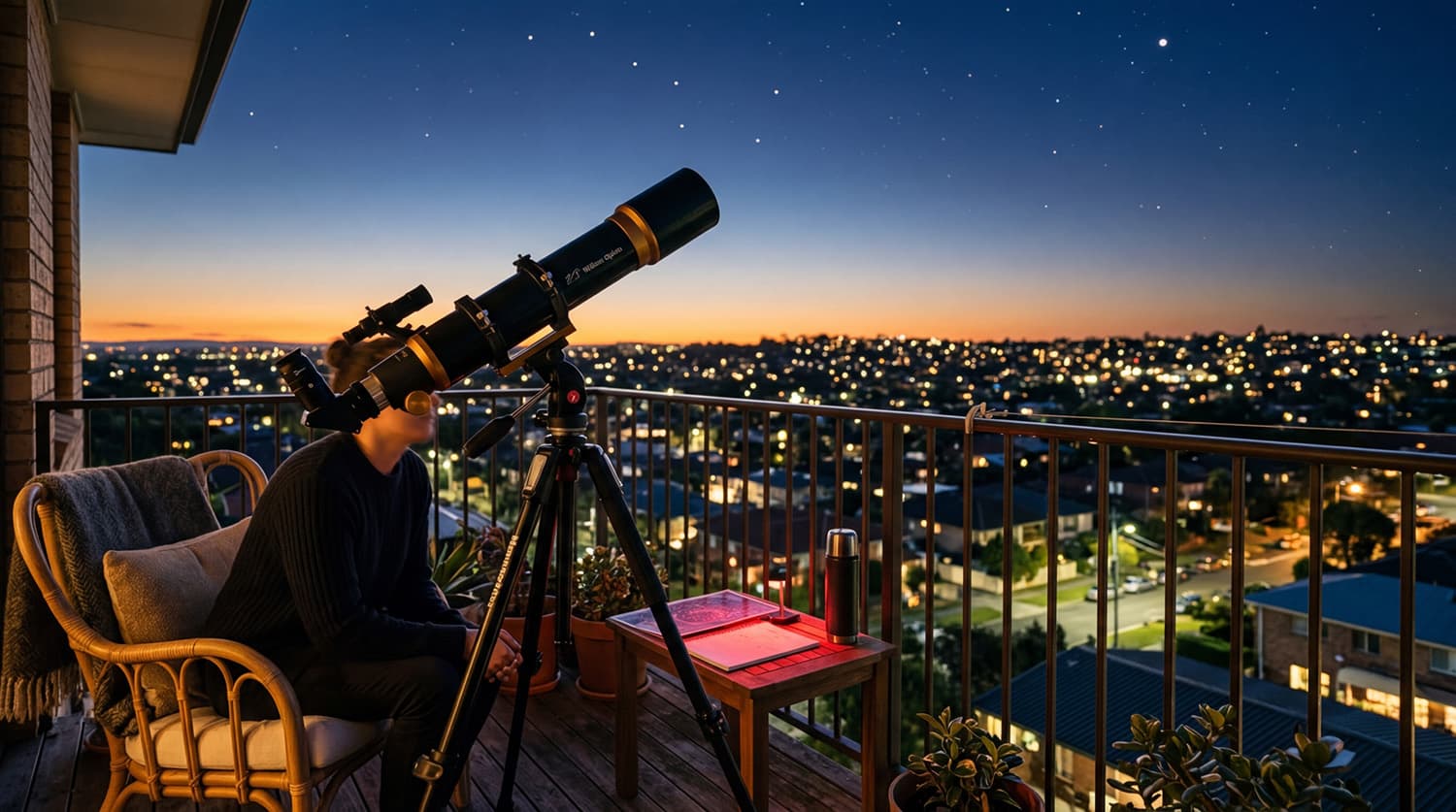
You want zero maintenance. A refractor's sealed tube means no collimation, no dust on the mirrors, and no cooldown surprises. Set it up and observe. This makes refractors particularly well-suited for beginners who do not want to learn mirror alignment before their first night out. If you are still deciding whether to start with binoculars instead, see our binoculars vs telescope guide.
You observe from a balcony or travel frequently. Most refractors fit in a backpack. A Celestron Travel Scope 80 weighs 2.0kg (4.5 lbs) and folds into a carry case. Good luck doing that with a 130mm Newtonian.
Your targets are the Moon and planets. Refractors produce high-contrast images without the diffraction spikes caused by a reflector's secondary mirror spider vanes. For lunar craters and planetary detail, a quality refractor punches above its aperture class. Check our best telescopes for planets and galaxies guide for top-scoring options.
You are buying for a child. Refractors are harder to break, require no adjustment, and the eyepiece is at the back of the tube (intuitive to look through). See our best telescopes for kids guide.
Your budget is under $200. At that price every reflector in our catalogue is a Bird-Jones or a fast spherical design. A 70-80mm achromat is the honest buy.
The tradeoff: You get less aperture for your money. A $300 refractor maxes out at 102mm. A $300-$470 reflector reaches 130-150mm, gathering 60-120% more light.
When to Choose a Reflector
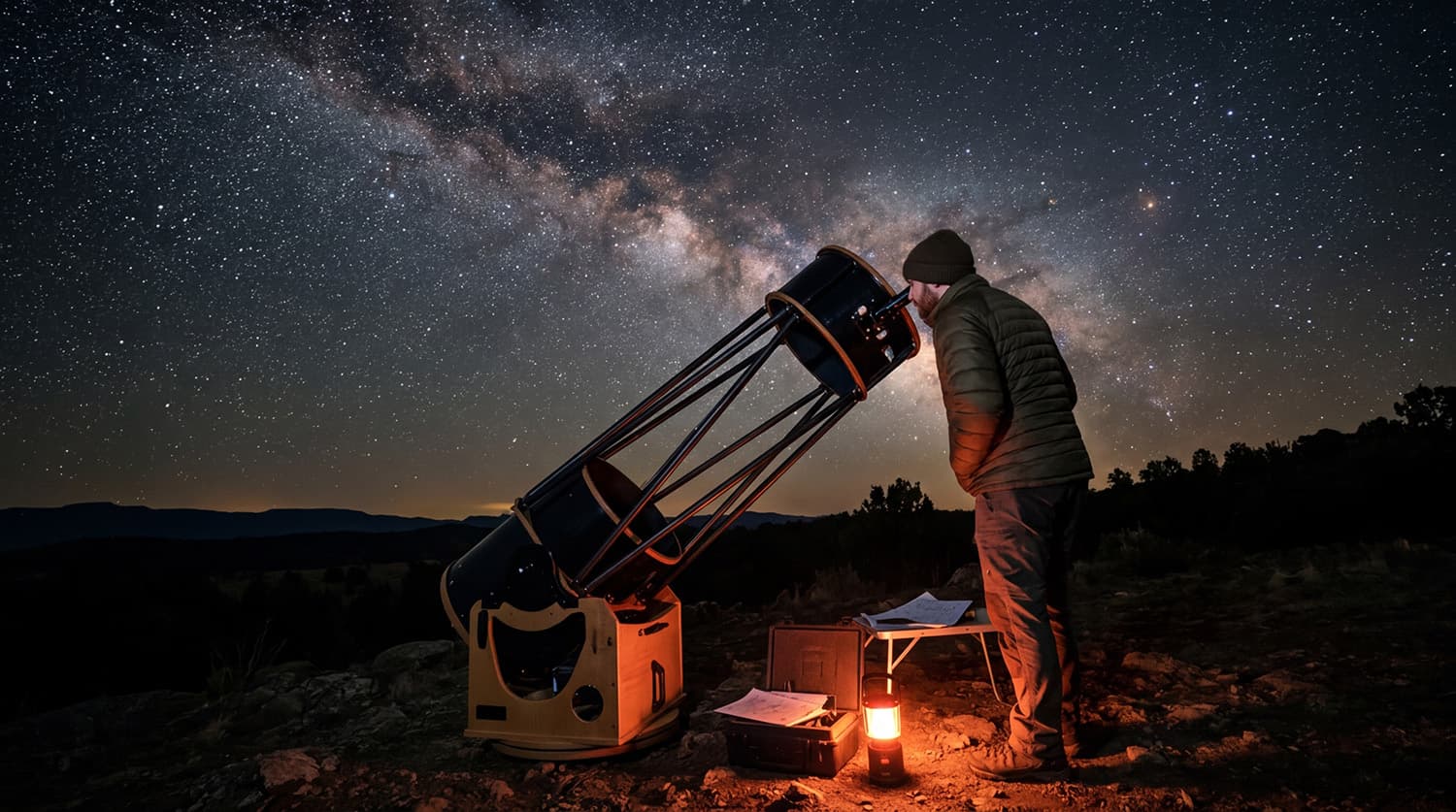
You want the most aperture for your budget. This is the reflector's defining advantage. The Sky-Watcher Heritage 150P delivers 150mm of parabolic aperture for $309. To match that aperture in a refractor you would spend well over $1,000, and consumer refractors above 102mm are scarce. For the ultimate aperture-per-dollar option, a Dobsonian puts all your budget into the optics rather than the mount.
You plan to hunt deep sky objects. Galaxies, nebulae, and star clusters demand light. More mirror area means more photons reaching your eye, and the achromat refractors a beginner can afford average a deep sky score of 41 against 52 for reflectors. See our best deep sky telescopes for top performers.
You want GoTo on real aperture. The Virtuoso GTi 150P puts a 150mm parabolic mirror on an app-controlled GoTo base for $402.31. In our database, no refractor offers that combination of aperture and GoTo anywhere near the price.
You do not mind occasional collimation. Reflector mirrors shift during transport and temperature changes. Collimation (realigning the mirrors) takes 5-10 minutes with a basic tool once you learn the process. Most observers collimate every few sessions, not every night.
The tradeoff: Reflectors are heavier, need cooldown time for the mirrors to reach ambient temperature, the open tube collects dust over time, and you have to check the mirror figure before buying.
What About Compound Telescopes?
There is a third option. Compound (catadioptric) telescopes combine lenses and mirrors in a sealed, compact tube. The two main types are Schmidt-Cassegrains (SCT) and Maksutov-Cassegrains (MAK).
Compounds offer the sealed tube of a refractor with aperture closer to a reflector, in a shorter package. The Celestron NexStar 8SE packs 203mm of aperture into a tube that is only about 430mm long. The catch: they cost more per millimeter of aperture than either reflectors or refractors, and their longer focal ratios make them less suited for wide-field viewing.
Compound telescopes score well in our database; the 16 Schmidt-Cassegrains average 74 overall and lead every other family on planetary score (64). They are worth considering if you want a portable scope with serious aperture and are willing to pay a premium. For the full breakdown of all five telescope categories, see our types of telescopes guide.
Decision Flowchart
Use this to narrow down your choice:
1. What is your budget?
- Under $200: Refractor (the reflectors at this price are the ones to avoid)
- $200-$500: Either design works; continue below
- $500+: All three designs are available; continue below
2. How important is portability?
- Very important (travel, balcony, backpacking): Refractor
- Somewhat important: Refractor, compound, or tabletop Dobsonian
- Not a priority (backyard, dark site trips by car): Reflector
3. What do you want to observe?
- Moon and planets primarily: Refractor or compound
- Deep sky objects (galaxies, nebulae): Reflector
- A mix of everything: Reflector (the extra aperture helps across the board)
4. How do you feel about maintenance?
- Zero maintenance, please: Refractor
- Willing to learn collimation: Reflector, with a parabolic mirror
Best Refractors in Our Database
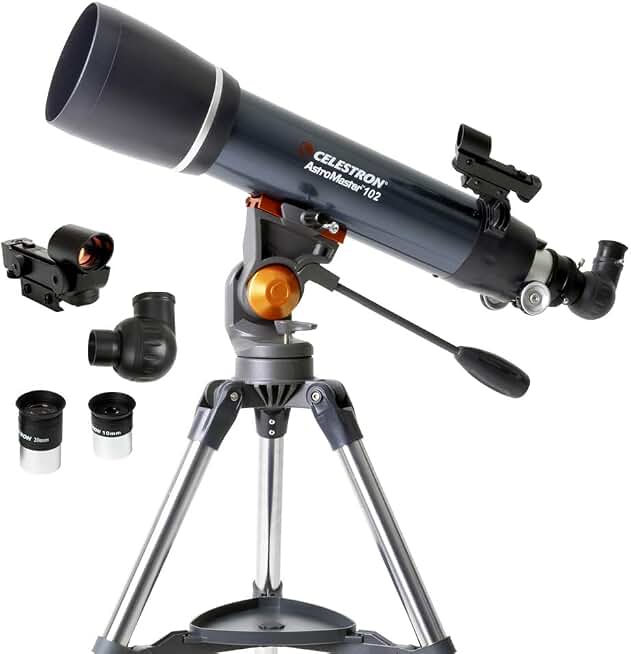
1. Celestron AstroMaster 102AZ
Celestron
Celestron AstroMaster 102AZA capable 102mm refractor that gets you outside and observing on your first night out
The Celestron AstroMaster 102AZ is the highest-scoring in-stock refractor under $500 at 72 overall, and at 102mm it is the largest aperture you will find in a refractor at $252.52. The achromat at f/6.5 balances magnification and field of view, the alt-azimuth mount has slow-motion controls on both axes, and the included 20mm and 10mm eyepieces give 33x and 66x per Celestron. 351 Amazon reviews average 4.3 stars. The 5.8kg total weight remains manageable for backyard sessions. It leads our best telescopes under $300 guide.
Who it is for: Observers who want more aperture than a 70mm scope without jumping to a reflector.
The tradeoff: Achromat design shows some chromatic aberration (purple fringing) on bright objects at high magnification.
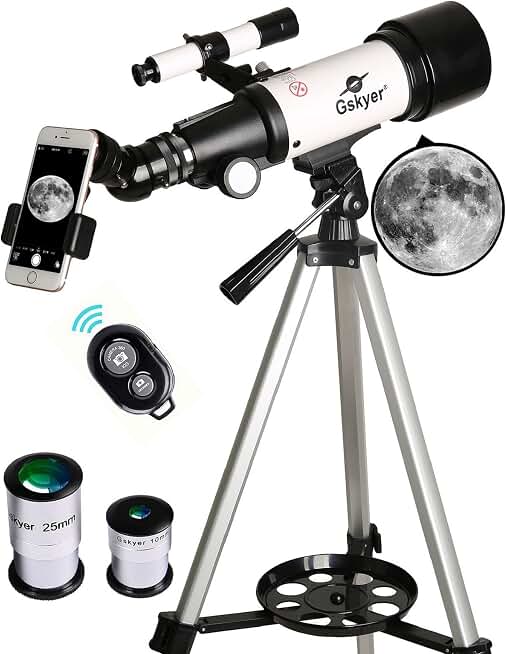
2. Gskyer 70AZ
Gskyer
Gskyer 70AZA capable 70mm refractor that punches above its price for beginners ready to explore the night sky.
The Gskyer 70AZ scores 69 overall with a value score of 94. At $85.49, it is one of the most accessible telescopes in our database. The 70mm aperture handles lunar craters, Jupiter's moons, and Saturn's rings, though do not expect to resolve faint deep sky targets. With over 21,800 Amazon reviews and a 4.3-star rating, it is the most-reviewed telescope we track. It weighs 2.6kg (5.7 lbs), making it genuinely portable.
Who it is for: First-time buyers who want a functional telescope without committing to a large investment.
The tradeoff: 70mm of aperture limits deep sky capability. You will outgrow it if you get serious.
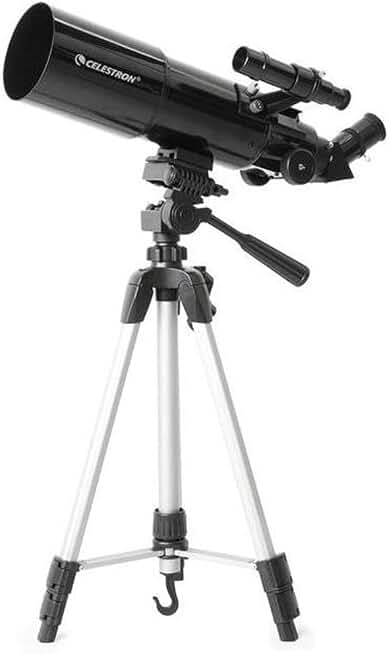
3. Celestron Travel Scope 80
Celestron
Celestron Travel Scope 80Portable 80mm refractor that goes where you go, without sacrificing the views that matter most
The Celestron Travel Scope 80 scores 69 overall with a value score of 90. It earns its name: at 2.0kg (4.5 lbs) and 400mm focal length, this scope was designed to travel. The 80mm aperture is a step up from 70mm models, gathering 31% more light. The included backpack makes it a natural choice for camping trips and vacations. At $149.95, it punches well above its price for casual observing, and it leads our best telescopes under $200 guide.
Who it is for: Travelers and casual observers who want a real telescope they can pack anywhere.
The tradeoff: The lightweight tripod struggles in wind, and 80mm is still limited for deep sky.
Best Reflectors in Our Database
All three have parabolic primary mirrors per the manufacturer's specification sheet.
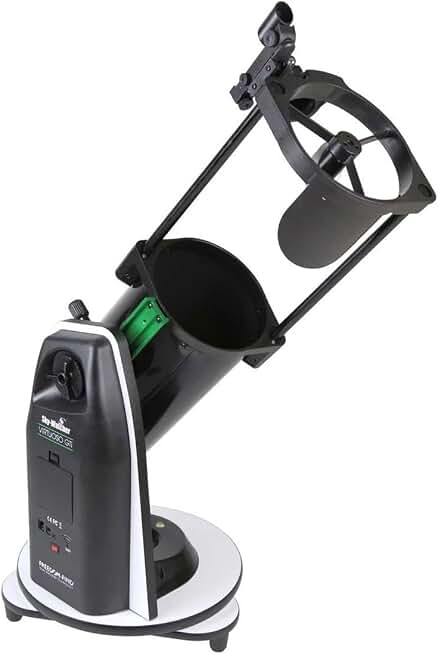
1. Sky-Watcher Virtuoso GTi 150P
Sky-Watcher
Sky-Watcher Virtuoso GTi 150PGoTo Dobsonian power in a tabletop package, with Wi-Fi control and the freedom to push around manually.
The Sky-Watcher Virtuoso GTi 150P is the highest-scoring in-stock reflector under $1,000 at 76 overall. It puts a 150mm f/5 parabolic mirror in a collapsible tube on a motorized tabletop Dobsonian base with built-in WiFi; the free SynScan Pro app aligns it (four methods), finds any of 10,000+ objects, and tracks them, while Freedom Find encoders let you push the tube by hand without losing alignment. At $402.31 it costs more than manual alternatives, but the GoTo means you spend time observing rather than searching. It scores 57 for deep sky and 52 for planetary. 52 Amazon reviews at 4.2 stars.
Who it is for: Beginners who want automation to accelerate their learning, and intermediate observers who value convenience.
The tradeoff: At 11.7kg it needs a sturdy table. Runs on 8 AA batteries or an external 12V supply. The app takes an evening to learn.
2. Celestron StarSense Explorer DX 130AZ
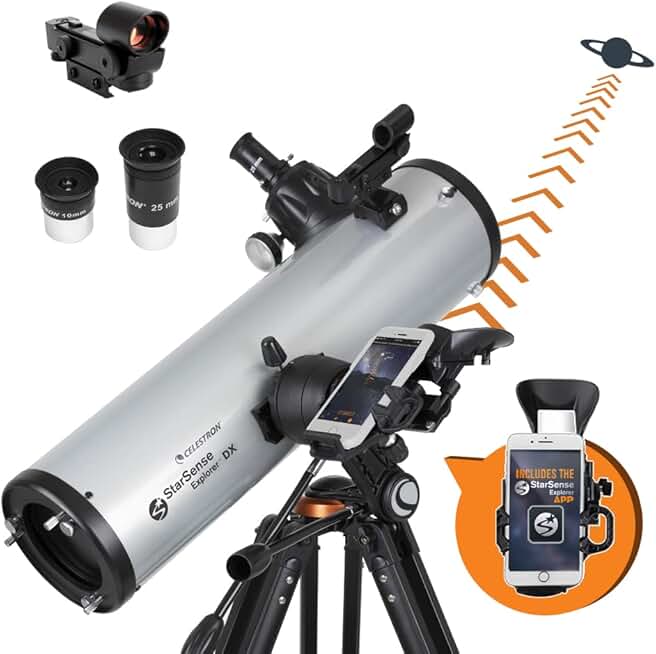
Smart phone-powered star finding meets a capable 130mm reflector, making the night sky genuinely accessible for beginners.
The Celestron StarSense Explorer DX 130AZ scores 74 overall and takes the app-guided route: dock a phone, and the StarSense app solves the sky and draws arrows to any target while you push the telescope. Celestron's spec sheet lists a parabolic primary, 130mm f/5 with a 650mm focal length in a 635mm tube, which is exactly what its cheaper 114mm StarSense siblings lack. At $499.95 with 1,550 Amazon reviews at 4.1 stars, it is the reflector we recommend to beginners who want help finding things without paying for motors.
Who it is for: Buyers who want a finding aid and honest 130mm optics under $450.
The tradeoff: No tracking; objects drift and you nudge. Needs a recent smartphone. 8.16kg.
3. Sky-Watcher Heritage 150P
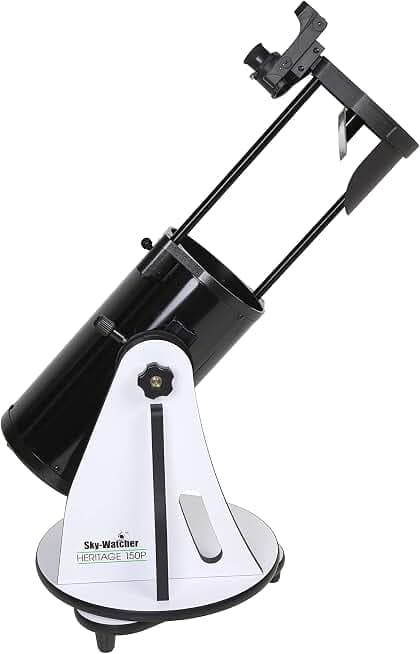
Sky-Watcher
Sky-Watcher Heritage 150PBig views, compact package: the Heritage 150P brings serious aperture to a tabletop Dobsonian under $400.
The Sky-Watcher Heritage 150P scores 68 overall and is the GTi's optics without the motors: the same 150mm f/5 parabolic mirror in a collapsible tube on a manual tabletop Dobsonian base, for $309. Amazon reviewers give it 4.6 stars across 74 reviews, the highest rating of the three. Its score trails the GTi and DX 130AZ only because the engine rewards finding aids; on optics it is the equal of the GTi.
Who it is for: Observers who want the most parabolic aperture per dollar and are happy to learn the sky with a phone app as a finder chart.
The tradeoff: No tracking, no electronics, needs a table. 9.34kg.
Understanding Key Specs
If you are new to telescopes, here are the specs that matter most when comparing reflectors and refractors.
Aperture
Aperture is the diameter of the telescope's main mirror or lens, measured in millimeters. It determines how much light the telescope collects. More aperture means brighter images and the ability to resolve finer detail. A 130mm reflector collects 3.4 times more light than a 70mm refractor. This is the single most important spec for visual observing, provided the optics are made properly.
Focal Ratio (f/number)
The focal ratio is the focal length divided by the aperture. Lower numbers (f/4 to f/6) produce wider fields of view and brighter images at low magnification, well-suited for deep sky. Higher numbers (f/8 to f/12) provide narrower fields with more magnification, better for planets. Most beginner reflectors sit around f/5 to f/8; most beginner refractors range from f/5 to f/13. For a reflector, a fast focal ratio also raises the stakes on mirror figure: a spherical mirror that is acceptable at f/8 is not at f/5.
Mirror Figure
Whether a reflector's primary is parabolic or spherical, and whether the stated focal length is real or produced by a corrector lens in the focuser. Manufacturer specification tables state it. See The Mirror Trap above.
Collimation
Collimation means aligning the mirrors in a reflector telescope for sharp images. Refractors never need this. Reflectors need it periodically, especially after transport. It sounds intimidating, but it takes 5-10 minutes with a $15 collimation tool, and countless YouTube tutorials walk through the process step by step. Bird-Jones designs are the exception: the corrector lens sits in the way of the usual tools.
Chromatic Aberration
Achromat refractors (the most common type at beginner prices) bend different wavelengths of light at slightly different angles, producing purple or blue fringing around bright objects like the Moon and Jupiter. Reflectors avoid this entirely because mirrors reflect all wavelengths equally. ED (extra-low dispersion) and apochromat refractors fix this problem, but they cost significantly more.
