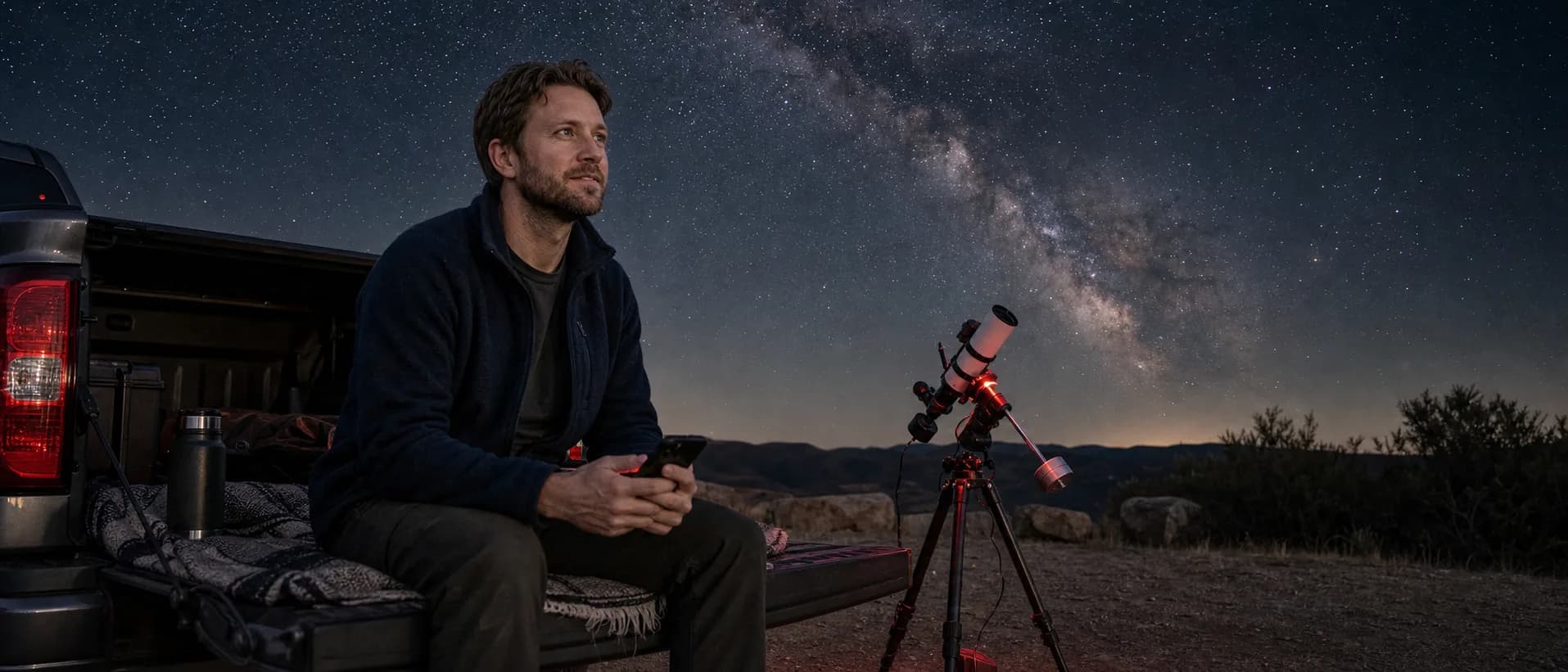

For most astrophotographers in 2026, the Celestron Origin Mark II is the best deep-sky imaging telescope under $5,000. It scores 90 on our astrophotography dimension, the highest in the database, and packages 152mm of aperture with autonomous alignment, tracking, and stacking into a single closed system. If $4,299 is too much, the Celestron Advanced VX 6" Newtonian at $1,299 gives you 152mm of aperture on a real equatorial GoTo mount; the best traditional astrograph value in our catalog.
This guide ranks telescopes specifically for imaging, not visual observing. The optical, mechanical, and tracking demands are different, and a great visual scope often makes a frustrating imaging platform.
Quick Picks
| Telescope | Best For | Astrophoto Score | Price |
|---|---|---|---|
| Celestron Origin Mark II | Best overall | 90 | $4,299 |
| Celestron Advanced VX 6" Newtonian | Best value DSO | 76 | $1,299 |
| ZWO Seestar S50 | Best smart for most | 71 | $499 |
| Celestron EdgeHD 800 OTA | Best for planets | 66 | $1,699 |
| Celestron AstroMaster 130EQ-MD | Best under $500 | 68 | $390 |
How We Chose These
Every telescope on WhichScope is scored across 7 dimensions, including a dedicated astrophotography score that weights focal ratio (faster is better for DSO imaging), mount stability and tracking, focal length appropriateness, included corrector or field-flattener support, and Amazon reputation among imaging-focused reviewers. We pulled the top scopes by astrophoto score, then curated across three imaging styles: wide-field deep sky, high-magnification planetary, and automated smart imaging. All scores and prices come directly from the database. Prices reflect current Amazon listings and change frequently.
What Makes a Telescope Good for Astrophotography
The specs that matter for imaging are not the same as the ones that matter for visual observing. If you are coming from a visual scope, expect to recalibrate.
Focal ratio is more important than aperture
Visual observers chase aperture for brighter views. Imagers chase fast focal ratios for shorter exposures. A 130mm telescope at f/5 collects light four times faster than a 130mm telescope at f/10 for any given pixel on the sensor. That difference compounds across multi-hour deep-sky sessions. For wide-field DSO work, f/4 to f/6 is the sweet spot. For planetary imaging, slower is fine because planets are bright and you need the resolution that long focal lengths provide. Anything in between (f/7 to f/9) is the awkward middle.
The mount carries the image quality
A $1,500 optical tube on a $300 mount produces blurry stars and trailing. A $500 optical tube on a $2,000 mount produces sharp, round stars. Periodic error, polar alignment accuracy, and payload margin all live in the mount. For unguided imaging, you want a mount rated for at least twice the weight of your imaging payload. For guided imaging, 1.5x is workable. Cheap fork mounts on alt-azimuth bases introduce field rotation that ruins long exposures even when the tracking is otherwise accurate.
Back-focus and corrector compatibility
Cameras need a specific distance from the focuser to the sensor (back-focus). If the telescope cannot accommodate your camera plus any field flattener or coma corrector at the right distance, you get elongated or distorted stars at the corners. Newtonians often need a coma corrector to deliver flat, sharp fields across modern large sensors. SCTs typically work with reducer/correctors that double as field flatteners. Refractors are the most plug-and-play; many ship with their corrector specified for a known back-focus distance.
Sensor compatibility
Match the telescope's image circle to your camera's sensor size. A 50mm refractor and a full-frame DSLR is a vignetting disaster. APS-C and four-thirds sensors are the safest bet for most beginner imaging telescopes; full-frame demands a properly corrected optical system specifically rated for it. If you are buying a dedicated astro camera with a small sensor (IMX585, IMX678, etc.), almost any telescope above 70mm aperture will produce a usable image circle.
Best for Wide-Field Deep Sky
Wide-field deep-sky imaging means nebulae, galaxies, and large emission regions where field of view matters as much as detail. Fast focal ratios and well-corrected optics rule this category.
1. Celestron CPC Deluxe 800 HD: Best Premium Wide-Field
Celestron
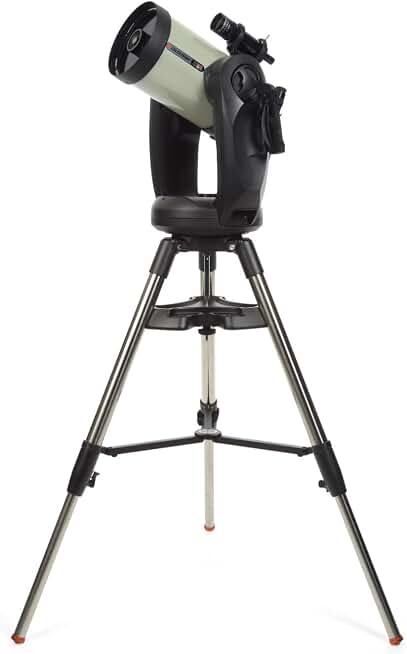
Celestron CPC Deluxe 800 HD8-inch Edge HD optics and GoTo tracking in a fork-mounted SCT built for both visual observing and serious astrophotography
The CPC Deluxe 800 HD pairs Celestron's 8-inch EdgeHD optics with a heavy-duty fork mount and GPS. It scores 84 on astrophotography, the highest non-smart telescope in our catalog. With a HyperStar or f/2 reducer, the 8-inch EdgeHD becomes a 400mm f/2 wide-field astrograph capable of pulling full nebula structure in 30 to 60 minute integrations. At native f/10, the same telescope shifts to a 2032mm planetary instrument; one OTA, two imaging personalities.
The fork mount tracks well, but the alt-azimuth configuration introduces field rotation over long exposures unless you add an equatorial wedge. Most serious imagers do exactly that. At 35kg fully assembled, this is not a grab-and-go setup; it lives semi-permanently on a deck or in a roll-off observatory.
Who it is for: Imagers who want one telescope for both wide-field nebula work (with HyperStar) and planetary detail (at native focal length), and have the budget and storage for a 35kg fork-mounted SCT.
The tradeoff: Field rotation on the alt-az fork limits unguided exposures unless you add a wedge. The price reflects the heavy mount; if you already own a good EQ mount, the EdgeHD 800 OTA alone is a better buy.
The most capable 8-inch SCT astrograph in our catalog.
2. Celestron Advanced VX 6" Newtonian: Best Value DSO Imager
Celestron
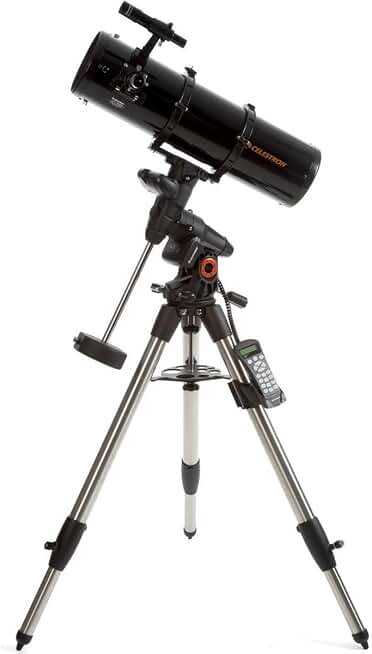
Celestron Advanced VX 6" Newtonian6-inch parabolic Newtonian on a capable GoTo mount, built for serious wide-field observing at a mid-range price.
This is the classic wide-field DSO imaging recipe at the most defensible price in the catalog. A 152mm (6-inch) f/5 parabolic Newtonian gives you a 760mm focal length and a bright, fast optical system well-suited to medium and large nebulae. The Advanced VX equatorial mount is Celestron's entry-level imaging mount; not bombproof, but rated to 13.6kg, properly equatorial, with autoguider port and GoTo. Astrophoto score 76, $1,299 for the complete package.
You will need a coma corrector to flatten stars in the corners (Baader MPCC or Tele Vue Paracorr are common picks, $200 to $350 extra). The mount benefits from a permanent assembly footprint, but it breaks down for transport in two trips. Belt-drive upgrades and PEC training extract more performance from this mount than most reviewers credit.
Who it is for: First-time imagers who want a real equatorial GoTo and a fast Newtonian without the $3,000+ commitment. Also great as a second OTA for an existing AVX owner.
The tradeoff: Coma at the field edges without a corrector. The mount is the weakest link in the system, so plan to spend an extra night learning to polar-align before expecting decent guiding.
152mm of fast aperture on a genuine EQ GoTo mount, under $1,300.
3. Celestron AstroMaster 130EQ-MD: Best Entry-Level Imager
Celestron
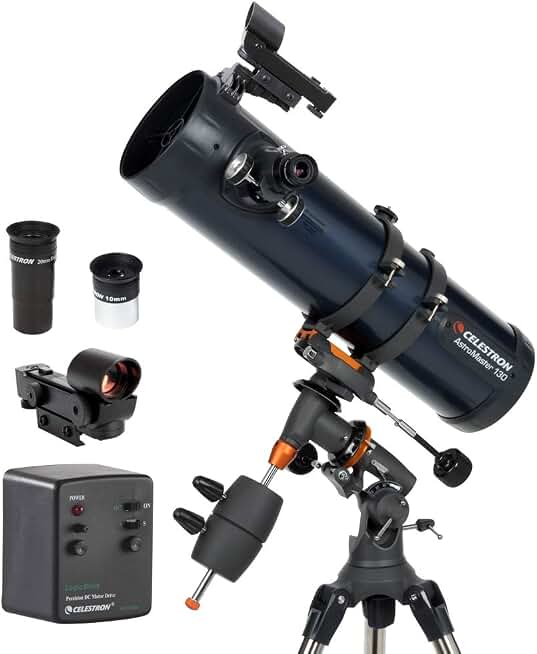
Celestron AstroMaster 130EQ-MD130mm of light-gathering power with motorized tracking, built for beginners ready to go beyond the Moon
The AstroMaster 130EQ-MD is the entry point for traditional astrophotography. A 130mm Newtonian at f/5 sits on a CG-3 German equatorial mount with a motor drive on the right ascension axis. It is the cheapest telescope in our catalog with both a real equatorial mount and motorized tracking, two non-negotiable features for any imaging that uses exposures longer than a few seconds. Astrophoto score 68, $390, with 1,900 Amazon reviews averaging 4.0 stars.
This is a learning platform, not a final destination. The mount is not stable enough for unguided exposures beyond about 30 seconds at this focal length, and the included eyepieces and finder are basic. But it lets you practice polar alignment, framing, focusing, and short-exposure DSO work for the price of one good eyepiece on a serious rig.
Who it is for: Beginners testing whether astrophotography is for them before committing $1,000+. Also a strong learning platform for short-exposure planetary stacking and lunar imaging.
The tradeoff: The mount is the weakest link; expect to outgrow it within a year if you stick with the hobby. Track-only RA motor means no DEC corrections without manual nudging. No GoTo.
The cheapest path into real equatorial tracking, under $400.
Best for Planetary Imaging
Planetary imaging is the opposite problem from DSO work. Targets are small, bright, and want long focal lengths plus enormous frame rates. Resolution beats focal ratio.
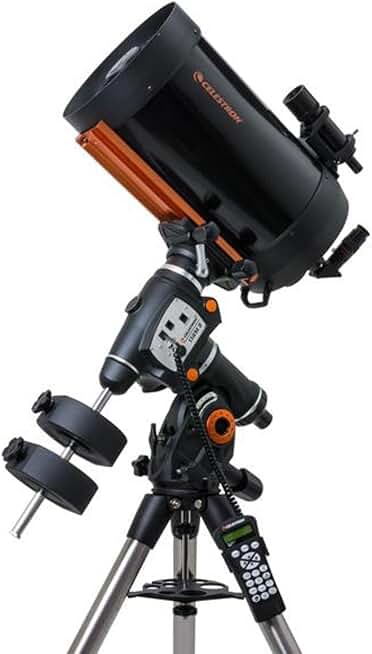
1. Celestron CGEM II 1100: Best High-End Planetary
Celestron
Celestron CGEM II 110011 inches of light-gathering power on a computerized equatorial mount, built for serious deep-sky and planetary work.
11 inches of aperture on a heavy GoTo equatorial mount is the most light-gathering planetary platform under $5,000. The 279mm aperture and 2800mm focal length at f/10 deliver image scales where Jupiter, Mars, and Saturn fill a high-frame-rate sensor with resolved cloud bands, polar caps, and Cassini Division. Planetary score 77, the highest in our catalog. The CGEM II mount is rated to about 18kg of payload, comfortable for the 11-inch SCT with imaging gear attached.
This is a permanent or semi-permanent setup. Cool-down time before useful imaging is 60 to 90 minutes on a cold night. Collimation matters more at this aperture than most owners initially realize. With proper thermal management and a decent atmospheric night, this scope produces planetary detail competitive with much more expensive Maks and CDKs.
Who it is for: Planetary specialists who want serious resolution, image scale, and have a permanent observing site or roll-off observatory.
The tradeoff: $4,299, 35+kg assembled, and 60 to 90 minute thermal equilibration time. This is not a casual instrument.
Top planetary score in our catalog, 11 inches of light bucket.
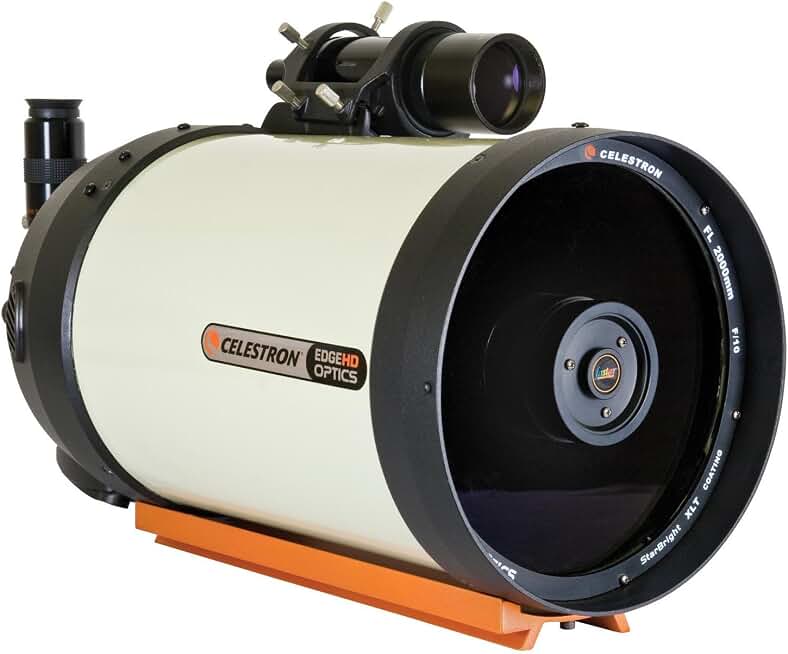
2. Celestron EdgeHD 800 OTA: Best 8-Inch Planetary
Celestron
Celestron EdgeHD 800 OTACelestron's sharpest 8-inch SCT, built from the ground up for serious visual and imaging work
The EdgeHD 800 OTA is Celestron's flagship 8-inch SCT, sold as a tube only so you can mount it on whatever you already own (Advanced VX or CGEM EQ recommended). The EdgeHD optical design corrects field curvature across modern sensors, so off-axis stars stay round, which matters as much for high-resolution planetary as it does for DSO. Astrophoto score 66, planetary score 69, 4.8 stars across 13 Amazon reviews.
At native f/10 and 2032mm focal length, this is a serious planetary instrument. Drop in a 2x Barlow and you are at 4064mm; image scales where Mars surface markings, Jupiter's GRS, and Saturn's bands fill a high-speed camera frame. The 8-inch aperture is the practical limit for backyard cool-down time; larger SCTs take meaningfully longer to settle.
Who it is for: Existing EQ mount owners who want a serious planetary OTA without the cost or weight of an 11-inch system. Also strong for high-detail lunar work.
The tradeoff: OTA only at $1,699; budget another $1,500 to $2,500 for a mount if you do not own one. Native f/10 is slow for DSO work without a reducer.
EdgeHD optics in the 8-inch sweet spot for planetary detail.
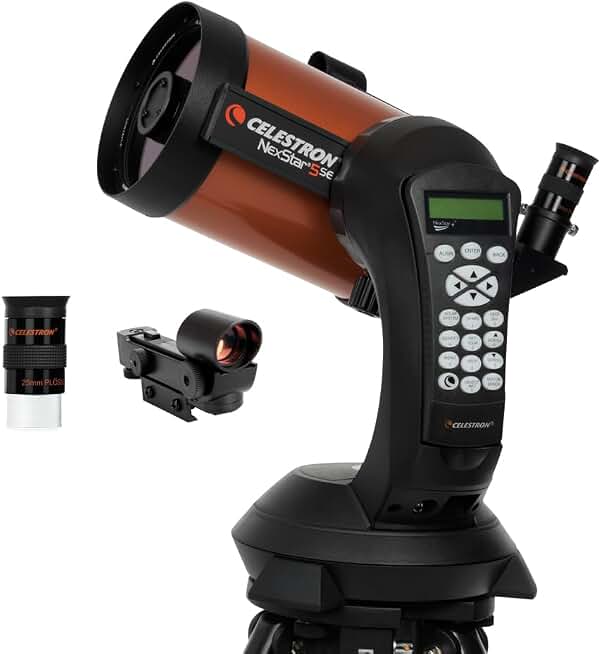
3. Celestron NexStar 5SE: Best Entry Planetary
Celestron
Celestron NexStar 5SECelestron's iconic 5SE brings computerized GoTo precision and Schmidt-Cassegrain optics into a genuinely portable package
The NexStar 5SE is the lightest serious planetary scope in the catalog. A 127mm SCT at f/10 gives you 1250mm of focal length in an 8kg complete package with GoTo, ready to image the Moon, Jupiter, and Saturn through a smartphone adapter or planetary camera. Planetary score 56, astrophoto score 66, 526 Amazon reviews averaging 4.4 stars. At $1,029 it is the cheapest GoTo SCT we recommend.
The fork mount limits long-exposure DSO work, but for lucky-imaging planetary stacks (where you record short video and select the sharpest frames), the included single-arm GoTo tracks well enough. Pair it with a 2x Barlow and an IMX585-class planetary camera and you are in business for under $1,500 all-in. If you are weighing the same formula with more aperture, our NexStar 8SE review covers the 8-inch version's planetary imaging strengths and its deep-sky limits.
Who it is for: Beginners who want serious planetary results without committing to a heavy EQ rig. Also genuinely portable for dark-sky trips.
The tradeoff: 5-inch aperture limits image scale on small planets; Mars will reward you only at opposition. No equatorial tracking, so DSO imaging needs a wedge or accept short-exposure work only.
GoTo Schmidt-Cassegrain optics in an 8kg package, under $1,100.
Best Smart Telescopes for Astrophotography
Smart telescopes deserve their own category. They automate alignment, tracking, focusing, and image stacking, delivering finished astrophotos to your phone in 10 to 30 minutes. The optical compromises are real (small apertures, fixed sensors), but the workflow advantages have made them legitimate competitors at every price point under $5,000.
1. Celestron Origin Mark II: Best Smart Overall
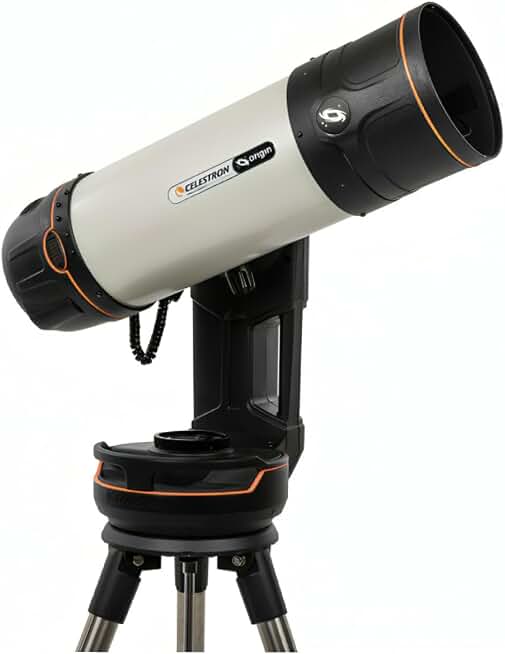
Celestron
Celestron Origin Mark IICelestron Origin Mark II: a 152mm smart astrograph that turns your backyard into a deep-sky imaging station
The Origin Mark II is what happens when Celestron applies a HyperStar f/2 system to a smart telescope concept. 152mm of aperture at f/2.2 with autonomous alignment, focusing, tracking, and live stacking is unprecedented in this category. Astrophoto score 90, the highest in our catalog. Output rivals what a careful imager pulls from a comparable EdgeHD rig with hours of work; the Origin does it autonomously in 30 to 60 minutes per target.
The price is the catch. At $4,299 the Origin Mark II is in serious-rig territory, and you trade flexibility for automation. You cannot easily swap cameras, use it as a visual scope, or repurpose it for planetary imaging. What you get is the fastest path from "I want to image NGC 7000" to "I have a publishable image of NGC 7000."
Who it is for: Imagers who value finished output and time over the journey of learning manual processing. Also the right tool for educational settings, public outreach, and anyone with limited backyard time.
The tradeoff: $4,299 is a lot. The closed system means no upgrade path beyond what Celestron firmware enables. At 19kg, it is not as portable as smaller smart scopes.
152mm of aperture at f/2.2, fully autonomous.
2. ZWO Seestar S50: Best Smart for Most People
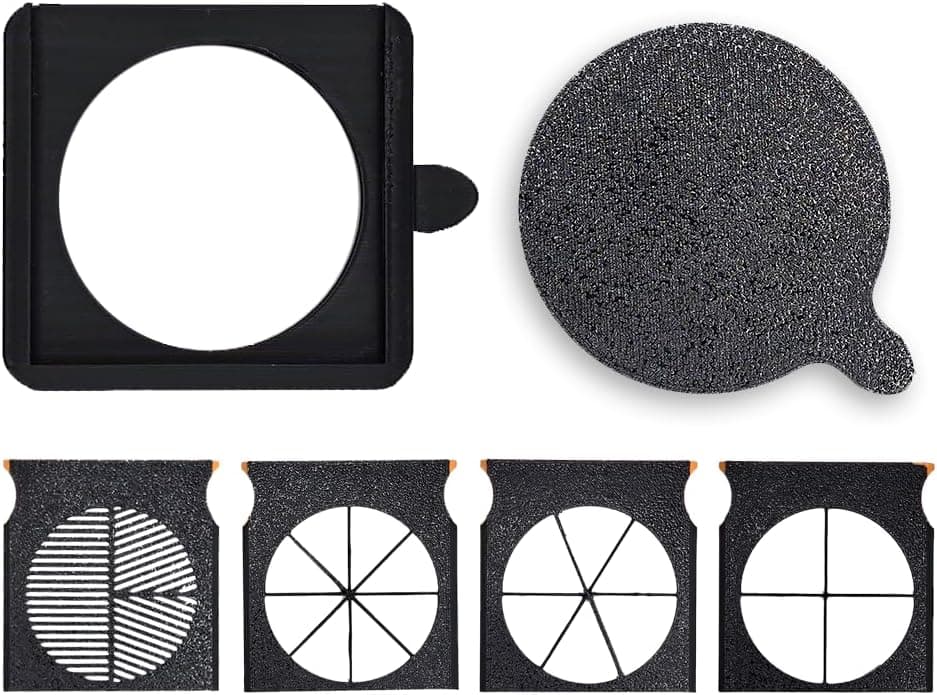
Point, tap, and image the night sky with no experience required, all in a 3kg package under $500.
The Seestar S50 is the smart telescope we recommend to anyone testing the format for the first time. A 50mm apochromatic refractor at f/5 with built-in tracking, alignment, dew heater, and live stacking, delivered in a 2.5kg package for $499. Astrophoto score 71, overall score 93 (the highest in our database), 4.5 stars across 326 Amazon reviews. For a deeper look, our Seestar S50 review covers it in full.
The 50mm aperture is the obvious ceiling; faint targets need longer integrations than larger smart scopes. But the optical quality is excellent for the price, the workflow is genuinely beginner-friendly, and the cost-per-image ratio is unmatched. For the price of one premium eyepiece on a serious rig, you get a complete imaging system.
Who it is for: Anyone curious about astrophotography who wants results from night one. Also a great second scope for traditional imagers who want a grab-and-go for clear nights.
The tradeoff: 50mm aperture is the small end of the smart category. Targets fainter than magnitude 11 take hours of stacking. The fixed sensor means no upgrade path.
The best $499 in astrophotography, fully automated.
3. DWARFLAB DWARF 3: Most Portable Smart
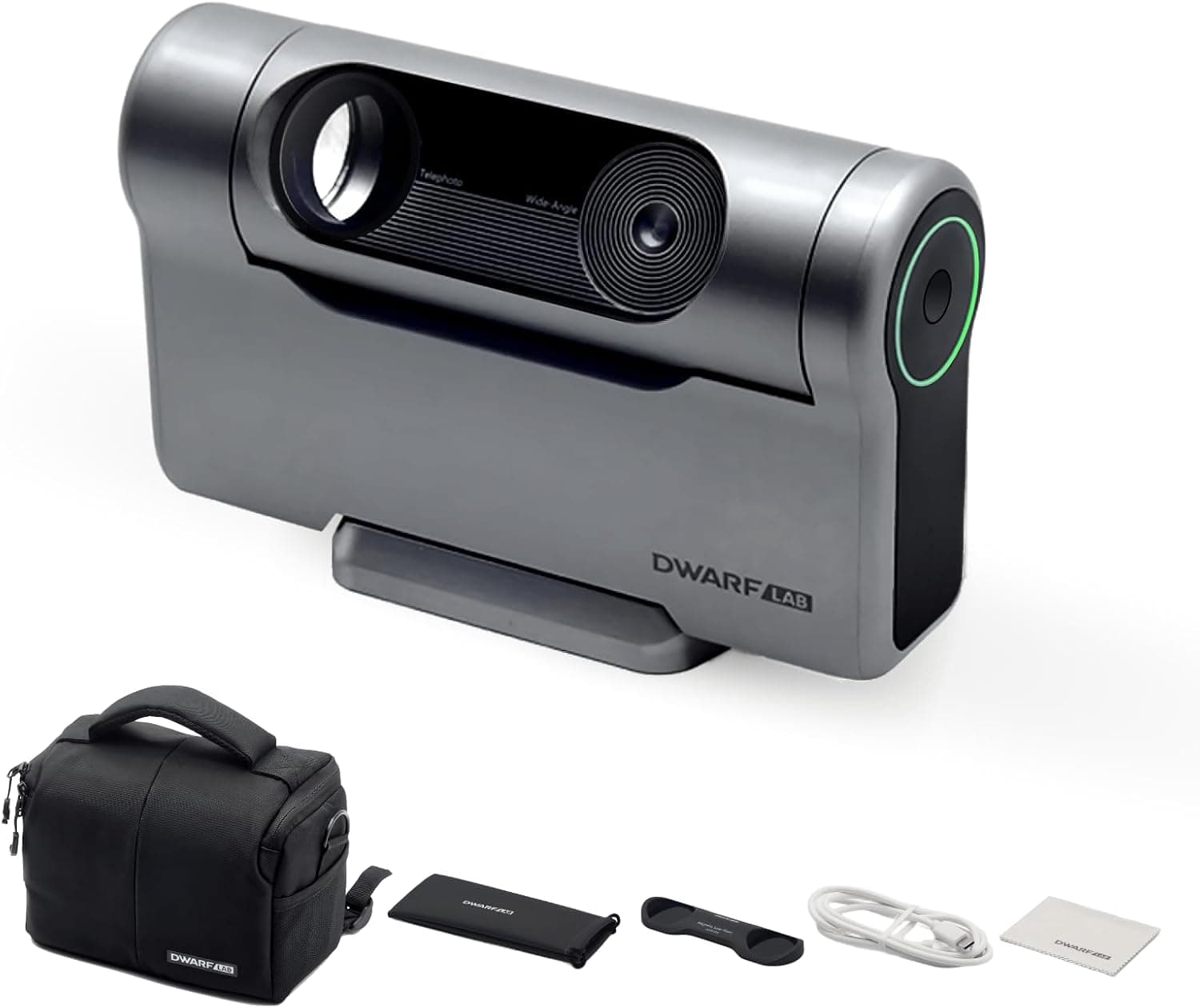
DWARFLAB
DWARFLAB DWARF 3Pocket-sized smart telescope with dual lenses, GoTo tracking, and live stacking for deep sky and daytime use
The DWARF 3 fits an entire imaging system into 1.3kg. The dual-lens design (wide-angle plus telephoto) is unique in the category, letting you shoot context shots and zoomed targets without swapping equipment. Astrophoto score 70, 4.6 stars across 139 Amazon reviews. Our DWARF 3 review goes deeper on the optical and software tradeoffs.
The 24mm aperture is small even by smart-scope standards, but the f/4.2 effective focal ratio and modern sensor compensate for nebula work and wide-field star fields. Battery life of 5+ hours and a tripod-free magnetic mount option make this the closest thing to a "throw it in your bag" deep-sky camera that exists in 2026.
Who it is for: Travelers, hikers, and anyone whose imaging happens away from a fixed observing site. Also useful as a wide-field complement to a traditional rig.
The tradeoff: 24mm aperture is genuinely small; expect significantly longer stacking times than the Seestar S50 on equivalent targets. The dual-lens system adds complexity if you mainly want astrophotography.
1.3kg of fully automated astrophotography, dual lenses.
The Mount Matters More Than the OTA
If you take one thing from this guide, take this: spend more on the mount than on the optical tube. A common beginner mistake is buying a $1,500 imaging refractor and putting it on an $800 mount. The image stars are oblong and the imaging session is frustrating. The same money distributed as a $600 refractor on a $1,700 mount produces visibly better results, every session, for years.
Mount tiers for astrophotography
Entry equatorial ($300 to $500): Celestron CG-3, Sky-Watcher EQM-35. Track-only motors, no GoTo, payload limits around 5 to 8kg. Adequate for short-exposure imaging with a small refractor or 130mm Newt. Plan to upgrade within a year if you stay in the hobby.
Mid-range GoTo ($1,000 to $2,000): Celestron Advanced VX, Sky-Watcher HEQ5/EQ6-R. Payload 10 to 15kg, autoguider ports standard, GoTo with most catalog. This is the realistic minimum for serious DSO imaging. The AVX is what ships with the Celestron Advanced VX 6" Newtonian as a complete imaging package.
Premium GoTo ($2,500 to $5,000): Sky-Watcher EQ8, iOptron CEM70, Celestron CGEM II / CGX. Payload 20 to 30kg, precision-rated for unguided imaging, strain-wave or belt drive on better models. This tier supports 8-inch SCTs and 5 to 6-inch apochromatic refractors comfortably.
Observatory-grade ($5,000+): Astro-Physics, 10Micron, Paramount. Diminishing returns above mid-range for backyard imagers, but the precision pays off for unguided long-exposure work and remote observatories.
Why smart telescopes sidestep this
The Seestar, DWARF, and Origin systems are sealed mount-OTA combinations. The mount is tuned exactly to the OTA, the firmware compensates for periodic error in software, and there are no compatibility decisions for you to make. That is the entire value proposition. Traditional imaging is more flexible but the mount-OTA matching is your responsibility, and getting it wrong is the single most common reason new astrophotographers quit the hobby.
For the broader smart telescope landscape, see our best smart telescopes guide. For traditional GoTo systems on a budget, the best telescopes under $1,000 guide covers the entry-mid range across all use cases.
