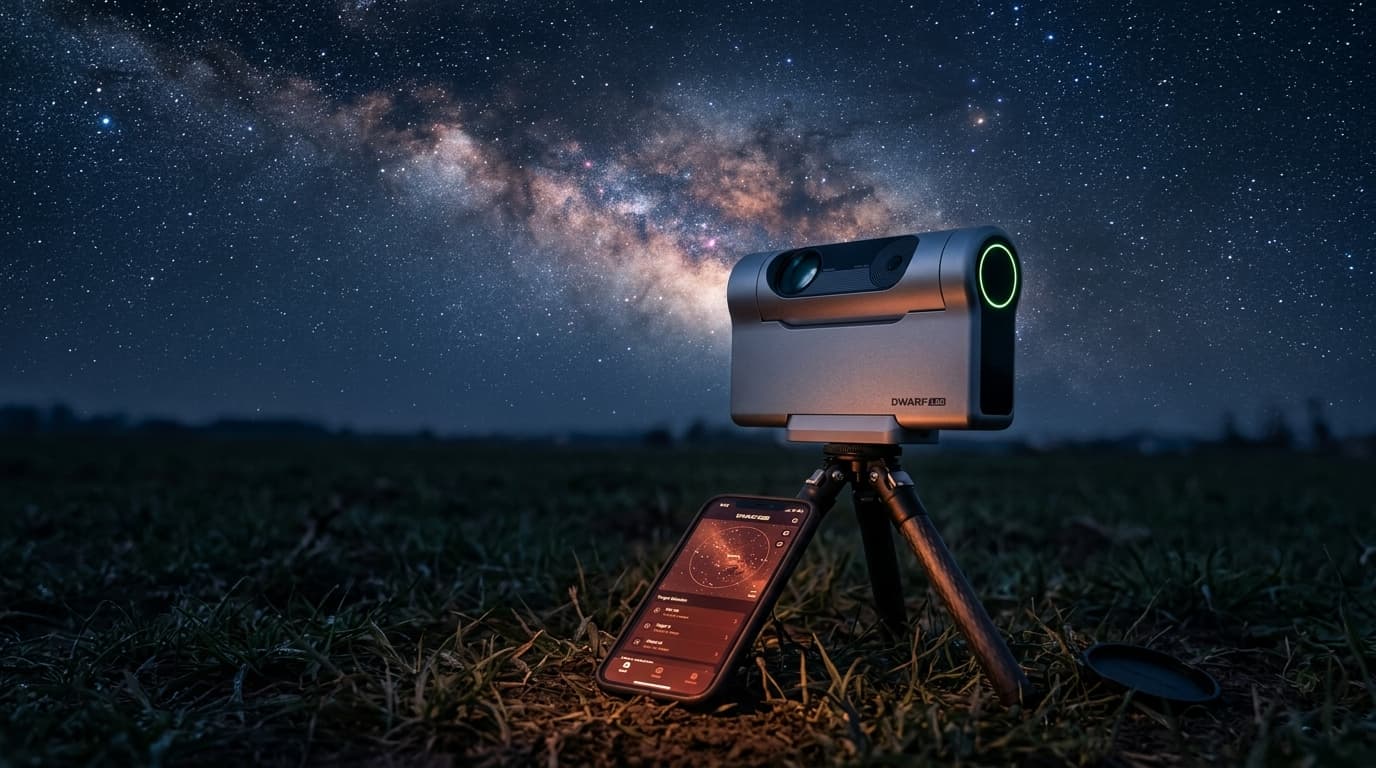

The DWARFLAB DWARF 3 is a pocket-sized smart telescope that automates everything from alignment to image stacking, all controlled from your phone. At $549 with a 24mm dual-lens system, it sits in a competitive spot between the budget Seestar S30 and the established Seestar S50. It scores 83 overall on WhichScope, with strong marks for portability (74) and beginner-friendliness (70), but its small aperture limits what it can do with faint targets.
Quick Verdict
| Category | Score |
|---|---|
| Overall | 83/100 |
| Beginner | 70 |
| Astrophoto | 70 |
| Portability | 74 |
| Value | 68 |
| Deep Sky | 59 |
| Planetary | 34 |
Bottom line: The DWARF 3 is the most portable smart telescope you can buy, and its dual-lens system is genuinely unique in this price range. If you want a backpack-friendly device that produces real deep-sky images on your first night out, it delivers. But the 24mm aperture is a real constraint, and at $549 the Seestar S50 offers twice the aperture for $50 less.
DWARFLAB
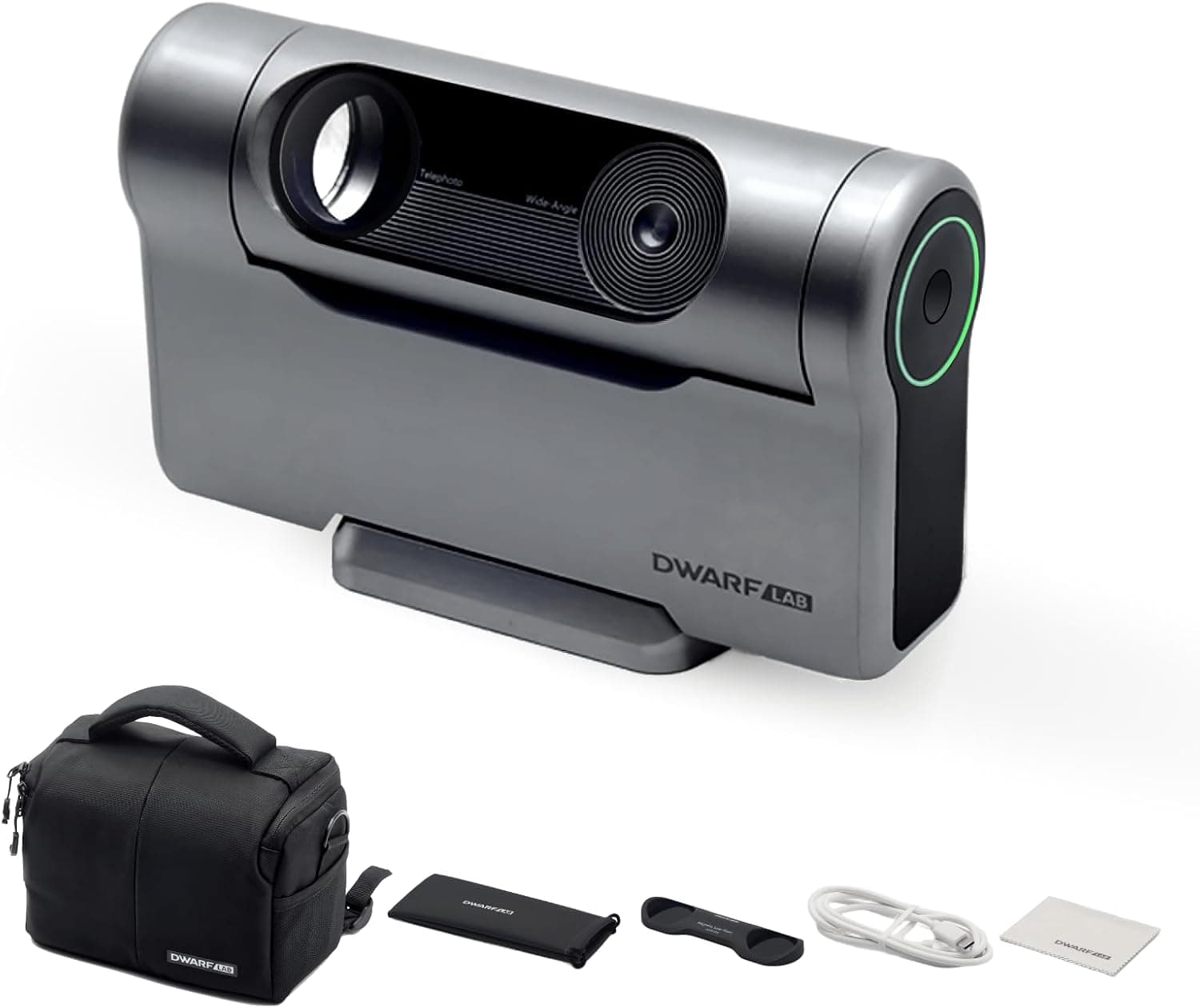
DWARFLAB DWARF 3Pocket-sized smart telescope with dual lenses, GoTo tracking, and live stacking for deep sky and daytime use
Full Specifications
| Spec | Value |
|---|---|
| Aperture | 24mm |
| Focal Length | 100mm |
| Focal Ratio | f/4.2 |
| Mount | Alt-Az (motorized) |
| GoTo | Yes |
| Tracking | Yes |
| Live Stacking | Yes |
| Weight | 1.3kg (2.9 lbs) |
| Connectivity | WiFi, Bluetooth |
| App | iOS, Android |
| Included | Telephoto lens, wide-angle lens, magnetic solar filter, tripod |
Score Breakdown
The DWARF 3 scores well across the beginner and astrophotography dimensions, which makes sense for a device designed to automate the entire imaging workflow. Here is how it breaks down.
Beginner (70/100): Setup is genuinely fast. The app walks you through alignment, and GoTo targeting means you never need to learn star-hopping. The learning curve is about 10 minutes.
Astrophotography (70/100): Live stacking, cloud-based processing, and RAW export give you a complete imaging pipeline. The automated workflow means your first night produces real results, not just frustration.
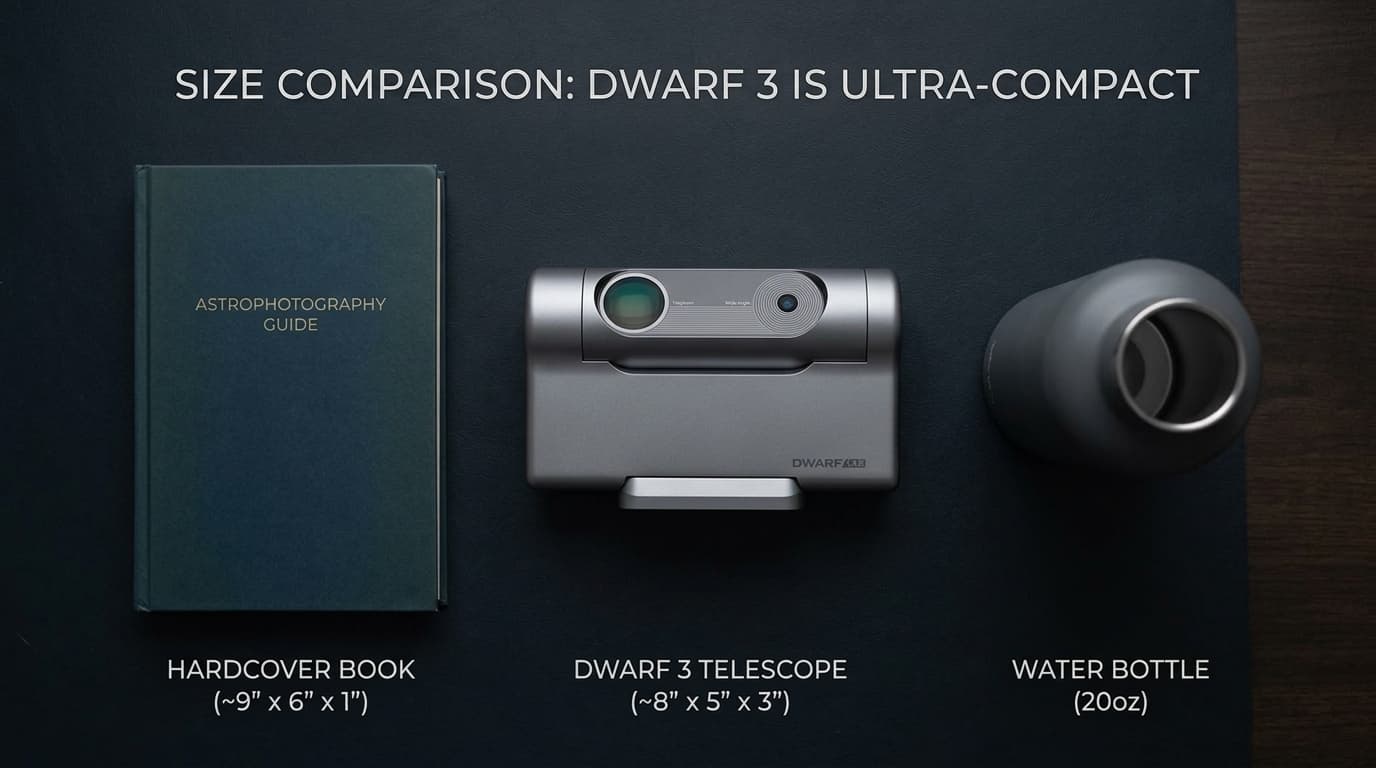
Portability (74/100): At 1.3kg and roughly the size of a coffee thermos, this is the most portable smart telescope on the market. It fits in a daypack with room to spare.
Value (68/100): Decent but not exceptional. The $549 price is competitive within the smart telescope category, but the 24mm aperture means you are paying primarily for convenience and the dual-lens system rather than raw optical capability.
Deep Sky (59/100): The 24mm aperture collects limited light, so faint targets like distant galaxies need long integration times and dark skies to produce detailed results. Bright targets like the Orion Nebula and Andromeda Galaxy look good.
Planetary (34/100): This is the DWARF 3's weakest dimension. The short focal length and small aperture cannot resolve planetary detail the way a traditional telescope can. You will see Jupiter and Saturn, but do not expect cloud bands or ring detail.
What Makes the DWARF 3 Unique: Dual Optics
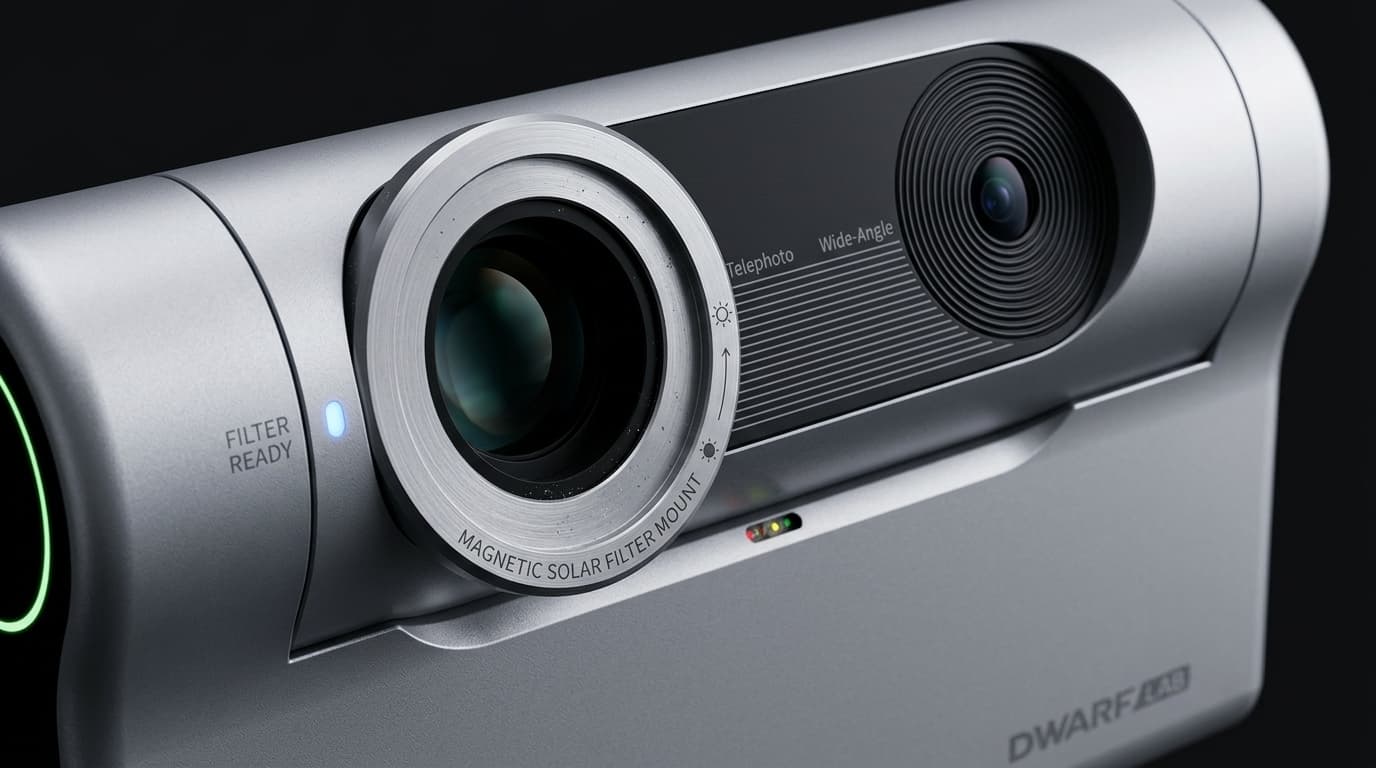
The DWARF 3's defining feature is its dual-lens system. Every other smart telescope in this price range gives you a single optical path. The DWARF 3 ships with two:
Telephoto lens (24mm, f/4.2, 100mm FL): This is the primary astrophotography optic. It handles nebulae, galaxies, star clusters, and basic planetary imaging through live stacking. Think of it as the "zoom" side.
Wide-angle lens: This second optic captures a much wider field of view, which is useful for Milky Way panoramas, star trail time-lapses, and constellation framing. No other smart telescope under $1,000 offers this.
In practice, the wide-angle lens adds genuine versatility. You can capture a detailed shot of the Orion Nebula with the telephoto, then switch to a Milky Way panorama without any hardware changes. For social media sharing and astrophotography that goes beyond deep-sky stacking, this is a real advantage.
The magnetic solar filter is another thoughtful inclusion. It snaps onto the telephoto lens and lets you safely image the Sun, including sunspots and solar prominences. Most competitors either do not support solar observation or sell the filter separately.
What Works Well
Setup speed. The DWARF 3 goes from box to first image in under five minutes. The DWARFLAB app handles plate-solving and alignment automatically. You place it on the included tripod, connect via WiFi, and tap your target.
Portability is unmatched. At 1.3kg, this is lighter than most water bottles. You can genuinely toss it in a backpack for a hike and set up at a dark-sky overlook without planning around it. The Seestar S50 weighs nearly twice as much.
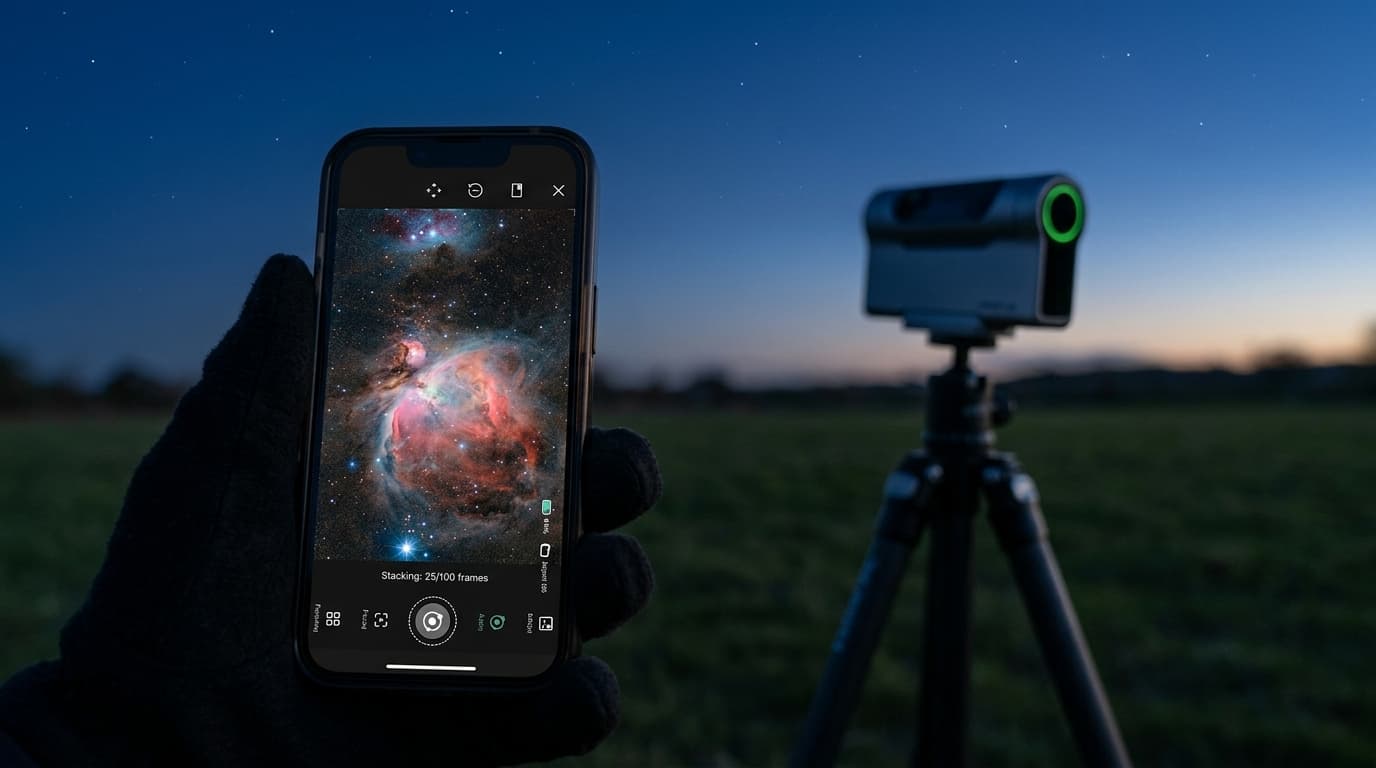
The app works. This sounds basic, but smart telescope apps vary wildly in quality. The DWARFLAB app is responsive, handles GoTo reliably, and the live stacking preview gives you real-time feedback on what your image will look like. Cloud-based processing means you can enhance results without dedicated software.
Dual-use capability. Beyond nighttime astronomy, the wide-angle lens handles daytime landscapes and wildlife observation. It is not replacing a dedicated birding scope, but it adds practical value that a single-lens smart telescope cannot offer.
Amazon reviews confirm this. With a 4.6-star rating across 131 reviews, the DWARF 3 has stronger user satisfaction than several competitors at higher price points.
What Falls Short
24mm aperture is limiting. This is the fundamental constraint. Light gathering scales with the square of the aperture, so the DWARF 3 collects roughly four times less light than the Seestar S50's 50mm lens. Faint targets like the Veil Nebula or dimmer galaxies need significantly more stacking time, and results from light-polluted locations will show more noise.
Planetary imaging is weak. If you want to see Saturn's rings or Jupiter's cloud bands, this is not the right tool. The 100mm focal length and 24mm aperture simply cannot resolve that level of detail. Planets will appear as bright dots with maybe a hint of color.
Price-to-aperture ratio. At $549, you are paying more per millimeter of aperture than almost any other telescope on the market. The value proposition depends entirely on how much you weight the dual-lens system, portability, and automation versus raw optical performance.
Cloud processing dependency. Some of the more advanced processing features route through DWARFLAB's cloud servers. This works well now, but it creates a long-term dependency on the company maintaining those services.
Real-World Performance
For bright deep-sky targets, the DWARF 3 delivers satisfying results. The Orion Nebula (M42) shows clear structure and color after 5-10 minutes of stacking. The Andromeda Galaxy (M31) fills a good portion of the frame and reveals its dust lanes under dark skies with 20-30 minutes of integration.
Star clusters like the Pleiades (M45) are a strong suit because they are bright and extended, playing to the telephoto lens's strengths without demanding extreme light-gathering power.
Where results drop off is with fainter, smaller targets. Galaxies in the Virgo Cluster or dim planetary nebulae require dark skies (Bortle 4 or better) and patience. From a suburban backyard (Bortle 6-7), you will hit the aperture ceiling faster than with a 50mm or larger system.
The wide-angle lens produces surprisingly good Milky Way shots, with enough resolution to see individual star fields and the galactic core structure on clear nights. Star trail mode works well too, and is something no other smart telescope in this class offers.
DWARF 3 vs Seestar S50
This is the comparison most buyers are making. Here is how they stack up:
| Spec | DWARF 3 | Seestar S50 |
|---|---|---|
| Price | $549 | $499 |
| Aperture | 24mm | 50mm |
| Focal Length | 100mm | 250mm |
| Weight | 1.3kg | 2.5kg |
| Lenses | Dual (tele + wide) | Single |
| Solar Filter | Included | Sold separately |
| Overall Score | 83 | 93 |
| Amazon Rating | 4.6 (131 reviews) | 4.5 (317 reviews) |
Choose the DWARF 3 if: portability is your top priority, you want the wide-angle lens for Milky Way shots, or you value the included solar filter.
Choose the Seestar S50 if: deep-sky image quality matters most. The 50mm aperture gathers over four times more light, which translates directly to better images of faint targets. At $50 less, it is hard to argue against on pure optical performance.
See our full comparison for a detailed side-by-side breakdown.
DWARF 3 vs Seestar S30
The Seestar S30 is ZWO's budget entry at $399, making it $150 cheaper than the DWARF 3; our Seestar S30 review has the full breakdown.
| Spec | DWARF 3 | Seestar S30 |
|---|---|---|
| Price | $549 | $349 |
| Aperture | 24mm | 30mm |
| Weight | 1.3kg | 1.65kg |
| Lenses | Dual | Dual (tele + wide) |
| Overall Score | 83 | 91 |
The S30 actually has slightly more aperture (30mm vs 24mm) at a significantly lower price. It also ships with two lenses now, which neutralizes what was previously the DWARF 3's unique advantage. The S30's higher overall score (91 vs 83) reflects its stronger value proposition.
The DWARF 3 wins on: slightly lighter weight (1.3kg vs 1.65kg), included magnetic solar filter, and arguably more refined build quality.
The S30 wins on: price ($200 less), aperture (30mm vs 24mm), and the broader ZWO ecosystem.
See our full comparison for more detail.
DWARF 3 vs DWARF II
If you are considering the older DWARF II at $339, the DWARF 3 offers meaningful upgrades: a newer sensor, improved app experience, better build quality, and the wide-angle lens. Both share the same 24mm aperture and f/4.2 focal ratio, so optical performance is similar. The $210 premium for the DWARF 3 is justified if you want the latest software features and dual-lens capability. If budget is tight, the DWARF II still produces solid results for $339.
Who Should Buy the DWARF 3
Buy it if you:
- Prioritize portability above all else (hiking, travel, backpacking to dark sites)
- Want a dual-lens system for both deep-sky stacking and wide-field Milky Way shots
- Need solar observation capability out of the box
- Value a fast, automated setup that works on the first night (great for beginners)
- Are comparing it specifically to the DWARF II and want the upgrade
Skip it if you:
- Want the best deep-sky image quality under $500 (the Seestar S50 wins here)
- Care about planetary viewing (the 24mm aperture cannot resolve meaningful detail)
- Are on a tight budget (the Seestar S30 offers more for less)
- Prefer traditional visual observing through an eyepiece (smart telescopes are screen-only)
The DWARF 3 is best for travelers and hikers who want a smart telescope that disappears into a backpack.
