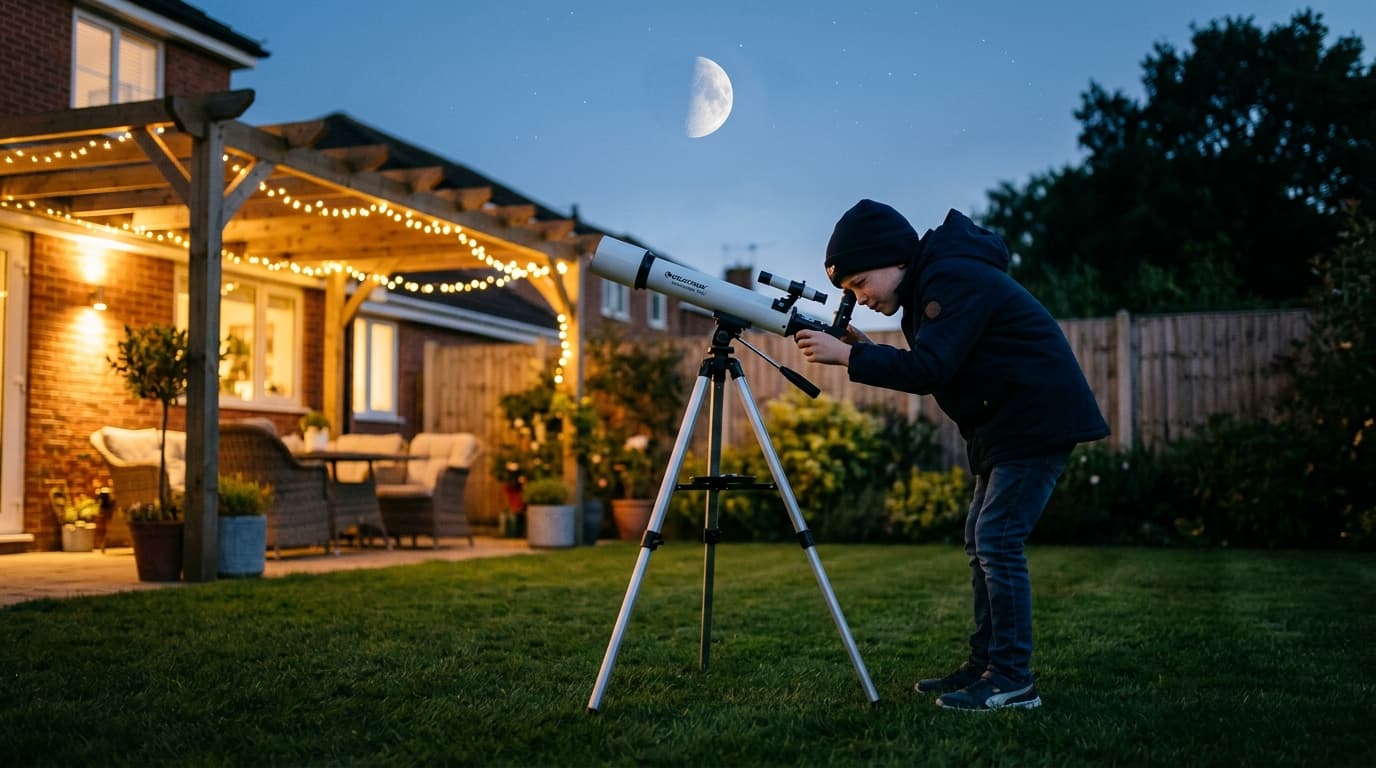

The right first telescope keeps a kid engaged; the wrong one collects dust in a closet within two months. For ages 6-8, the Celestron Travel Scope 70 at $89.99 is lightweight, simple, and backed by well over fourteen thousand reviews. For ages 9-12, the Celestron StarSense Explorer LT 80AZ uses a phone app to guide kids to targets on an honest 80mm refractor. For teens ready to get serious, the Sky-Watcher Virtuoso GTi 150P has full GoTo that finds and tracks objects on its own, on 150mm of real aperture.
Two picks that used to headline the tween and teen sections, the StarSense Explorer LT 114AZ and the Celestron 114LCM, are gone. Both are Bird-Jones designs, a fast spherical mirror with a Barlow lens hidden in the focuser, and our scoring engine now accounts for that. What to Avoid explains how to spot one, because they are the most common brand-name telescopes at exactly the prices parents shop at.
We scored every telescope across 7 dimensions, including beginner-friendliness, value, and portability. The picks below are organized by age group, with weight limits and setup complexity matched to what each age can handle.
Quick Picks by Age
| Age Range | Telescope | Price | Why This One |
|---|---|---|---|
| 6-8 | Celestron Travel Scope 70 | $89.99 | 1.91kg, fits in a backpack, 14,700+ reviews |
| 6-8 | Gskyer 70AZ | $85.49 | 21,800+ reviews, 4.3-star average |
| 9-12 | StarSense Explorer LT 80AZ | $199.99 | App-guided finding on an 80mm refractor, 4.17kg |
| 9-12 | Celestron Travel Scope 80 | $149.95 | Portable upgrade, 80mm refractor, 2.04kg |
| 9-12 | Celestron AstroMaster 102AZ | $252.52 | Most aperture in a refractor under $300 |
| 13+ | Sky-Watcher Virtuoso GTi 150P | $402.31 | GoTo finds objects for you, 150mm aperture |
| 13+ | StarSense Explorer DX 130AZ | $499.95 | Parabolic 130mm with app guidance |
| 13+ | Sky-Watcher Heritage 150P | $309 | Most aperture per dollar, 4.6-star rating |
| Tech teen | DWARFLAB DWARF 3 | $549 | Smart telescope with live stacking, 1.3kg |
What to Look for in a Kids' Telescope
A telescope for a child is not just a scaled-down adult scope. The factors that determine whether a kid sticks with astronomy are different from what matters to an experienced observer. For a broader overview of telescope designs, see our types of telescopes guide.
Weight and Size
If a child cannot carry the telescope outside on their own, they will not use it. For ages 6-8, stay under 2.5kg. For ages 9-12, under 5kg is comfortable and 6kg is the practical limit. Teens can handle 6-10kg on a tripod; a tabletop Dobsonian can weigh a little more because it is carried in one piece and set down on a table rather than balanced on legs. Anything heavier becomes a chore that requires a parent's help every time.
Setup Time
A 6-year-old loses interest after about 3 minutes of assembly. An 8-year-old gives you 5. A teenager tolerates 10-15 minutes if they know something worth seeing is coming. Alt-azimuth mounts (point and look, like a camera tripod) set up in 2-3 minutes. GoTo mounts need 5-10 minutes for alignment. Equatorial mounts take 15-20 minutes and are best avoided for kids under 14.
GoTo vs Manual
For ages 6-8, skip GoTo entirely. Young kids are engaged by the Moon and bright planets, which are easy to find by pointing. The added setup complexity of GoTo alignment frustrates them before they ever look through the eyepiece. For ages 9-12, app-guided options like the StarSense Explorer line offer a middle ground: the app shows where to point, but the child moves the telescope manually. For teens 13+, GoTo is worth the investment because it opens up hundreds of fainter objects they cannot find on their own.
The Mirror, Not Just the Aperture
Bigger numbers on the box are not always better optics inside it. A reflector's mirror should be parabolic. Several of the most popular brand-name kids' telescopes, all 114mm Celestron models with a "1000mm" focal length in a tube shorter than your arm, use a spherical mirror with a Barlow lens hidden in the focuser to fake that focal length. The result rarely focuses as sharply as a proper Newtonian and is harder to collimate. Refractors sidestep the issue entirely, which is one more reason they suit younger kids; for reflectors, look for "parabolic" on the manufacturer's spec sheet.
Durability
Kids bump things. They grab the eyepiece. They knock the tripod. Refractors are more durable than reflectors because the sealed tube protects the optics. Reflectors have exposed mirrors that can go out of alignment from a bump. For younger kids, a sealed refractor design is the safer choice.
Included Eyepieces
More eyepieces mean more magnification options to experiment with. Most kid-friendly scopes include 2-3 eyepieces. Check whether a Barlow lens (which doubles the magnification of any eyepiece) is included, as this effectively doubles the eyepiece count. Use our eyepiece calculator to see what magnification each eyepiece delivers with a given telescope.
Best for Ages 6-8 (Around $100)
At this age, simplicity wins. The goal is to get the Moon in the eyepiece within 5 minutes of going outside. Both picks here are 70mm refractors on alt-azimuth mounts, meaning zero alignment, zero electronics, and lightweight enough for a child to carry. For more sub-$100 options, see our best telescopes for beginners guide.
1. Celestron Travel Scope 70: Best Overall for Young Kids
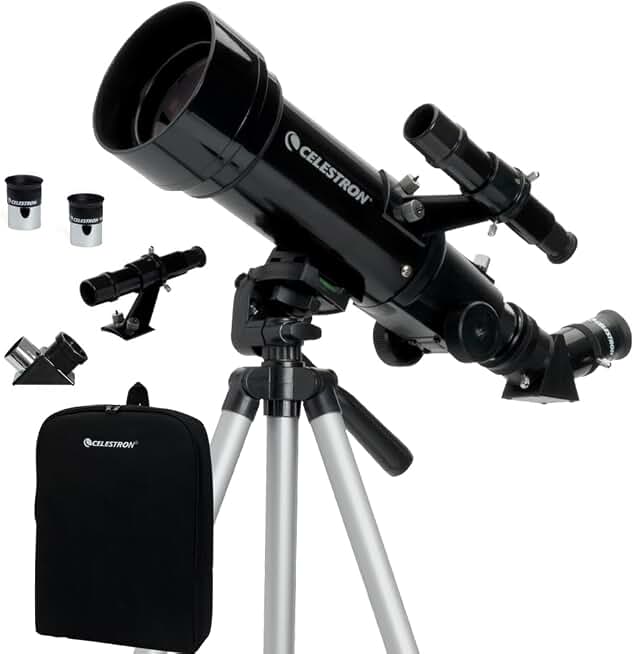
A capable 70mm grab-and-go refractor that earns its place in any beginner's kit without breaking the bank.
The Travel Scope 70 is one of the most-reviewed telescopes in our database, with well over fourteen thousand Amazon reviews at a 4.2-star average. That volume of feedback tells you something: this scope works, it ships complete, and most buyers are satisfied. At $89.99, it costs about the same as a mid-size LEGO set a 7-year-old would ask for.
The 70mm f/5.7 achromatic refractor shows the Moon's craters in sharp detail, Saturn's rings as a small but distinct oval, and Jupiter's two main cloud bands with 4 visible moons. The included 20mm and 10mm eyepieces give 20x and 40x magnification, which is the right range for a child who is still learning to aim.
The entire package weighs 1.91kg and fits into the included backpack. That portability matters. A child can bring this on camping trips, to grandma's house, or out to the backyard on their own. Setup is trivial: extend the tripod legs, slide the tube onto the mount, insert an eyepiece. A 6-year-old can do it with minimal help.
Its value score is among the highest in our catalog, and it also appears in our best telescopes under $200 guide.
The tradeoff: 70mm of aperture is physically limited. Faint nebulae and galaxies will be invisible. The tripod is lightweight and wobbles at higher magnification. If your child gets hooked, they will outgrow this scope within a year.
The most-reviewed beginner scope on Amazon. Under 2kg, under $100.
2. Gskyer 70AZ: Most Popular Pick
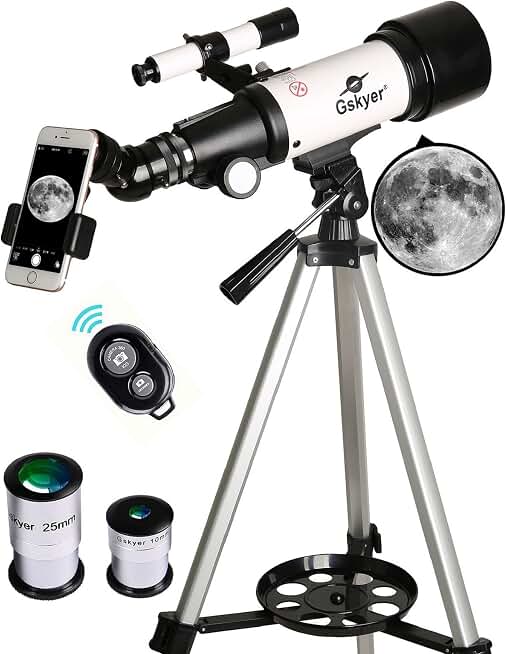
Gskyer
Gskyer 70AZA capable 70mm refractor that punches above its price for beginners ready to explore the night sky.
The Gskyer 70AZ is the most-reviewed telescope in this age category, with over 21,800 Amazon reviews at 4.3 stars. That is the higher rating of the two 6-8 age group picks. The 70mm f/5.7 optics match the Celestron Travel Scope 70 spec for spec, and the included eyepieces and Barlow lens give a useful magnification range from about 14x to 114x.
At 2.59kg, the Gskyer is heavier than the Travel Scope 70, but still within the range a 7-year-old can manage. The aluminum tripod is more stable than many sub-$100 competitors, reducing the wobble that frustrates kids when they are trying to keep the Moon centered.
Who it is for: Parents who want proven reliability backed by the largest review count and highest rating in this price range.
The tradeoff: At 2.59kg it is the heaviest of the 6-8 picks, and the longer tube makes it the least backpack-friendly. You are paying for a steadier tripod and accessories rather than better optics, which matters most if the child sticks with it.
21,800+ reviews, 4.3 stars. Proven reliability for under $100.
Best for Ages 9-12 (Under $300)
By age 9, kids can handle slightly more complex gear and have the patience to spend 10-15 minutes learning how a telescope works. This is the age where upgrading from 70mm to 80-102mm makes a visible difference: more detail on planets, star clusters that resolve into individual stars, and the Orion Nebula showing real structure instead of a faint smudge. All three picks here are refractors, which is deliberate: nothing to collimate, nothing to knock out of alignment, and no mirror to check.
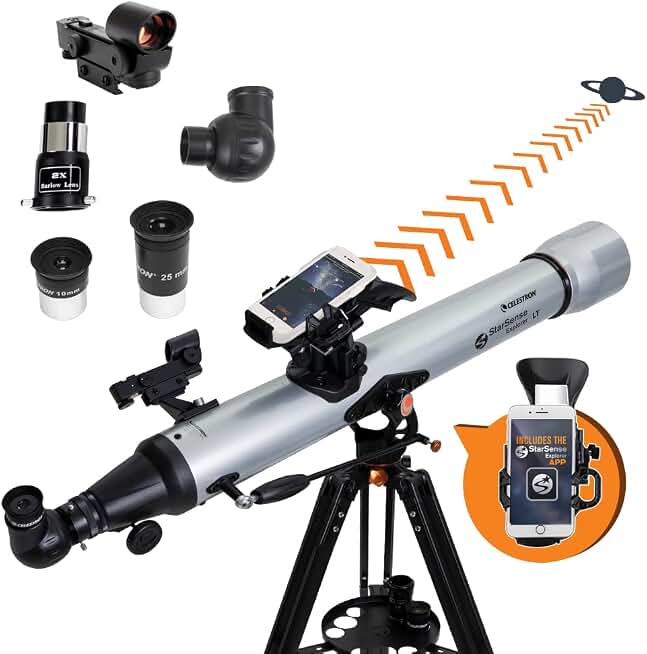
1. Celestron StarSense Explorer LT 80AZ: Best Overall for Tweens
Celestron
Celestron StarSense Explorer LT 80AZCelestron's StarSense Explorer LT 80AZ: smartphone-guided starfinding that actually works, in a capable 80mm refractor.
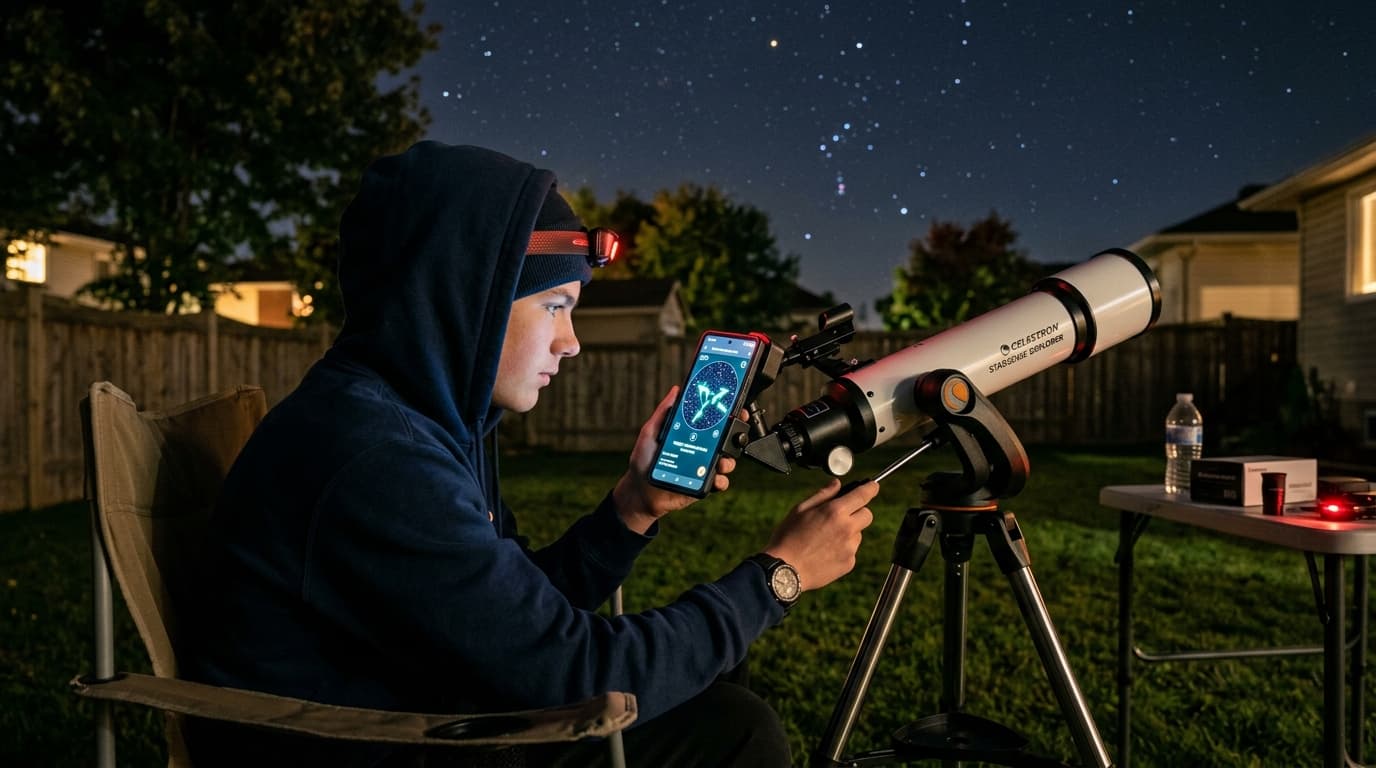
The StarSense Explorer system is Celestron's solution to the biggest frustration in kid astronomy: "I can see the Moon, but I cannot find anything else." Dock a smartphone, and the app uses its camera to solve the sky in real time, showing exactly where the telescope points and drawing on-screen arrows to any target. It is not GoTo, the child moves the telescope, but it solves the finding problem that causes most kids to give up. We recommend it on the LT 80AZ rather than the better-known LT 114AZ because the 80AZ is a straightforward 80mm f/11.3 achromatic refractor with nothing hidden in the focuser, while the 114AZ is a Bird-Jones (see What to Avoid).
The long 900mm focal length makes it a Moon-and-planets scope first, which is exactly what a 10-year-old wants to look at: Saturn's rings, Jupiter's belts and moons, lunar craters, double stars. At 4.17kg the whole setup is within a tween's carrying range, and the sealed refractor tube survives being knocked. 566 Amazon reviews averaging 4.3 stars.
Who it is for: Kids 9-12 who have shown enough interest to warrant a real upgrade, and who already have a smartphone they can dock. Also works well as a family telescope where parents and kids explore together.
The tradeoff: 80mm is modest aperture and the slow focal ratio gives a narrow field, so large clusters will not frame well and faint deep-sky targets are out of reach. No motorized tracking, so objects drift through the eyepiece at higher magnification. Your child needs a compatible smartphone.
Phone-guided finding on an honest 80mm refractor. The best upgrade for a curious tween.
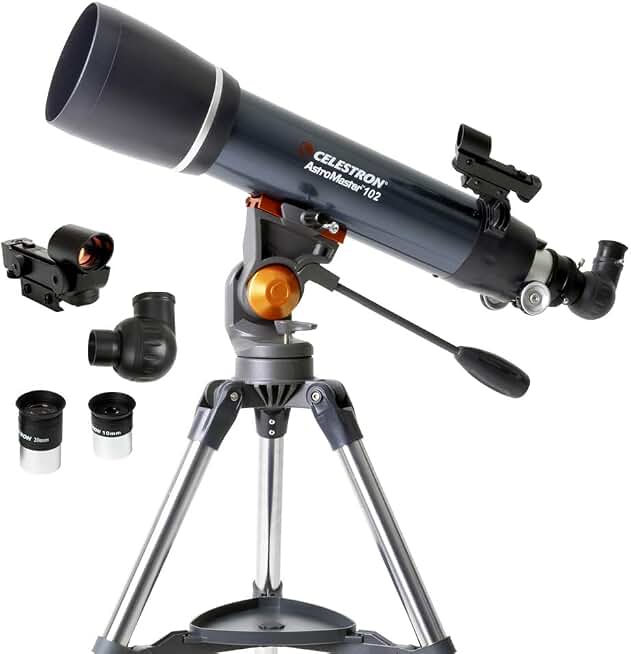
2. Celestron AstroMaster 102AZ: Most Aperture Without a Mirror
Celestron
Celestron AstroMaster 102AZA capable 102mm refractor that gets you outside and observing on your first night out
If your tween does not have a phone to dock, or you would rather they learned the sky the old way, the AstroMaster 102AZ is the most optical capability you can put in a refractor under $300. A 102mm (4-inch) achromat at 660mm focal length (f/6.5), it gathers more than twice the light of the 70mm scopes in the younger section and resolves visibly more detail on Jupiter's belts, Saturn's rings, and the Moon. The included 20mm and 10mm eyepieces give 33x and 66x according to Celestron's spec sheet, and the built-in red-dot finder is easy for a kid to align.
At 5.84kg it sits at the top of the weight range for this age; a 9-year-old will want a parent to carry the tripod, a 12-year-old will manage alone. 351 Amazon reviews averaging 4.3 stars. It is our top pick in the under $300 guide.
Who it is for: Tweens with real interest and a parent who will help on the first few nights, families who want one telescope everyone can use.
The tradeoff: No finding aid beyond the red dot, so a free phone app like Stellarium becomes the star chart. Achromatic optics show some violet fringing on the Moon's limb at high power, which is normal at this price.
102mm of refractor aperture, nothing to collimate, under $300.
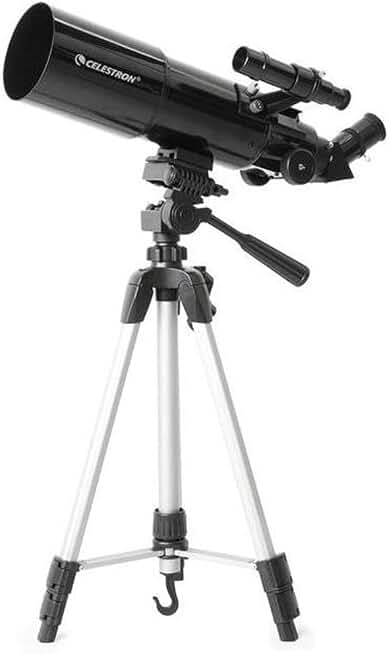
3. Celestron Travel Scope 80: Best Portable Upgrade
Celestron
Celestron Travel Scope 80Portable 80mm refractor that goes where you go, without sacrificing the views that matter most
The Travel Scope 80 takes the same grab-and-go philosophy as the Travel Scope 70 and adds 14 percent more aperture, which is about 30 percent more light. The 80mm f/5 achromatic refractor delivers brighter images and slightly sharper detail on everything from Moon craters to Jupiter's bands. At $149.95, the price bump over the 70mm version is modest.
The refractor design is sealed and maintenance-free, which matters for a scope that a 10-year-old is carrying in and out of the house. No collimation, no exposed mirrors, no alignment worries. At 2.04kg, it is still light enough for a child to handle independently, and it fits in a carry bag for travel.
Over 1,700 Amazon reviews at 4.2 stars. If your child enjoyed a 70mm scope and is ready for a step up without the complexity of a reflector, this is the natural progression.
Who it is for: Kids who have outgrown a 70mm scope or families who want a portable telescope for vacations and camping trips that also performs well in the backyard.
The tradeoff: 80mm is still a modest aperture. Deep sky objects remain limited. The alt-az mount is basic, with no tracking or GoTo capability. For a child ready for a bigger jump in capability, the AstroMaster 102AZ above offers more.
Portable 80mm refractor. The natural step up from a 70mm scope.
Best for Ages 13+ (Under $500)
Teenagers are ready for real telescopes. They can handle 10-15 minutes of setup, they can learn alignment procedures, and they have the patience to track objects across the sky. These picks offer genuine optical capability and room to grow into the hobby over several years. For more options at this price point, see our best telescopes under $500 guide.
1. Sky-Watcher Virtuoso GTi 150P: Best GoTo for Teens
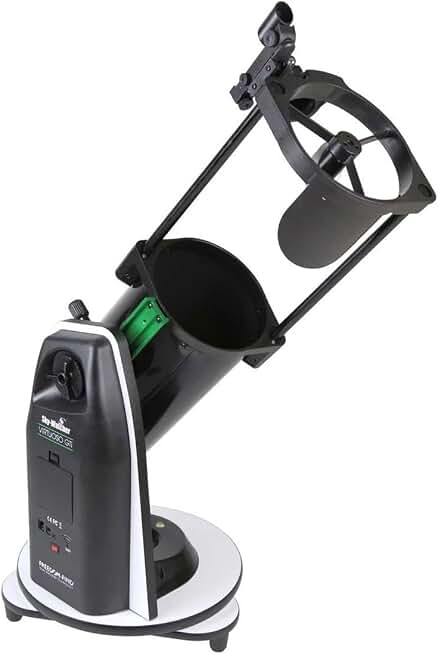
Sky-Watcher
Sky-Watcher Virtuoso GTi 150PGoTo Dobsonian power in a tabletop package, with Wi-Fi control and the freedom to push around manually.
For a teenager, GoTo changes everything. Instead of squinting at star charts trying to find the Ring Nebula, they pick it in an app and the telescope slews to it. The Virtuoso GTi 150P is the GoTo telescope we recommend because it pairs that convenience with 150mm of aperture, the same 150mm f/5 collapsible optical tube format as the Heritage 150P, on a motorized tabletop Dobsonian base with built-in WiFi. Align using one of four methods in the free SynScan Pro app, choose from more than 10,000 objects, and it finds and tracks them. Sky-Watcher's Freedom Find dual encoders let a teen push the tube by hand to sweep the Milky Way without losing alignment.
150mm gathers about 75 percent more light than the 114mm GoTo scope that used to hold this slot, enough for globular clusters to start resolving into stars and for galaxies to show shape rather than smudge. 52 Amazon reviews averaging 4.2 stars is a small sample; Sky-Watcher's Heritage and Virtuoso lines have long track records in the community.
Who it is for: Teens 13+ who want to explore beyond the Moon and bright planets. GoTo removes the biggest barrier to deep-sky observing, opening up hundreds of objects that are nearly impossible to find manually with a small scope.
The tradeoff: At 11.7kg it is the heaviest scope in this guide, though it is carried in one piece and set on a table rather than balanced on a tripod. Runs on 8 AA batteries or an external 12V supply that is not included. The SynScan app takes an evening to learn. It tracks in alt-azimuth, so it is not an astrophotography platform beyond the Moon and planets.
GoTo on 150mm of honest aperture. The best way to unlock the deep sky for a teenager.
2. Celestron StarSense Explorer DX 130AZ: Best Optics with App Guidance
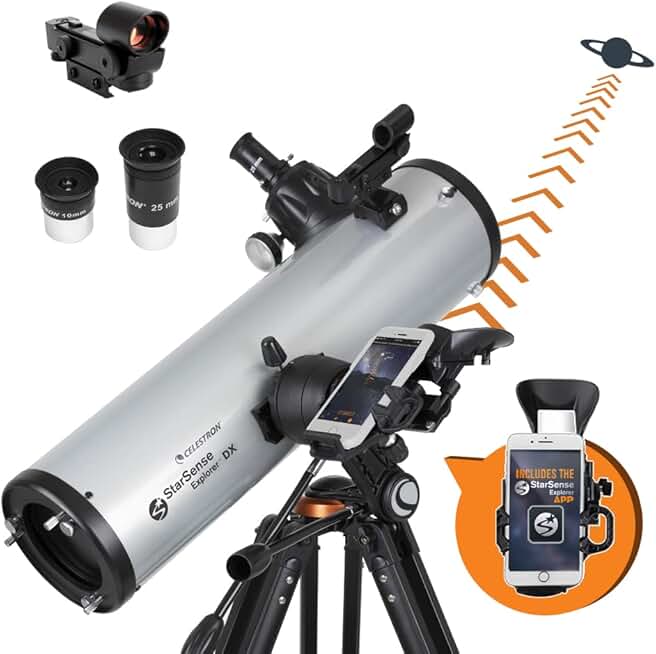
Smart phone-powered star finding meets a capable 130mm reflector, making the night sky genuinely accessible for beginners.
The DX 130AZ is the StarSense Explorer scope we recommend without an asterisk. Celestron's spec sheet lists a parabolic primary mirror: 130mm at f/5 with a 650mm focal length in a 635mm tube, a real Newtonian with the right mirror. The 130mm aperture collects about 30 percent more light than the 114mm StarSense model it replaces in this guide, which translates to brighter views of nebulae and galaxies and finer detail on planets, and it does so on a mirror that can actually deliver it. The f/5 focal ratio gives wide fields of view, making sweeps through the Milky Way genuinely rewarding.
The StarSense app guidance works identically to the LT model: dock your phone, and it shows where the scope points with arrows directing you to any target. For a teenager, this teaches sky navigation in a way that GoTo does not. They learn the constellations and the spatial relationships between objects while the app ensures they actually find what they are looking for. At $499.95 with 1,550 Amazon reviews at 4.1 stars. At 8.16kg it needs care with the larger tube during setup.
Who it is for: Teens who want the best optics in this price range and prefer learning to navigate the sky over pressing a button.
The tradeoff: No motorized tracking. Objects drift through the eyepiece, requiring manual nudges every 30-60 seconds at higher magnification. Newtonians need occasional collimation. At 8.16kg it needs a sturdy surface and is not truly grab-and-go.
A parabolic 130mm with app guidance. Serious optics for a growing astronomer.
3. Sky-Watcher Heritage 150P: Most Aperture per Dollar
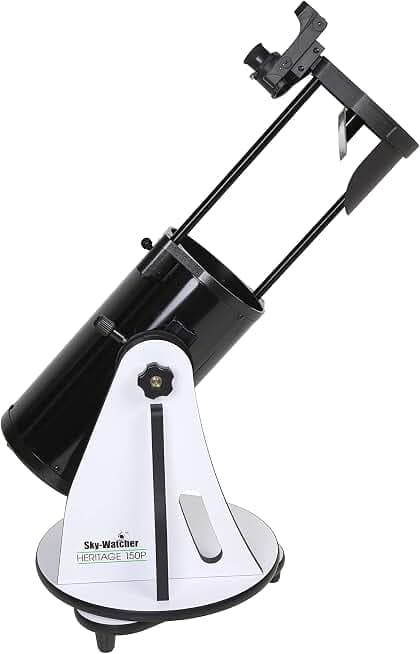
Sky-Watcher
Sky-Watcher Heritage 150PBig views, compact package: the Heritage 150P brings serious aperture to a tabletop Dobsonian under $400.
The Heritage 150P puts 150mm (6 inches) of parabolic-mirror aperture on a tabletop Dobsonian mount for $309. That is as much light-gathering as the GTi without the motors, and the optical difference over a 100mm scope is substantial. The Orion Nebula shows wispy structure and a hint of its fan shape. The Andromeda Galaxy extends beyond a fuzzy dot into an elongated glow. Globular clusters like M13 begin to resolve into individual stars at the edges.
The Dobsonian mount is the simplest design in astronomy: a box that rotates in two axes. Set it on a sturdy table, push it to aim, look through the eyepiece. No alignment procedure, no electronics, no batteries. The collapsible tube design makes it compact for storage. At 9.34kg it sits on a table rather than a tripod, so there is no stability issue.
Amazon reviewers give it 4.6 stars across 74 reviews, the highest rating of any traditional scope in this article. For a teenager with genuine interest, this scope has years of capability ahead. It also appears in our best telescopes for beginners guide. For a deeper look at how reflectors compare to refractors, see our reflector vs refractor guide.
Who it is for: Teens who prioritize optical quality and do not mind learning basic star-hopping. This is the scope for the kid who reads about astronomy, watches YouTube videos about deep sky objects, and wants to see them for real.
The tradeoff: No GoTo, no app guidance, no tracking. The Newtonian design requires occasional collimation (mirror alignment), which sounds intimidating but takes about 5 minutes with a laser collimator. The 9.34kg weight and need for a sturdy table limit portability.
150mm parabolic Dobsonian. The most aperture per dollar in this guide.
Smart Telescope for Tech-Savvy Teens
DWARFLAB DWARF 3: Astronomy on a Phone Screen
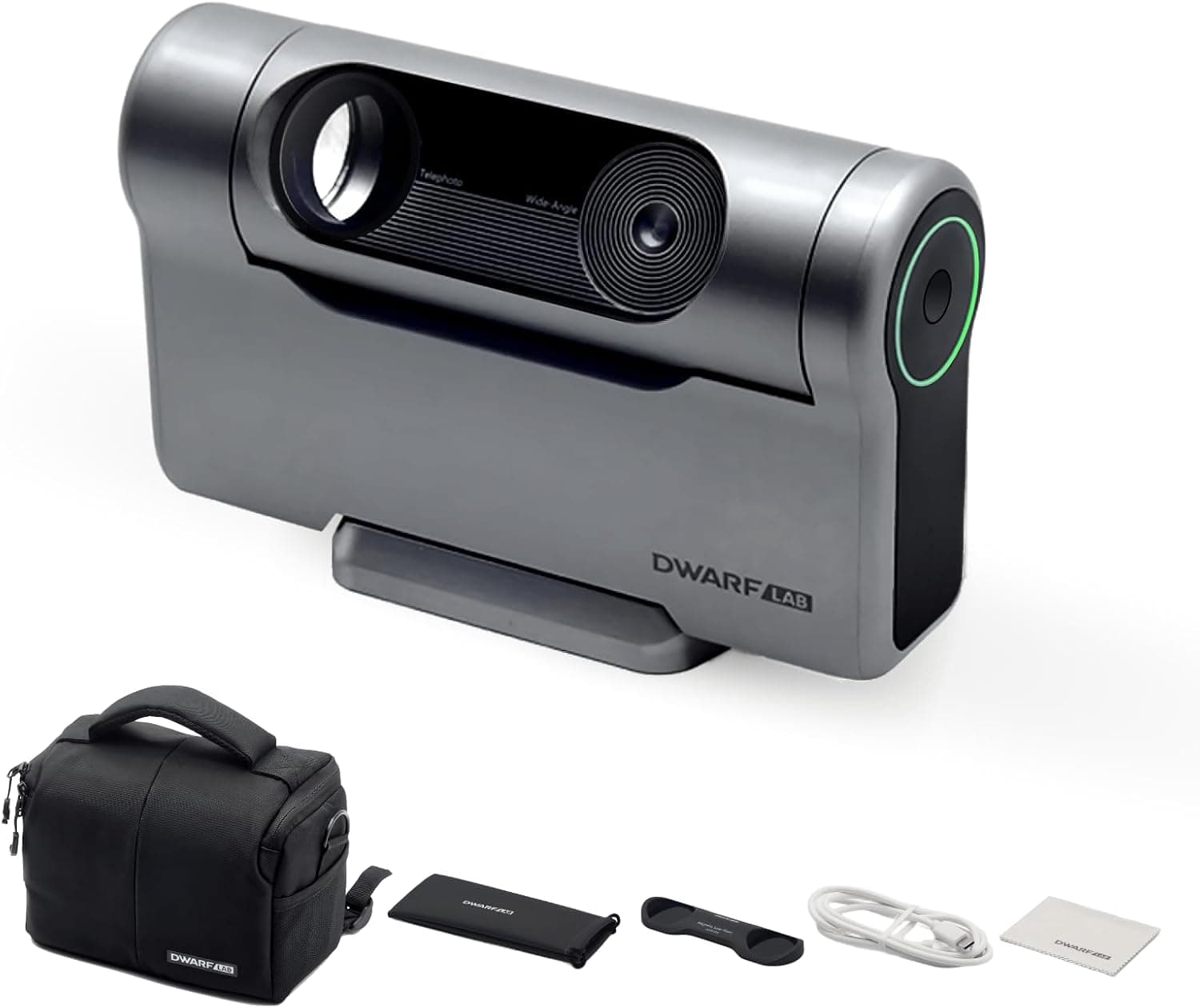
DWARFLAB
DWARFLAB DWARF 3Pocket-sized smart telescope with dual lenses, GoTo tracking, and live stacking for deep sky and daytime use
Some teenagers would rather interact with a screen than squint through an eyepiece, and that is a legitimate way to do astronomy. The DWARFLAB DWARF 3 is a fully automated smart telescope that handles alignment, tracking, and live stacking through a smartphone app. Point it at the sky, tap a target, and within minutes there is a color image of a nebula or galaxy on the phone. No star charts, no manual finding, no learning curve. It pairs a telephoto lens with a wide-angle one, so it also shoots the Milky Way and, with the included filter, the Sun.
At $549 and 1.3kg, it is the lightest telescope in this entire guide. It scores 83 overall in our database with 139 Amazon reviews at 4.6 stars. Read our DWARF 3 review for the full assessment. The ZWO Seestar S30 and S50 are the other smart scopes we would recommend at this price, and score higher, but both have been out of stock on Amazon for months.
The results are inherently shareable: every observation produces an image your teen can save, post, or send to friends. For a generation raised on screens, this approach feels natural rather than alien.
Who it is for: Tech-oriented teens who want to explore the night sky through their phone. Also a strong option for kids with glasses or vision issues that make eyepiece viewing uncomfortable.
The tradeoff: The aperture is tiny by telescope standards. Live stacking compensates by combining many short exposures, but you are looking at processed images, not direct light. There is no eyepiece, so the traditional "looking through a telescope" experience is absent. Battery life is a factor; traditional scopes use no power.
Smart telescope, 1.3kg, 4.6 stars. Astronomy for the screen generation.
First Night Observation Plan
The single most important thing you can do to keep a child engaged with a new telescope is make the first night a success. Here is a plan that works with every telescope in this guide, starting with the easiest targets and building to the most rewarding.
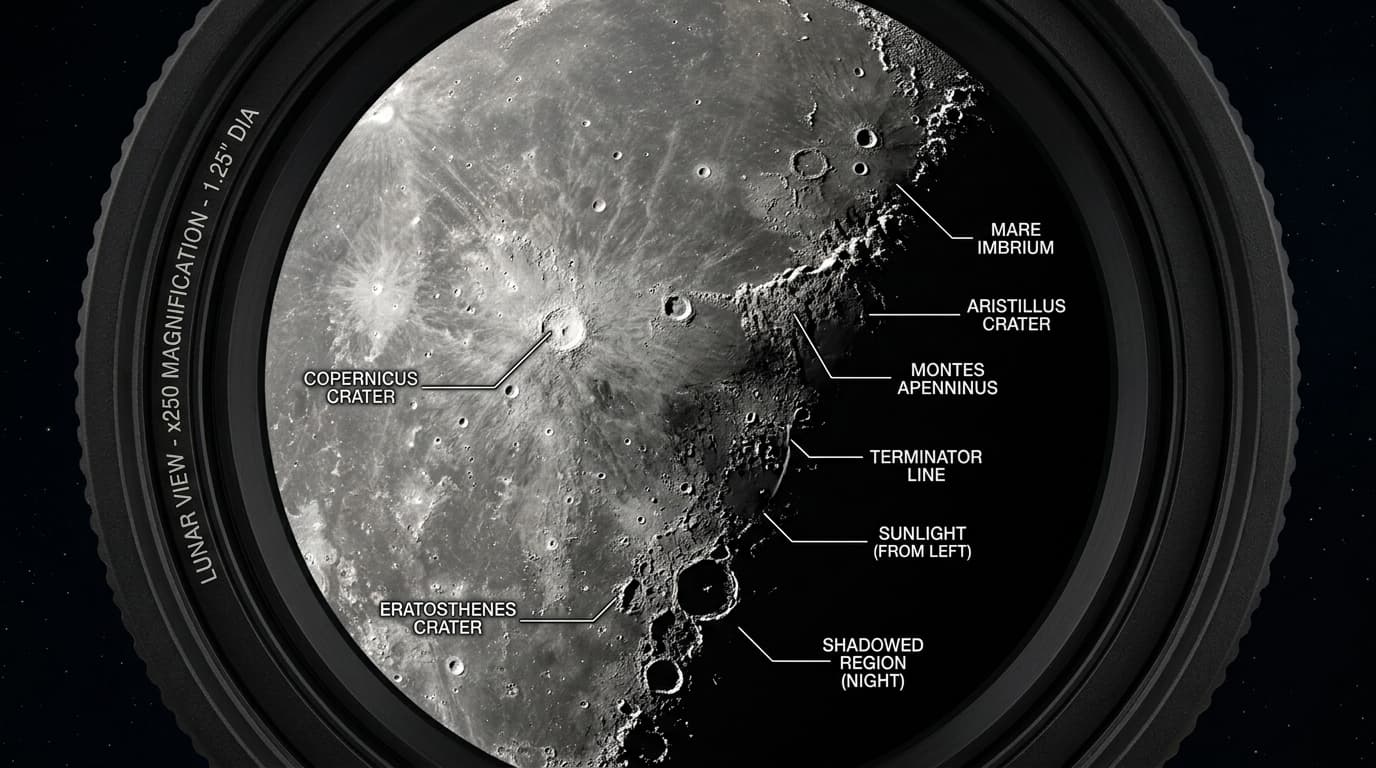
1. The Moon
Start here, every time. The Moon is bright enough to find without any skill, and the view through even a $100 telescope is genuinely striking. Focus on the terminator, the line between the lit and dark portions of the Moon. Craters along the terminator cast long shadows that create a three-dimensional effect visible in any telescope. A half-Moon (first or third quarter) shows more crater detail than a full Moon because the shadows are longer.
2. Jupiter
Jupiter is the brightest "star" in the evening sky for most of the year. Even a 70mm scope at 40-50x shows the disk shape, the two main equatorial cloud bands, and up to 4 bright moons (the Galilean moons: Io, Europa, Ganymede, and Callisto). The moons change position nightly, which gives kids a reason to come back and look again.
3. Saturn
Saturn's rings are visible in any telescope at 30x or higher. In a 70mm scope, they appear as a small but distinct oval. In a 100mm or larger scope at 100x, the gap between the rings and the globe becomes clear. Saturn is the target that makes kids say "I can actually see it." No other object in the sky delivers that same sense of wonder through a small telescope.
4. The Orion Nebula (Winter) or the Pleiades (Fall/Winter)
For a first deep sky object, the Orion Nebula (M42) is the easiest target in winter skies. It is visible to the naked eye as a fuzzy "star" in Orion's sword, and through a telescope it reveals a glowing cloud of gas with a cluster of young stars at its center. In autumn and winter, try the Pleiades (M45), a cluster of bright blue stars that fits beautifully in a wide-field eyepiece. Both targets work in every telescope on this list.
What to Avoid
Bird-Jones Reflectors With a Famous Name on the Box
The most common brand-name telescopes at kid-gift prices are the ones to avoid. The Celestron PowerSeeker 127EQ, AstroMaster 114EQ, StarSense Explorer LT 114AZ and 114LCM all advertise a 1000mm focal length in a tube of 40-60cm. Celestron's own spec sheets describe each as "Spherical Primary Mirror," and its knowledgebase explains where the missing length comes from: a Barlow lens built into the focuser. Hands-on reviewers who have taken these designs apart report that the image never focuses quite sharply and that collimating means removing the corrector first, and the PowerSeeker has its own dedicated warning subreddit, r/dontbuyapowerseeker. Two of these used to be picks in this guide; our scoring engine now accounts for the design and we no longer recommend any of them for a child.
Toy Store Telescopes
Any telescope under $40 from a brand you have never heard of is almost certainly a waste of money. The optics produce blurry images, the tripods wobble at the slightest touch, and the advertised magnification numbers (300x, 525x, 675x) are physically impossible with the included aperture. These scopes are the single biggest reason children decide they "do not like telescopes." Spend around $90 on one of the 70mm scopes above instead.
Scopes Over 10kg for Kids Under 12
A telescope that requires adult help to set up every single time becomes the parent's telescope, not the child's. Kids under 12 should be able to carry, set up, and operate their scope with minimal assistance. That means staying around 2.5kg for ages 6-8 and under about 6kg for ages 9-12. Every telescope in our age-appropriate sections above meets those limits, with the Gskyer 70AZ a hair over at 2.59kg.
Complex Equatorial Mounts for Beginners
Equatorial mounts align with the Earth's rotation axis, which is useful for tracking and astrophotography. They also require polar alignment, counterbalancing, and an understanding of right ascension and declination. For a child under 14, this is more complexity than benefit. Alt-azimuth mounts (up-down, left-right) and Dobsonian mounts (push and look) are intuitive for any age. Save the equatorial mount for when the kid asks for one. For a detailed comparison of mount types, see our types of telescopes guide.
