

For under $200 in 2026, the honest answer is a good small refractor. The Celestron Travel Scope 80 at $149.95 gets you 80mm of aperture, a two-kilogram package that fits in the included backpack, and a review history in the thousands. It shows you the Moon in detail, Saturn's rings, Jupiter's moons and belts, and the brighter clusters, which is the realistic ceiling at this price.
Under-$200 is the most crowded and most misleading price tier in astronomy retail, and not only because of the generic "Telescope for Adults & Kids" listings. The two brand-name reflectors that dominate it on Amazon, the Celestron PowerSeeker 127EQ and AstroMaster 114EQ, used to sit at the top of this guide. They are gone, and the reason is worth two minutes of your time (see Red Flags below). If your budget can bend at all, the Sky-Watcher Heritage 130P at about $270 is a different class of telescope from anything on this list.
Quick Picks
| Telescope | Best For | Overall Score | Price |
|---|---|---|---|
| Celestron Travel Scope 80 | Best overall | 69 | $149.95 |
| Celestron AstroMaster 70AZ | Best for the Moon and planets | 67 | $151.90 |
| Celestron Travel Scope 70 | Best for kids and travel | 69 | $89.99 |
| Gskyer 70AZ | Most-reviewed budget brand | 69 | $85.49 |
How We Chose These
Every telescope in our database is scored across 7 dimensions. For this guide we filtered to active products under $200 that are actually in stock, then prioritized recognized brands over generic Amazon listings even when the latter scored higher on raw value. Department-store telescopes can rate well on price-to-aperture math while still being miserable to actually use.
Two things changed since this guide was first written. Our scoring engine now accounts for optical execution: whether a reflector's mirror is parabolic or spherical, and whether a "long focal length" is real or manufactured by a Barlow lens hidden in the focuser. That change is what moved the PowerSeeker 127EQ and AstroMaster 114EQ off this list. And our previous top pick, the National Geographic Explorer 114mm, has been unavailable on Amazon for months; it stays in the catalogue but not in a list of things you can buy today.
For the brackets around this one, see the under $300 guide and the under $1,000 guide.
Prices and scores come directly from our database; prices reflect current Amazon listings and update daily.
Our Top Picks
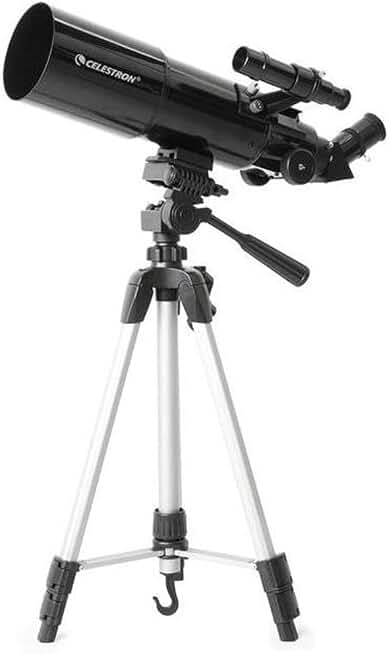
1. Celestron Travel Scope 80: Best Overall Under $200
Celestron
Celestron Travel Scope 80Portable 80mm refractor that goes where you go, without sacrificing the views that matter most
The Travel Scope 80 is the same travel-friendly concept as Celestron's famous Travel Scope 70 with one important upgrade: 80mm of aperture instead of 70mm. That extra 10mm collects roughly 30 percent more light, which is the difference between Saturn's rings being "there" and being obvious. At 400mm focal length (f/5) the field of view is wide and forgiving, so finding things by eye is easy, and the included eyepieces cover the Moon, planets and clusters without buying anything else on day one.
The full package (telescope, tripod, backpack, accessories) weighs 2.04kg. 1,749 Amazon reviews averaging 4.2 stars. It is the right pick for anyone who suspects they will stick with the hobby and wants a scope that stays useful as a grab-and-go even after they buy something bigger.
Who it is for: First-time buyers who want the most capable refractor under $200, travelers, families buying a one-and-done first telescope for a teen.
The tradeoff: 80mm is still small; faint deep-sky targets are out of reach and galaxies are faint smudges at best. The tripod is the same lightweight design as the 70's, so expect some wobble at high magnification. Achromatic optics show a little color fringing on the Moon's limb and bright planets.
80mm of aperture in a 2kg package. The best refractor under $200.
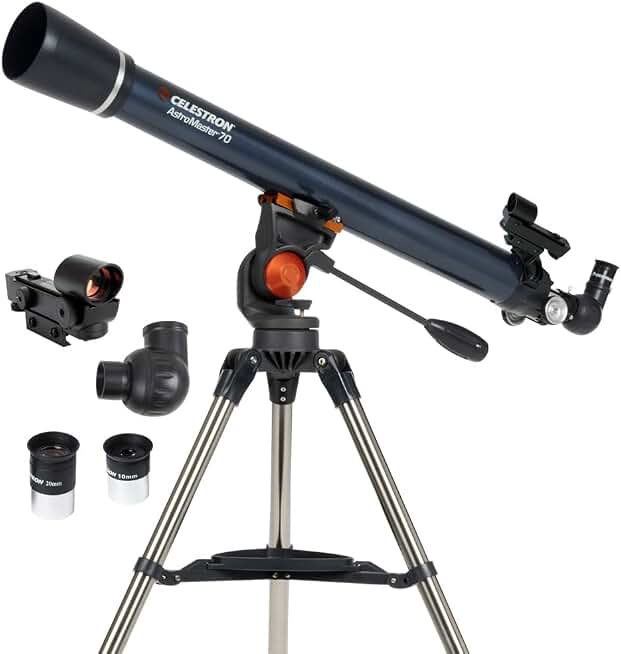
2. Celestron AstroMaster 70AZ: Best for the Moon and Planets
Celestron
Celestron AstroMaster 70AZA no-fuss 70mm refractor that gets beginners outside and observing on their first night out.
The AstroMaster 70AZ is the classic refractor shape: a 70mm objective at the front of a long tube on a sturdy alt-azimuth tripod. The unusually long 900mm focal length (f/12.9) is the giveaway that this scope is optimized for the Moon and planets. The slow focal ratio keeps chromatic aberration well controlled and produces high native magnification with modest eyepieces. The mount is all-aluminum, meaningfully more stable than the plastic mounts on cheaper 70mm refractors.
What you see at f/12.9 with 70mm: Saturn's rings clearly resolved, Jupiter's main belts and four Galilean moons, lunar craters down to a few kilometers across, double-star pairs cleanly split. Deep-sky targets like nebulae and galaxies are dim or invisible; this scope is not built for those. 3,771 Amazon reviews averaging 4.4 stars is the strongest review record of any traditional refractor under $200 in our catalog.
Who it is for: Beginners who want a refractor specifically (no collimation, no maintenance), Moon-and-planets watchers, anyone who values a five-minute setup over maximum capability.
The tradeoff: 70mm is the small end of usable aperture. The long focal ratio gives narrow fields of view, so large nebulae and clusters will not frame well, and the erecting-prism eyepiece Celestron includes for daytime use costs you a little light at night.
The classic 70mm refractor done right. Built solidly, priced fairly.
3. Celestron Travel Scope 70: Best for Kids and Travel
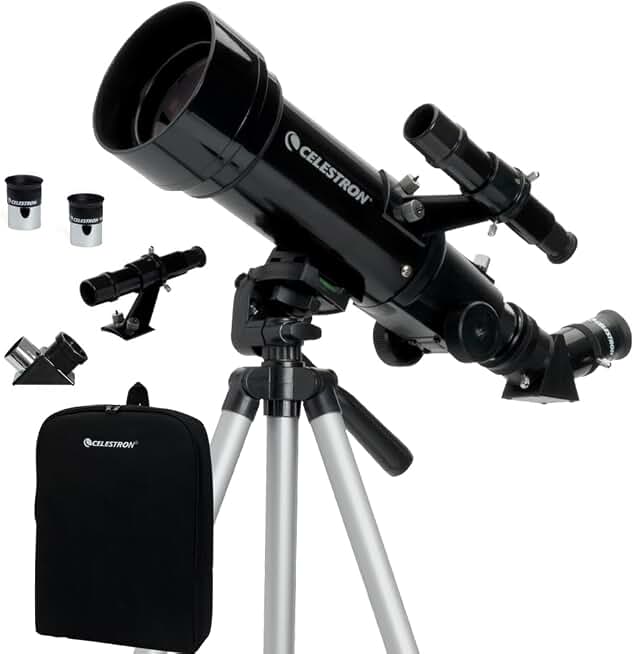
A capable 70mm grab-and-go refractor that earns its place in any beginner's kit without breaking the bank.
The Travel Scope 70 is the most-reviewed telescope on Amazon, period. At $89.99 with the whole package fitting in the included backpack at under two kilograms, this is how a substantial portion of the astronomy hobby gets started: a kid or curious adult sees the price, buys it, takes it outside on the first clear night, and either falls in love with the hobby or quietly puts it away.
The optics are 70mm at 400mm focal length (f/5.7), which means wide, easy-to-aim views. The Moon fills the eyepiece beautifully. Saturn shows its rings small but clearly. Bright star clusters look great. The aluminum tripod is short but functional; most owners use it on a table or low chair. This same scope appears as the budget pick in our under $300 guide and best telescopes for kids guide because nothing else at the price competes with its review history.
Who it is for: Complete beginners testing the hobby for under $100, kids 8-14, travelers who want a scope that fits in a daypack, gift buyers on a tight budget.
The tradeoff: 70mm aperture is genuinely small. The lightweight tripod is short and flexes if bumped. Astrophotography is limited to smartphone-through-the-eyepiece shots of the Moon and bright planets. You will outgrow it if you stay in the hobby.
The most-reviewed telescope on Amazon, the safest first scope under $100.
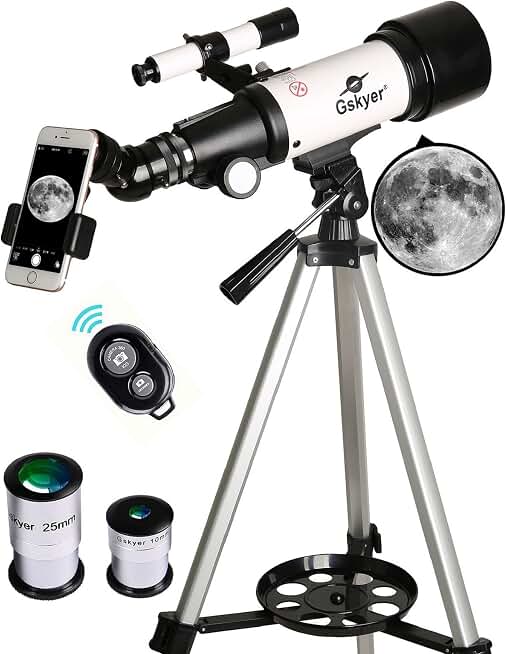
4. Gskyer 70AZ: Most-Reviewed Budget Brand
Gskyer
Gskyer 70AZA capable 70mm refractor that punches above its price for beginners ready to explore the night sky.
The Gskyer 70AZ earns a spot on this list because of the sheer weight of its review history: 21,839 Amazon reviews averaging 4.3 stars, roughly 50 percent more reviews than the Celestron Travel Scope 70 with a higher average rating. At $85.49 it sits squarely in the same price-and-form-factor niche. Specs are essentially identical: 70mm aperture, 400mm focal length, f/5.7.
Gskyer is a budget import brand, not a household name like Celestron or Sky-Watcher. The 70AZ has been the brand's hit product for years. Reviewers consistently praise the included accessory kit (3 eyepieces, a Barlow lens, a moon filter, a smartphone adapter) and the backpack. The optics are workable but probably a touch behind Celestron's equivalents; the assembly experience is well documented in YouTube reviews.
Who it is for: Buyers who weigh review quantity heavily, anyone who cares more about the included accessories than the brand name on the box.
The tradeoff: Lower brand reputation than Celestron or Sky-Watcher, even if the underlying scope is comparable. Customer service is reportedly less responsive. Not a long-term scope; expect to outgrow it within a year if astronomy sticks.
21,839 Amazon reviews. The most-bought budget astronomy starter.
What to Realistically Expect
Setting expectations is the most important thing you can do before buying a telescope under $200. Most reviews of "disappointing telescopes" come down to mismatched expectations, not bad optics.
What you WILL see
- The Moon in striking detail. Even at 70mm aperture, the Moon's terminator (the day-night boundary) shows craters in sharp relief and mountain peaks casting shadows. Lunar viewing is the most universally rewarding experience at any aperture.
- Saturn's rings. Any 70mm or larger telescope at 50x or more shows the rings clearly, and Titan as a small bright dot. The Cassini Division wants 100mm or more and a steady night.
- Jupiter's cloud bands and four largest moons. Two prominent dark belts visible at 80x. The moons (Io, Europa, Ganymede, Callisto) shift positions night to night.
- Bright nebulae and star clusters. Orion's Nebula, the Pleiades, the Andromeda Galaxy as a soft glow, the Beehive Cluster (M44), the Double Cluster in Perseus.
- Brighter double stars. Albireo's gold-and-blue pair, Mizar and Alcor, Castor.
What you will NOT see
- Hubble-style images of galaxies and nebulae. Visual observing through an eyepiece always shows objects dimmer and smaller than long-exposure photos. This is physics, not your telescope.
- Color in deep-sky objects. Galaxies and most nebulae appear gray to the eye even through large telescopes. Color in astrophotos comes from camera sensors integrating light over minutes.
- Faint galaxies, planetary nebulae, or globular cluster detail. At 70-80mm from suburban skies, anything below magnitude 9 or so will be invisible or barely visible. Dark skies help; aperture helps more.
Red Flags: Budget Telescopes to Avoid
The sub-$200 tier has more dangerous purchases than any other. Watch for these signs that a telescope is not worth buying.
A 1000mm focal length in a tube half that long. In a standard Newtonian the tube is in the same ballpark as the focal length, not half of it. When a "1000mm" reflector ships in a tube of 40-60cm, the extra focal length comes from a Barlow lens built into the focuser, which Celestron's own knowledgebase confirms for its AstroMaster 114 line. That construction is called a Bird-Jones, and it is why the Celestron PowerSeeker 127EQ (436mm tube), AstroMaster 114EQ (395mm tube), StarSense Explorer LT 114AZ and 114LCM are no longer on our lists. Celestron's specification sheets describe every one of them as "Spherical Primary Mirror." What that means in use comes from people who have taken them apart: telescopicwatch's teardown of the 127EQ found that the corrector moves with the focuser, so the correction is never quite right, and that collimating requires removing it first. Owners on r/telescopes describe the same struggle, call the 127EQ a "hobby killer," and maintain a subreddit specifically to warn people off it. Our scoring engine now accounts for the design: the 127EQ scores 60 and the 114EQ 57, below every scope in this guide.
"500x magnification" or "450x power" on the box. Useful magnification maxes out at roughly 2x the aperture in millimeters: 140x for a 70mm scope, 260x for a 130mm. Anything above that is empty magnification, a bigger and blurrier image. Boxes claiming triple-digit magnifications are counting a plastic 3x Barlow and a 4mm eyepiece nobody should use; the resulting view is unwatchable.
Plastic mount and tripod for under $50. If the entire telescope, including tripod and accessories, costs less than $50, the mount is almost certainly thin extruded plastic that flexes at every touch. The optical tube might be okay, but the mount instability will make every observing session frustrating.
Marketing photos with composited Milky Way backgrounds. Telescopes get sold to people who have never used one, so listings show fake Milky Ways and Hubble photos suggesting that is what you will see. A real telescope view through a real eyepiece looks more like a sharp ink-on-paper sketch than a colorful photograph.
No brand name you recognize, no review history, no astronomy community presence. Cloudy Nights, Reddit's r/telescopes, Astrobin: search the brand and model. If a $90 telescope from an unfamiliar brand has 20 Amazon reviews and no community discussion, it is probably a rebadged generic optical assembly with no support infrastructure.
