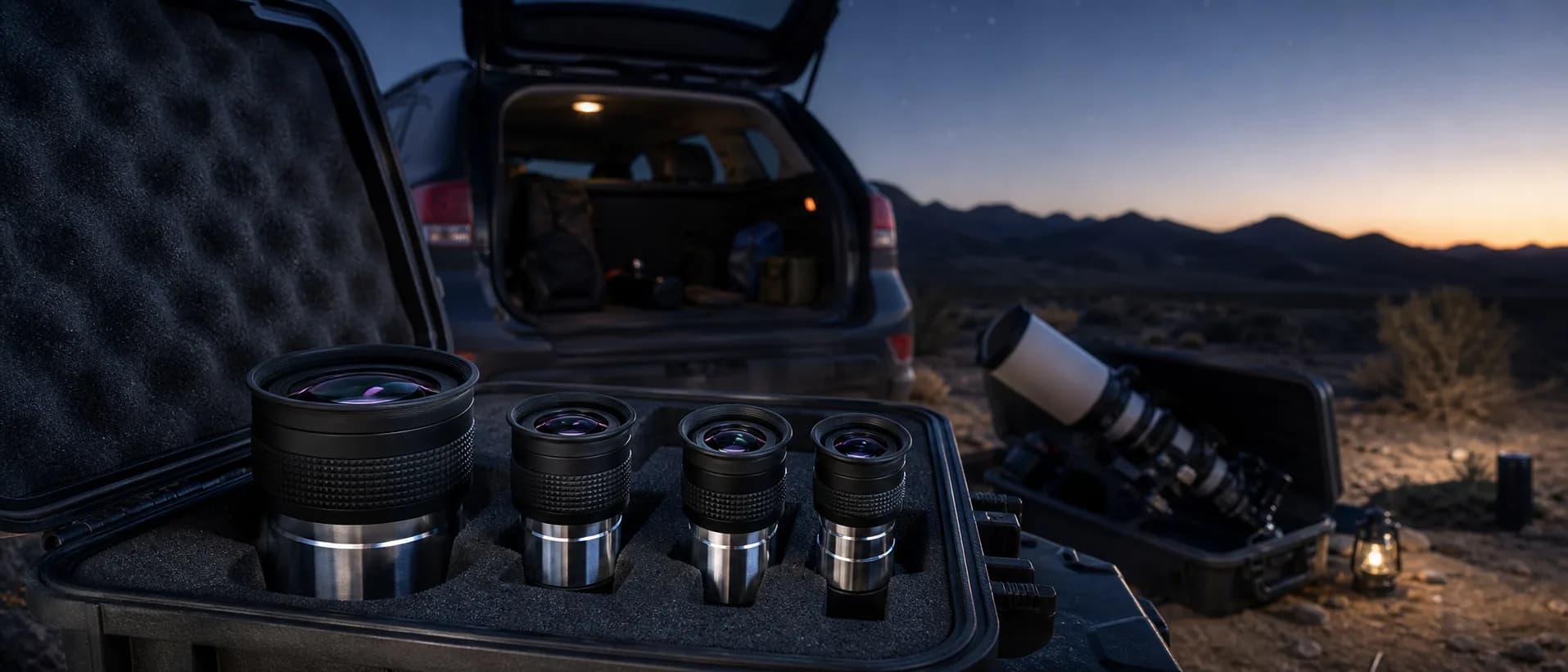

Upgrading your eyepieces is the cheapest meaningful improvement you can make to any telescope; the two basic Plossls that shipped in the box are almost never the limit of what your optics can do. We scored 28 eyepieces in the WhichScope database, and the Celestron X-Cel LX 12mm is the best single upgrade for most people at about $95. Below are our picks by use case, plus three complete starter sets by budget.
Quick Picks
| Eyepiece | Best For | Score | Price |
|---|---|---|---|
| Celestron Omni 32mm | Best low-power on a budget | 83 | $49.99 |
| Celestron X-Cel LX 12mm | Best overall upgrade | 82 | $93 |
| Celestron X-Cel LX 5mm | Best for planets | 80 | $93 |
| Celestron Luminos 19mm | Best wide-field deep sky | 76 | $199.95 |
| Astromania Plossl 10mm | Cheapest worthwhile upgrade | 75 | $16.91 |
| Celestron Luminos 7mm | Best ultra-wide at high power | 74 | $118.96 |
| Astromania Planetary 6mm | Best budget planetary | 72 | $49.99 |
| Astromania Super Plossl 56mm | Cheapest way into 2 inches | 69 | $63.97 |
How We Chose These
WhichScope scores every eyepiece in the database on the same dimensions we use for telescopes: optical performance for planetary and deep-sky use, value against street price, and build quality signals from verified owner feedback. The scores come from specs and data, not from a sponsored shortlist; our methodology explains exactly how the math works. We only recommend products that are in stock with live pricing.
One honesty note up front: eyepiece quality also depends on the telescope in front of it. A $250 wide-angle behaves differently in an f/4.9 Dobsonian than in an f/10 Schmidt-Cassegrain. Where a pick is sensitive to focal ratio, we say so.
Eyepiece Basics: The Four Numbers That Matter
Before the picks, four specs decode every eyepiece listing.
Focal length (mm)
The focal length printed on the eyepiece sets your magnification: divide your telescope's focal length by the eyepiece's. A 12mm eyepiece in a 1200mm Dobsonian gives 100x. Shorter eyepiece focal lengths mean more magnification, not better views; the practical ceiling is about 2x your telescope's aperture in millimeters before the image goes dim and mushy.
Apparent field of view (AFOV)
AFOV is how wide the view feels, measured in degrees. A 50-degree Plossl feels like looking through a porthole; an 82-degree ultra-wide feels like a spacewalk. Wider fields cost more because they need more glass elements to stay sharp at the edges. One catch worth knowing: at long focal lengths the barrel itself limits the field, so a 40mm Plossl in a 1.25-inch barrel delivers around 40 degrees rather than its design figure.
Eye relief (mm)
Eye relief is how far your eye can sit from the lens and still see the whole field. Below about 10mm you are pressing your eyeball to the glass, which is miserable at high power and unusable with glasses. If you observe with glasses on, treat 15mm as the floor.
Barrel size (1.25" vs 2")
The barrel is the chrome tube that slides into the focuser. Nearly every modern telescope accepts 1.25-inch eyepieces; 2-inch barrels exist to serve wide fields at long focal lengths that physically cannot fit through a 1.25-inch opening. You only need a 2-inch eyepiece if your focuser accepts one and you want maximum true field.
Eyepiece Types Explained
Plossl (4 elements, ~50 degrees). The default design for 40 years, and the type bundled with most telescopes. Good ones are sharp in the center and cheap; the tradeoffs are narrow fields and eye relief that collapses at short focal lengths. A 6mm Plossl has around 5mm of eye relief, which is why nobody enjoys using one.
Wide-angle (5 to 6 elements, 58 to 68 degrees). The sweet spot for most owners. Designs like the X-Cel LX hold 16mm of eye relief at every focal length, so a 5mm high-power eyepiece is as comfortable as a 25mm.
Ultra-wide (7 or more elements, 82 degrees and up). Immersive views, especially in undriven telescopes like Dobsonians where objects drift through the field; a wider field means less nudging. The cost is money and weight, and cheaper ultra-wides get soft at the edges in fast scopes below f/5.
Orthoscopic. A 4-element classic prized by planetary specialists for contrast, with tight ~45-degree fields and short eye relief. Great in theory; in practice good orthos are niche items that come and go from stock, and a modern wide-angle gets you 95% of the way with none of the discomfort.
Zoom. One eyepiece covering 8mm to 24mm sounds ideal, but you trade a narrower field at the long end and softer optics than fixed eyepieces at the same price. Zooms earn a place in travel kits; they are not the best first upgrade.
Our Top Picks
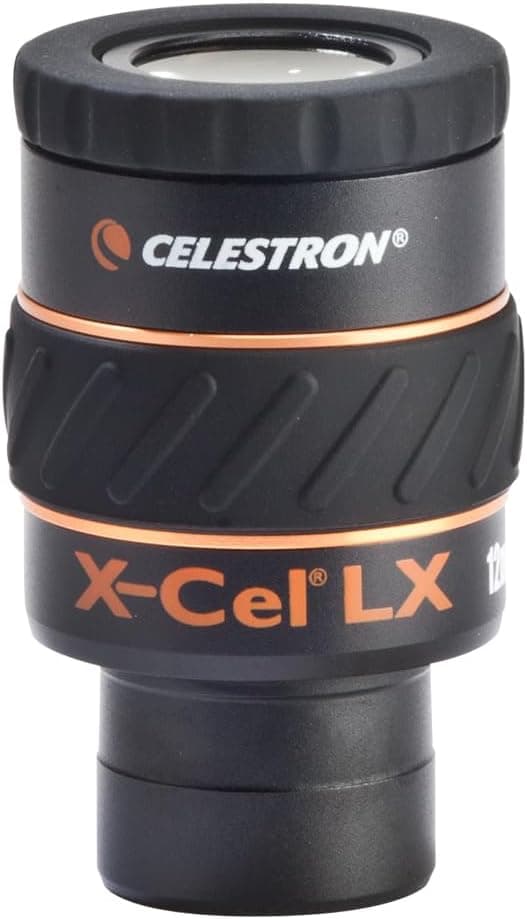
1. Celestron X-Cel LX 12mm: best overall upgrade
Celestron
Celestron X-Cel LX 12mmSharp planetary views at a fair price, with the comfort features that make long nights at the eyepiece worthwhile.
The X-Cel LX 12mm scores 82 overall, second only to a low-power Plossl among the 28 eyepieces we track, and it is our answer to "I have one eyepiece budget, what do I buy." The 60-degree field is noticeably wider than the 50-degree Plossl in your accessory tray, the 6-element design stays sharp across the field at f/5 and slower, and the 16mm of eye relief plus a twist-up eyecup make it comfortable with or without glasses. At 12mm it lands in the most-used magnification band for almost any telescope: 100x in a 1200mm Dobsonian, 169x in a NexStar 8SE.
Who it is for: Anyone replacing stock eyepieces who wants one do-everything mid-power upgrade.
The tradeoff: At about $95 it costs as much as three budget Plossls, and dedicated planetary or ultra-wide picks below beat it at their specialties.
The best single eyepiece upgrade for most telescopes.
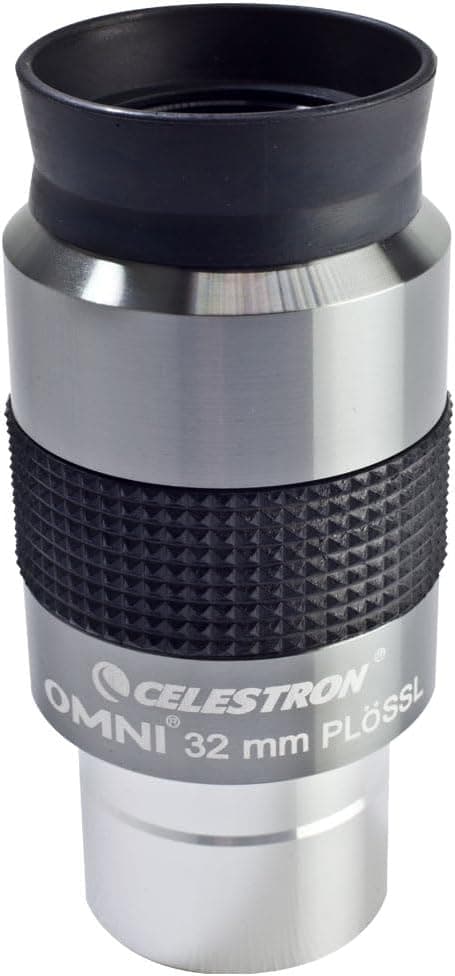
2. Celestron Omni 32mm: best low-power on a budget
Celestron
Celestron Omni 32mmCelestron's classic 32mm Plossl delivers wide, bright views at a price that leaves room for more accessories
Every kit needs a low-power, wide-view eyepiece for finding targets and framing big objects like the Pleiades or the Andromeda Galaxy, and the Omni 32mm is the highest-scoring eyepiece in our database at 83, with a 94 for value. It is a well-coated 4-element Plossl showing a 48-degree field with a comfortable 22mm of eye relief, and it sits at the longest focal length worth buying in a 1.25-inch barrel: past 32mm the barrel itself clips the field, so a 40mm shows no more sky, just more magnification. In an 8-inch Dobsonian it gives a relaxed 38x view about 1.25 degrees wide.
Who it is for: Owners whose longest included eyepiece is a 25mm or shorter and who want an affordable finder-and-framing workhorse.
The tradeoff: Plossl edge sharpness drops off in fast scopes below about f/5, and the field is average width; it wins on price, not immersion.
The affordable low-power eyepiece every kit is missing.
3. Celestron Luminos 7mm: best ultra-wide at high power
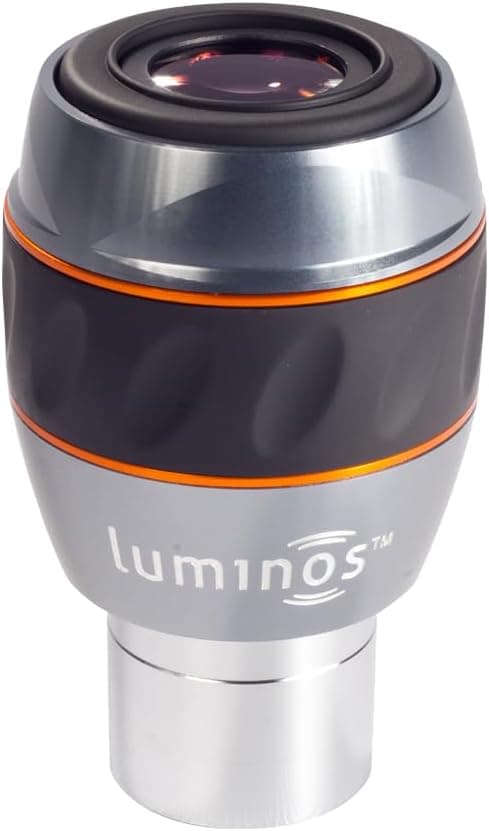
Celestron
Celestron Luminos 7mmWide-field, high-power views at 7mm: the Luminos delivers an 82-degree window into the night sky.
The Luminos 7mm is the affordable route into 82-degree ultra-wide viewing, scoring 74 overall at about $120. Eight elements hold the huge field usably sharp, and its 12mm of eye relief is more than double what a 7mm Plossl offers. In an undriven Dobsonian this combination is addictive at high power, because planets and doubles take three times longer to drift out of view than in a Plossl.
Who it is for: Dobsonian and manual-mount owners who want immersive high-magnification views without tracking.
The tradeoff: In scopes faster than about f/5 the outer 20% of the field softens, and at 82 degrees you pay for field you may not miss if you have never used more than 60.
An 82-degree window at high power for undriven scopes.
4. Celestron X-Cel LX 5mm: best for planets
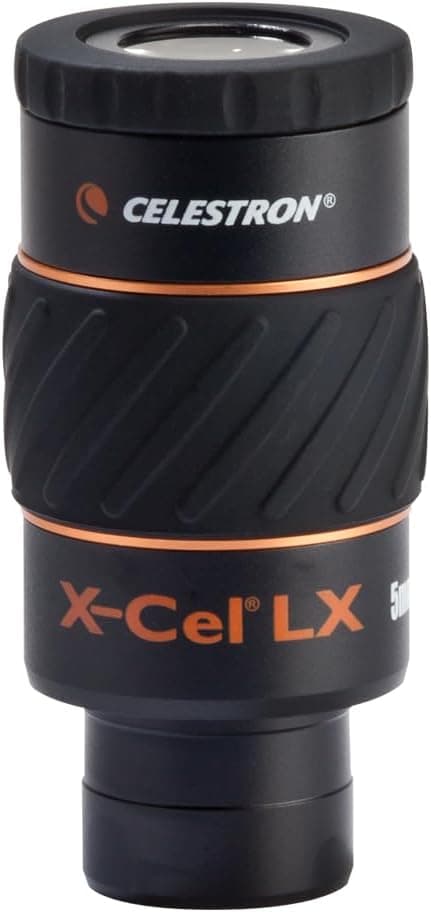
Celestron
Celestron X-Cel LX 5mmCelestron's sharpest planetary eyepiece packs six premium lenses and a 60-degree view into a comfortable 5mm package.
For Jupiter's cloud bands and Saturn's Cassini Division you want the highest magnification your sky allows with the contrast to use it, and the X-Cel LX 5mm scores 80 overall with 53 for planetary, near the top of our database. It gives 130x in a 650mm tabletop scope and 240x in a 1200mm Dobsonian, and unlike every 5mm Plossl or ortho, it keeps the full 16mm of eye relief; you can actually blink at 240x.
Who it is for: Planetary and lunar observers with steady skies who want a comfortable high-power eyepiece.
The tradeoff: Nights that support 200x and up are the exception in most locations, so this is a second or third purchase, not a first.
Comfortable high magnification for planetary nights.
5. Astromania Planetary 6mm: best budget planetary
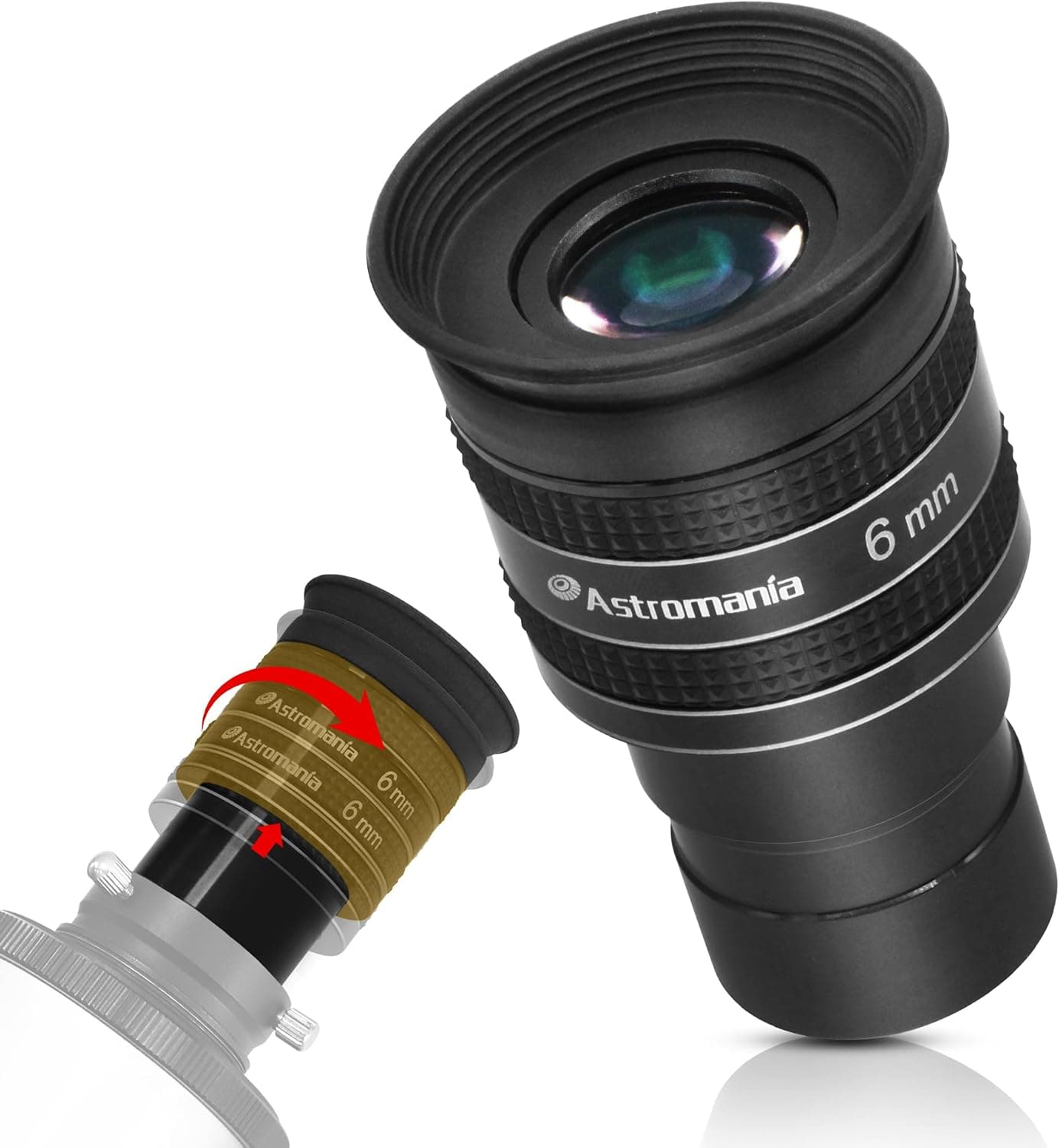
Astromania
Astromania Planetary 6mmAffordable 6mm planetary eyepiece with 58-degree field of view and 16mm eye relief for comfortable high-magnification viewing
The Astromania Planetary 6mm delivers a wider field than a Plossl at half the price of the premium options, scoring 72 overall and 91 for value. The 5-element design shows a 58-degree field, noticeably more generous than the 50-degree Plossls it competes with on price.
Who it is for: Budget-conscious owners of long focal length scopes who want a dedicated planetary eyepiece for around $50.
The tradeoff: Astromania publishes no per-model eye relief, only a series average, so we do not list a figure for it; and build quality matches the price, with a basic eyecup and coatings a step behind Celestron's.
Top-scoring planetary views for around fifty dollars.
6. Astromania Plossl 10mm: cheapest worthwhile upgrade
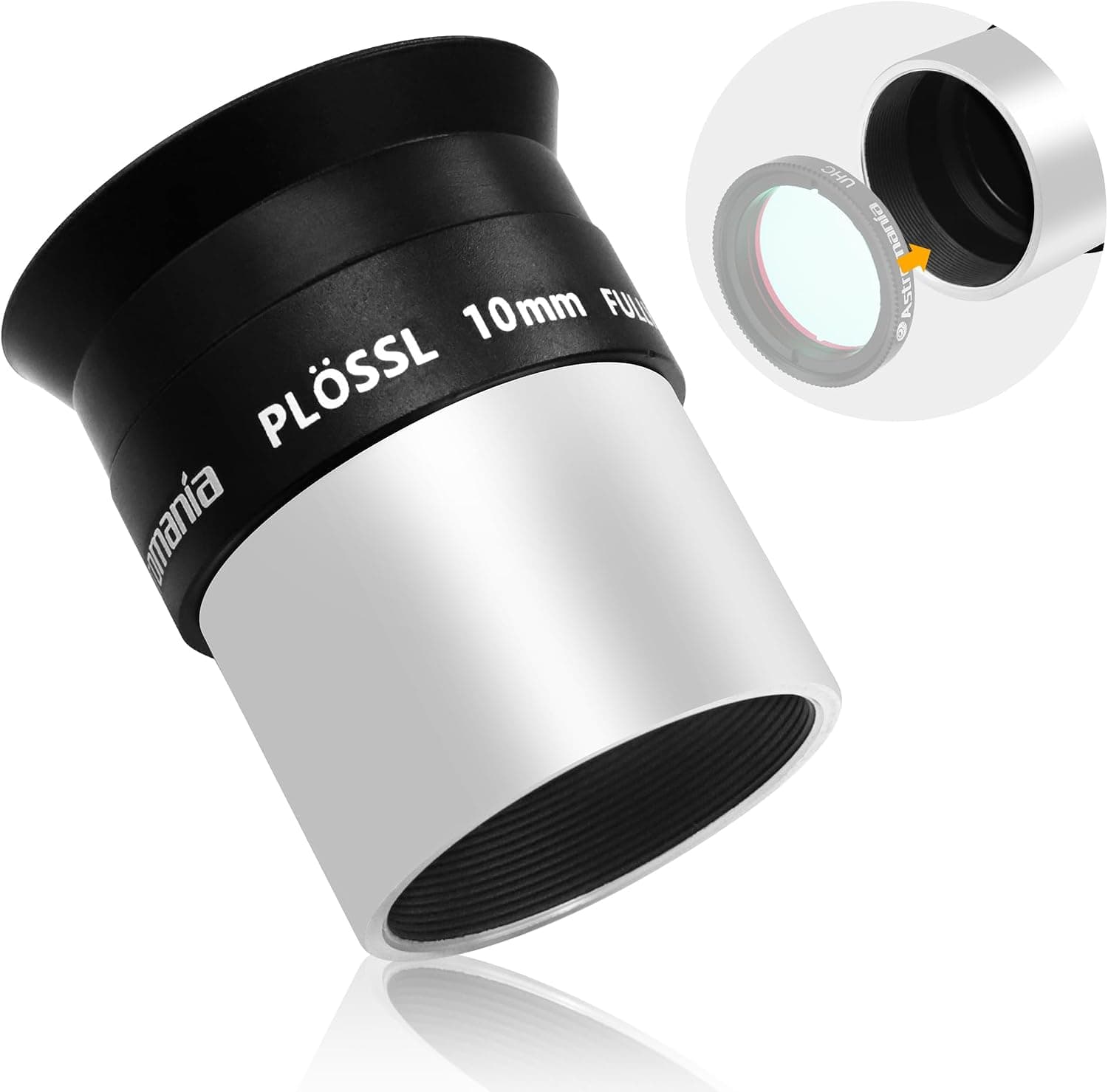
Astromania
Astromania Plossl 10mmSolid budget Plossl that punches above its price for lunar and cluster work
At $16.91 the Astromania Plossl 10mm is the cheapest eyepiece we can honestly recommend, scoring 75 overall and 95 for value. It is a plain, competently coated Plossl that outperforms the no-name 10mm bundled with most beginner telescopes, and it fills the mid-power slot while you save for the wide-angles above.
Who it is for: New owners testing whether eyepiece upgrades matter to them before spending real money.
The tradeoff: A 50-degree field is functional, not immersive, and eye relief on a 10mm Plossl is tight enough that glasses are not realistic. Astromania publishes no eye relief figure for it, which is its own kind of answer.
A sub-twenty-dollar test of what better glass does.
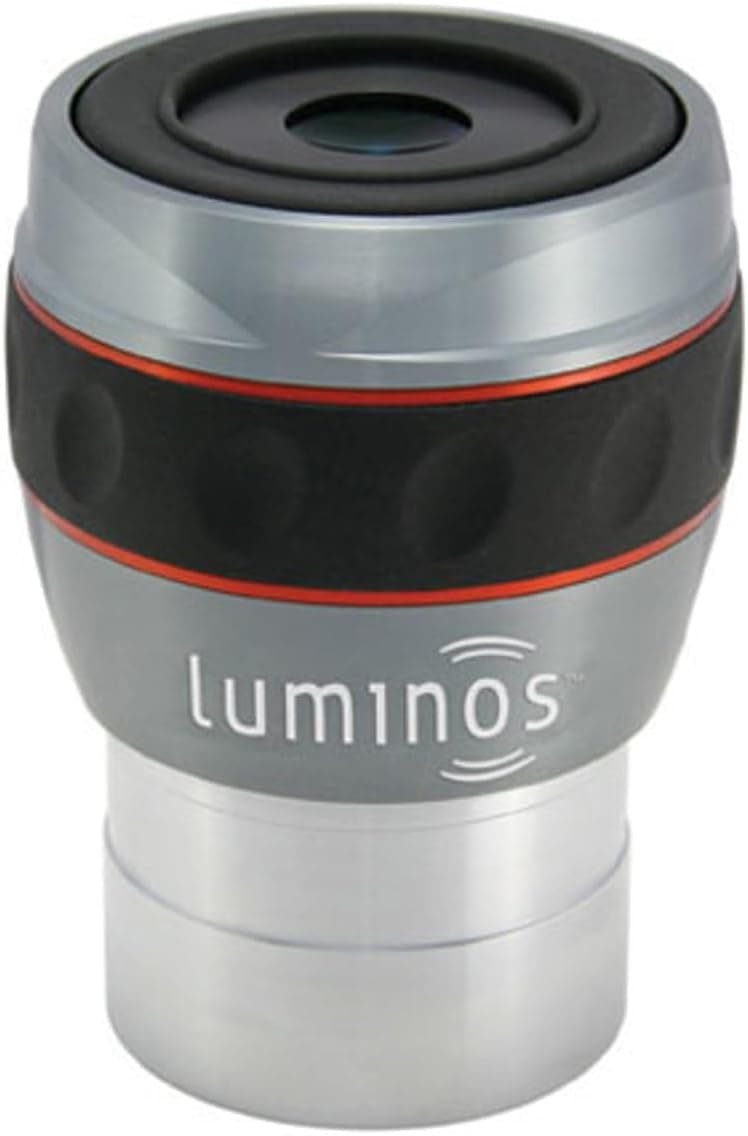
7. Celestron Luminos 19mm: best wide-field deep sky
Celestron
Celestron Luminos 19mmWide, immersive 82-degree views at a mid-range price, built for real observing sessions
For star clusters, nebulae, and galaxy fields, the Luminos 19mm pairs a mid-low magnification with the full 82-degree field, scoring 76 overall and 69 for deep sky, the best of any Luminos. It is a 2-inch eyepiece, the shortest and most affordable of the three 2-inch models in the line, and in an 8-inch f/5.9 Dobsonian it frames over 1.3 degrees of sky at a contrasty 63x, wide enough for the Double Cluster with room to spare. Eye relief is a comfortable 20mm.
Who it is for: Deep-sky observers with a 2-inch focuser who want an immersive 82-degree field without paying for the 31mm flagship.
The tradeoff: At about $200 its value score is a modest 55; you are paying for field width, and owners report edge-of-field brightening on the 2-inch Luminos models, covered in our full Luminos review.
The affordable entry into immersive 2-inch deep-sky viewing.
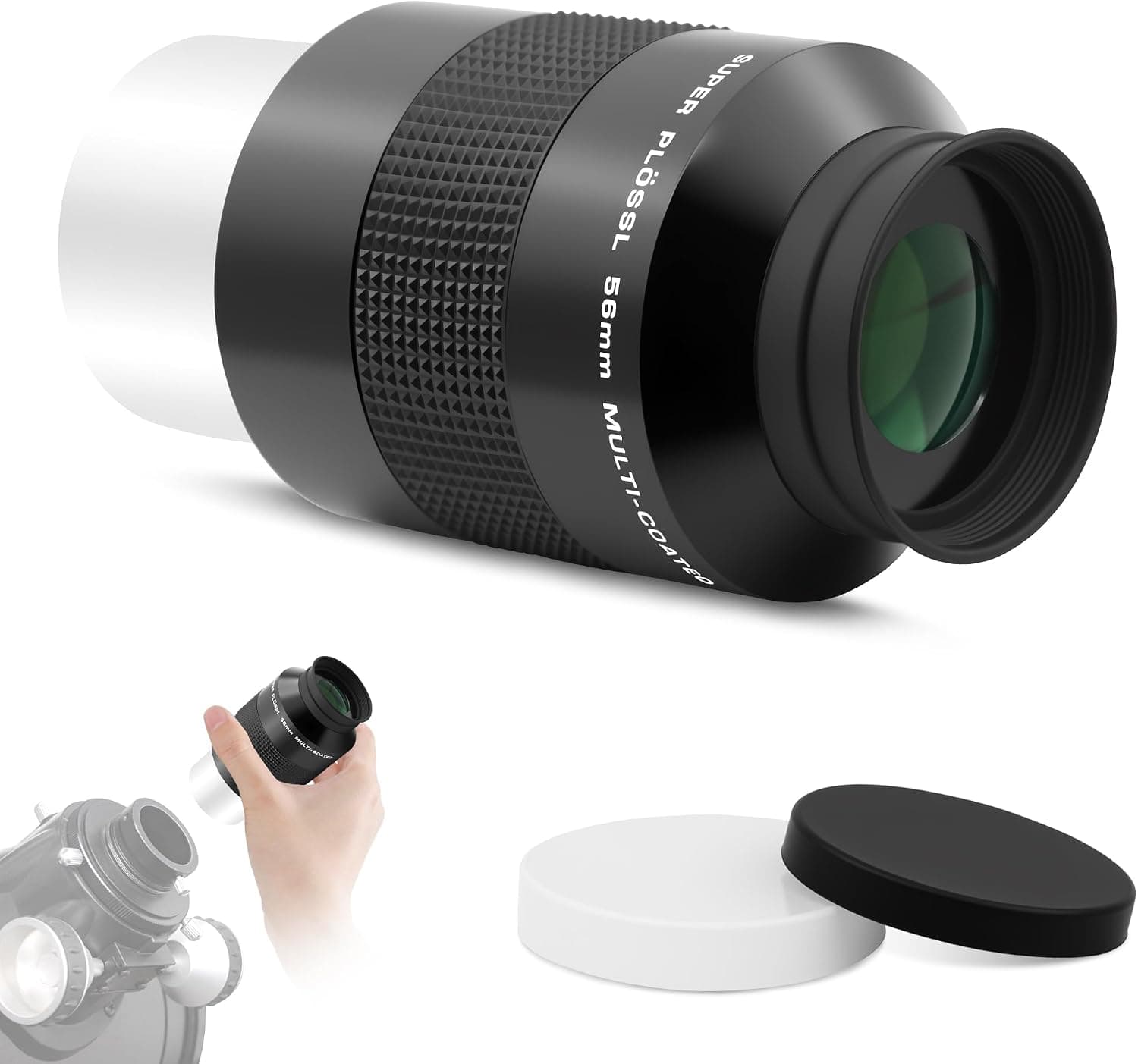
8. Astromania Super Plossl 56mm: cheapest way into 2 inches
Astromania
Astromania Super Plossl 56mmWide-field, low-power views at an honest price for observers who want the big picture.
If your telescope has a 2-inch focuser and a small budget, the Super Plossl 56mm is the cheapest way to use it, and it produces the largest exit pupil of anything we track, which makes it a dedicated finder eyepiece in slow scopes. It scores 69, the lowest of our picks, and we want to be straight about why it still earns a place: it is doing a job nothing else in this price range does.
Who it is for: Owners of f/6 and slower scopes with 2-inch focusers who want a low-power finder eyepiece for under $70.
The tradeoff: Two real caveats. The listing advertises 52 degrees, but a 56mm eyepiece at 52 degrees would need a field stop wider than a 2-inch barrel physically passes, so the barrel truncates it to roughly 46 degrees; we store the effective figure. And in fast scopes the 9mm-plus exit pupil wastes light and can show the secondary mirror's shadow. Check your focal ratio with our eyepiece calculator before buying.
The budget route to a 2-inch low-power eyepiece.
Recommended Starter Sets by Budget
Three eyepieces covering low, medium, and high power beat any single purchase. These sets assume the typical beginner scope between f/5 and f/10; run your own numbers in the eyepiece calculator.
Around $50: the Astromania Plossl trio. The 10mm, 6mm, and 4mm together cost about as much as one mid-range eyepiece and cover the mid-to-high power range for a tabletop scope; keep your included 25mm for low power. Eye relief is tight on the short pair, but the optics beat every included accessory kit.
Around $110: the Omni set. The Omni 32mm, Omni 15mm, and Omni 6mm give a clean 32/15/6 spread with Celestron's coatings. On a 1200mm Dobsonian that is 38x, 80x, and 200x: framing, general viewing, and planetary nights in three purchases.
Around $275: the X-Cel LX set. The 25mm, 12mm, and 5mm build the same spread with 60-degree fields and 16mm eye relief everywhere. This is the set that ends upgrade itch for most visual observers.
Matching Eyepieces to Your Telescope
Two formulas turn eyepiece shopping from guesswork into arithmetic.
Magnification = telescope focal length / eyepiece focal length. A NexStar 8SE at 2032mm turns a 12mm eyepiece into 169x; a 650mm tabletop turns the same eyepiece into 54x. The same glass plays a different role in every scope, which is why recommendations without your focal length attached are half-answers.
Exit pupil = eyepiece focal length / focal ratio. This is the width of the light beam reaching your eye. Keep it between roughly 1mm and 7mm: below 1mm images go dim and floaters intrude, above 7mm your dark-adapted pupil cannot swallow the beam and light is wasted. An f/10 Schmidt-Cassegrain hits 1mm with a 10mm eyepiece, so ultra-short eyepieces are wasted on it; an f/4.9 Dobsonian wants nothing longer than about 35mm.
As a rule of thumb, a useful three-piece kit lands near 35x to 50x for finding and framing, 80x to 120x for general work, and 150x to 250x for the Moon and planets, capped by 2x your aperture in millimeters. Our eyepiece calculator computes magnification, exit pupil, and true field for your exact telescope, and each product page on the eyepieces hub shows the same numbers against common scopes.
What to Avoid
Magnification marketing. Any listing advertising "525x power!" on a 60mm telescope is lying by arithmetic; a 60mm aperture supports about 120x on a good night. This is the same red flag we warn about in our beginner telescope guide.
No-name accessory bundles. Amazon is full of keyword-stuffed eyepiece kits with no stated AFOV, no eye relief spec, and no brand behind them. If the listing cannot tell you the four numbers from the basics section above, the manufacturer does not know them either.
Buying short before long. The instinct is to chase magnification, but the low-power eyepiece gets ten times the use. If your longest eyepiece is a 25mm, a 32mm or a 2-inch wide-field will change more nights than any 4mm.
Barlow-stacking. A decent 2x Barlow doubles your eyepiece collection on paper, and a good one is genuinely useful. But stacking a cheap Barlow on a cheap eyepiece multiplies their flaws along with the image; upgrade the eyepiece first.
