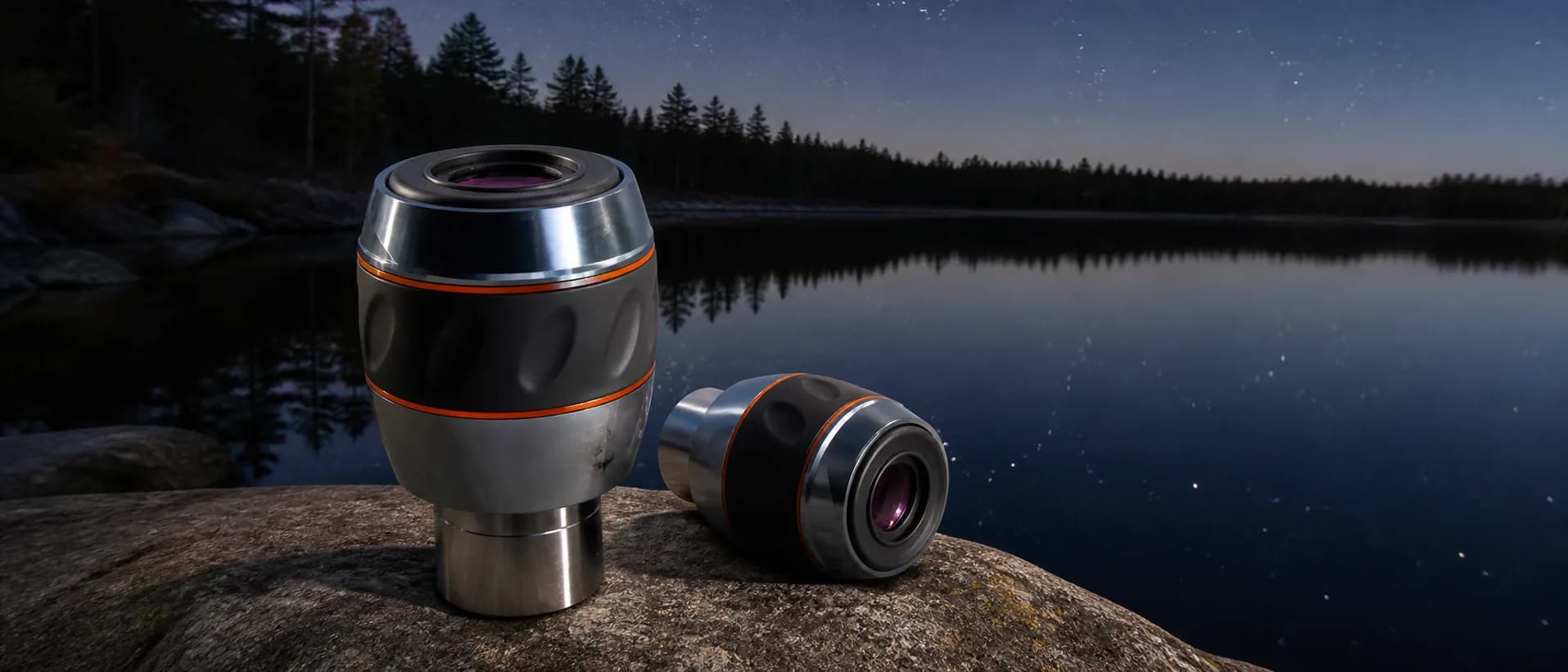

The Celestron Luminos line is the cheapest way to get a true 82-degree field in a new eyepiece, and it is also the most argued-about eyepiece series in amateur astronomy forums. Our scoring lands in an interesting place: the 19mm is the highest-scoring model in the line at 76, while the short 7mm and 10mm that owners praise most score 74 apiece, held back by eye relief of just 12mm. This review scores every focal length, lays out what owners consistently report, and is explicit about where our data and the community disagree.
The Line at a Glance
| Eyepiece | Barrel | Score | Price |
|---|---|---|---|
| Luminos 19mm | 2" | 76 | $199.95 |
| Luminos 7mm | 1.25" | 74 | $118.96 |
| Luminos 10mm | 1.25" | 74 | $139.95 |
| Luminos 23mm | 2" | 72 | $249.95 |
| Luminos 31mm | 2" | 69 | $299.49 |
| Luminos 15mm | 1.25" | 79 | not currently stocked |
All six share the same recipe: an 82-degree apparent field, a multi-element ultra-wide design (six to eight elements depending on focal length), a twist-up eyecup, and heavy all-metal construction with rubber armor. Eye relief grows with focal length, from 12mm on the 7mm and 10mm to 27mm on the 31mm, per Celestron's spec sheets. Scores come from our methodology, which weighs optical specs, value against live street price, and verified owner feedback; we have not bench-tested these ourselves, so every hands-on claim below is attributed to the owner communities where it was reported.
What the Luminos Line Is
Luminos is Celestron's mid-price ultra-wide series, introduced as the successor to the discontinued Axiom LX line. The pitch is simple: Tele Vue Nagler-style immersion at a fraction of Nagler money. A Luminos 7mm costs about $120, roughly a third of the premium ultra-wide equivalent.
That positioning explains both the praise and the criticism. Compared with the 52-degree Plossls bundled with most telescopes, any Luminos is a dramatic upgrade in field width and comfort. Compared with the premium glass it visually resembles, corners were cut, and owners disagree about how much those corners matter.
Scores by Focal Length
The 19mm (76) is the highest-scoring Luminos. It pairs the full 82-degree field with 20mm of eye relief and the line's best deep-sky score of 69, at the lowest price of the three 2-inch models. If you have a 2-inch focuser, this is where the line is strongest on paper.
The highest-scoring model in the Luminos line.
The 7mm and 10mm (74 each) are the ones owners actually recommend. They put the full 82-degree field into the high-power range where a Plossl of equal focal length gives you 5mm of eye relief and a pressed eyeball. Cloudy Nights users repeatedly single them out; one long-running thread calls the pair "surprisingly good" at the $50 to $60 they fetch used, and they routinely trade at that discount, which makes the used market the deepest value in the line.
Worth being direct about a disagreement here: our scoring rates these two below the 19mm, mainly because their eye relief is 12mm against the 19mm's 20mm, and eye relief carries real weight in a comfort-aware score. Owner consensus runs the other way, because at high power in an undriven scope the wide field matters more than eyecup comfort. Both readings are defensible; if you observe at high magnification and do not wear glasses at the eyepiece, weight the community view over ours.
The community's pick for high-power viewing, best bought used.
The 23mm (72) and 31mm (69) are good views with a falling value curve. Deep-sky scores keep rising with focal length (69, 70, 71 across the three 2-inch models) because a 2-inch barrel and long focal length are exactly what wide-field deep-sky observing wants. But prices rise faster, from about $200 to about $300, so value scores fall from 55 to 48 to 44, and portability collapses: the 31mm scores 3 out of 100 there, which is what 1.19kg on the end of a focuser earns. This is also the price territory where used premium alternatives start to compete seriously.
The 15mm is the one we cannot vouch for. It scores 79 on specs, but we do not stock it, and a Cloudy Nights member who measured one reports a real apparent field of 72 to 74 degrees rather than the advertised 82, with eye relief too short for eyeglass wearers. Our score is computed from Celestron's published figures, so if that owner measurement is right, the score is built on a number the product does not deliver. If you want that magnification range, the 12mm X-Cel LX covered below is the safer buy.
Why Owners Argue About This Line
Read the two most-linked community sources and you get opposite verdicts from the same facts. TelescopicWatch's line review, the only professionally structured review ranking for this query, lands on "Recommended". The loudest Cloudy Nights thread opens with "stay away", calls the line a lower-cost replacement for the better-reviewed Axiom LX, and notes some owners sold off every focal length.
The facts both camps agree on:
- The 7mm and 10mm are good, and excellent for the money used.
- The long 2-inch models show an optical quirk called edge-of-field brightening.
- Everything in the line is heavy.
The disagreement is tolerance, not facts. If you observe with the object centered and want maximum field per dollar, the line earns its "Recommended". If edge behavior in a fast scope bothers you, you will end up in the "sold them all" camp. The sections below unpack the three facts so you can place yourself.
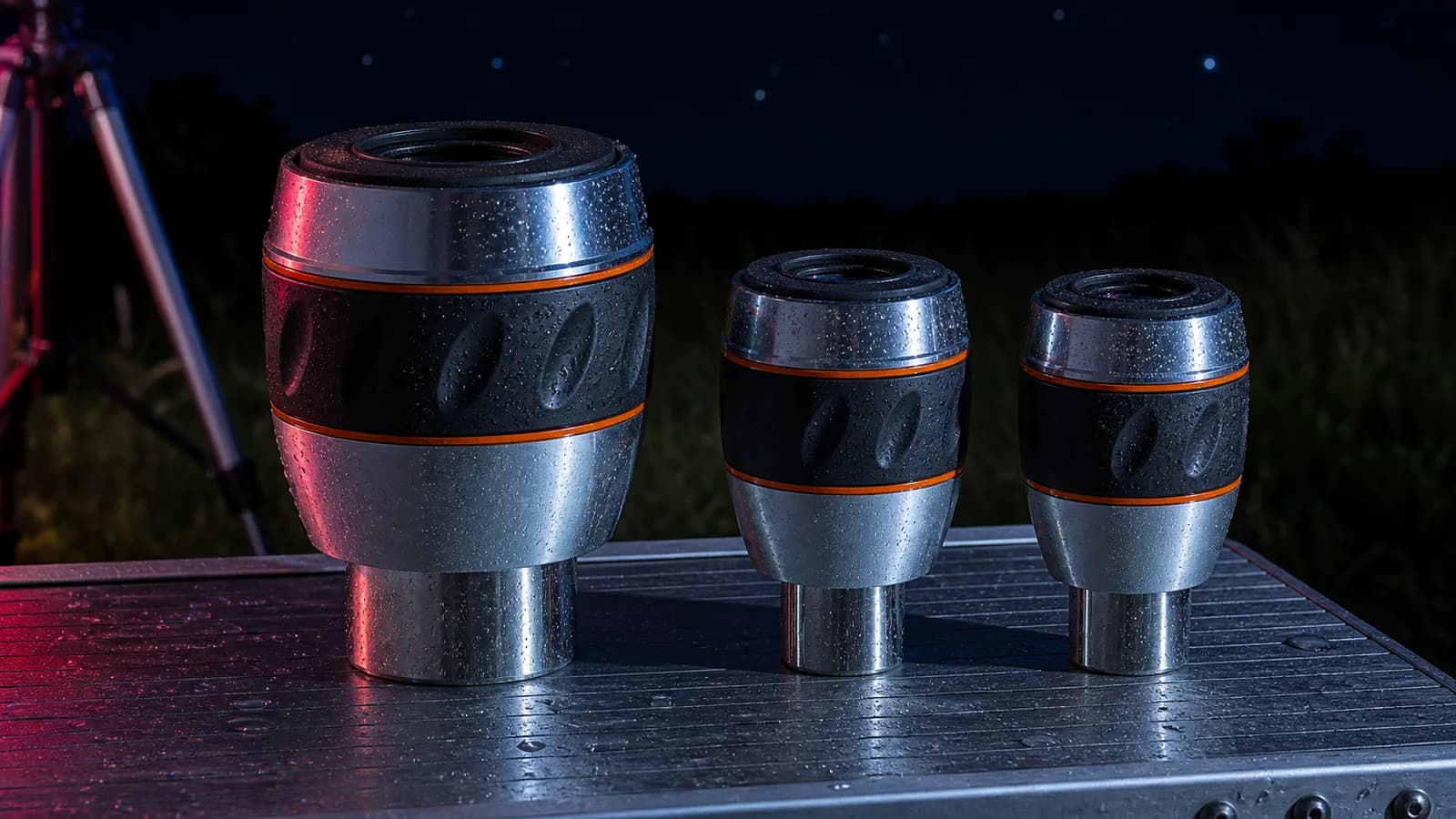
Edge-of-Field Brightening, Explained
EOFB is a pale ring or glow near the field stop, visible mainly on dark-sky backgrounds at low power. It does not blur stars; it lifts the background brightness at the edge, which costs contrast exactly where a wide-field eyepiece is supposed to shine during deep-sky sweeps.
Owner reports concentrate the complaint on the 2-inch models, with the 19mm named most often in the Cloudy Nights thread. Be aware the record is genuinely inconsistent from there: reports differ by focal length, unit, and observer, including from the same reviewer years apart, so treat "which focal lengths show it and how badly" as unsettled rather than settled. What is consistent: nobody reports it ruining the 7mm or 10mm, and observers who mostly work at medium and high power often never notice it at all.
Weight, Balance, and the Decloaking Trick
The Luminos models are heavy for their class; the 31mm weighs 1.19kg (2.6 lbs) on Celestron's own spec sheet, more than some complete tabletop telescope tubes. On a Dobsonian this means rebalancing when you swap eyepieces. On a fork-mounted Schmidt-Cassegrain it is more serious: a Stargazers Lounge owner running the 31mm on a NexStar 8SE reports "very very heavy, so good balancing needed", while also calling the build quality "first class, really feels premium". Both are true; the heft is the premium feel.
The community workaround is "decloaking": removing the outer rubber armor sleeve, which per a Cloudy Nights measurement cuts roughly 40% of the weight and leaves a decloaked 31mm lighter than a 35mm Panoptic. It is reversible and popular, but it is also disassembly of a new eyepiece, so treat it as an owner mod, not a Celestron feature.
One more ergonomic note from owners: with the twist-up eyecup at its lowest position, some observers get blackouts (the view winking out with small head movements) on the long focal lengths. Raising the eyecup fixes it for most, but eyeglass wearers cannot raise it far, which makes the long Luminos models a mixed experience with glasses despite the paper eye relief.
How They Behave in Fast Telescopes
Like every non-premium ultra-wide, the Luminos design leans on the telescope to feed it a well-behaved light cone. At f/6 and slower (most Schmidt-Cassegrains, Maksutovs, and long refractors), owners describe the field as clean and the line at its best. Around f/5, the outer field picks up visible astigmatism, and below that the edge softens enough that the extra field width stops being useful. In fast Newtonians the eyepiece also shows the scope's own coma at the edge; a coma corrector helps, but it cannot fix the eyepiece's own edge astigmatism.
If your telescope is an f/4.5 to f/5 Dobsonian and edge sharpness matters to you, this is the single biggest reason to look at better-corrected alternatives instead.
Which Luminos for Which Telescope
| Your telescope | Best fit | Why |
|---|---|---|
| f/10 SCT (NexStar 6SE/8SE) | 10mm or 19mm | Slow optics hide edge flaws; watch total weight on fork mounts |
| f/6 Dobsonian, 2" focuser | 19mm or 23mm | Wide true field, manageable edge behavior |
| f/4.5-f/5 fast Dobsonian | 7mm or 10mm only | High power keeps the exit pupil small and the edge usable |
| 1.25"-only focuser | 7mm or 10mm | The only current 1.25" models worth buying |
| Any scope, eyeglasses required | Consider alternatives | Eyecup-down blackout reports undercut the paper eye relief |
Run your own focal lengths through our eyepiece calculator to see the magnification, exit pupil, and true field each model gives your specific telescope.
The Alternatives That Matter
Celestron X-Cel LX (from the same catalog). The X-Cel LX 12mm scores 82, above every Luminos, at about $95. You give up field width (60 degrees vs 82) and gain edge correction, lower weight, and money left over. If you are not specifically chasing the spacewalk effect, it is the better first wide-angle; it tops our best telescope eyepieces guide for exactly that reason.
Used premium ultra-wides. At the 2-inch Luminos prices, used Explore Scientific 82-degree and older Tele Vue Nagler eyepieces enter the conversation, and the forum consensus favors them on edge correction. We do not track used prices, so weigh that option yourself.
Used Luminos. The counterintuitive winner. Because the line polarizes owners, clean used 7mm and 10mm units circulate at half of new price, where their flaws are easy to forgive.
Verdict
Buy the 7mm or 10mm if you want maximum field per dollar at high power in any telescope, especially used. They both score 74, and they are the models owners consistently name as the line's redeeming pair.
Buy the 19mm if you have a 2-inch focuser at f/6 or slower and want immersive deep-sky views without premium pricing, accepting some edge-of-field brightening at low power.
Skip the 23mm and 31mm unless the 82-degree field is non-negotiable, because their value scores (48 and 44) say you are paying flagship-adjacent money for the line's most criticized optical behavior, and the 31mm's weight makes it a balancing problem on most mounts.
Skip the whole line if you observe below f/5 and care about edges, or if you observe with glasses on; the X-Cel LX series or a used premium ultra-wide will serve you better.
