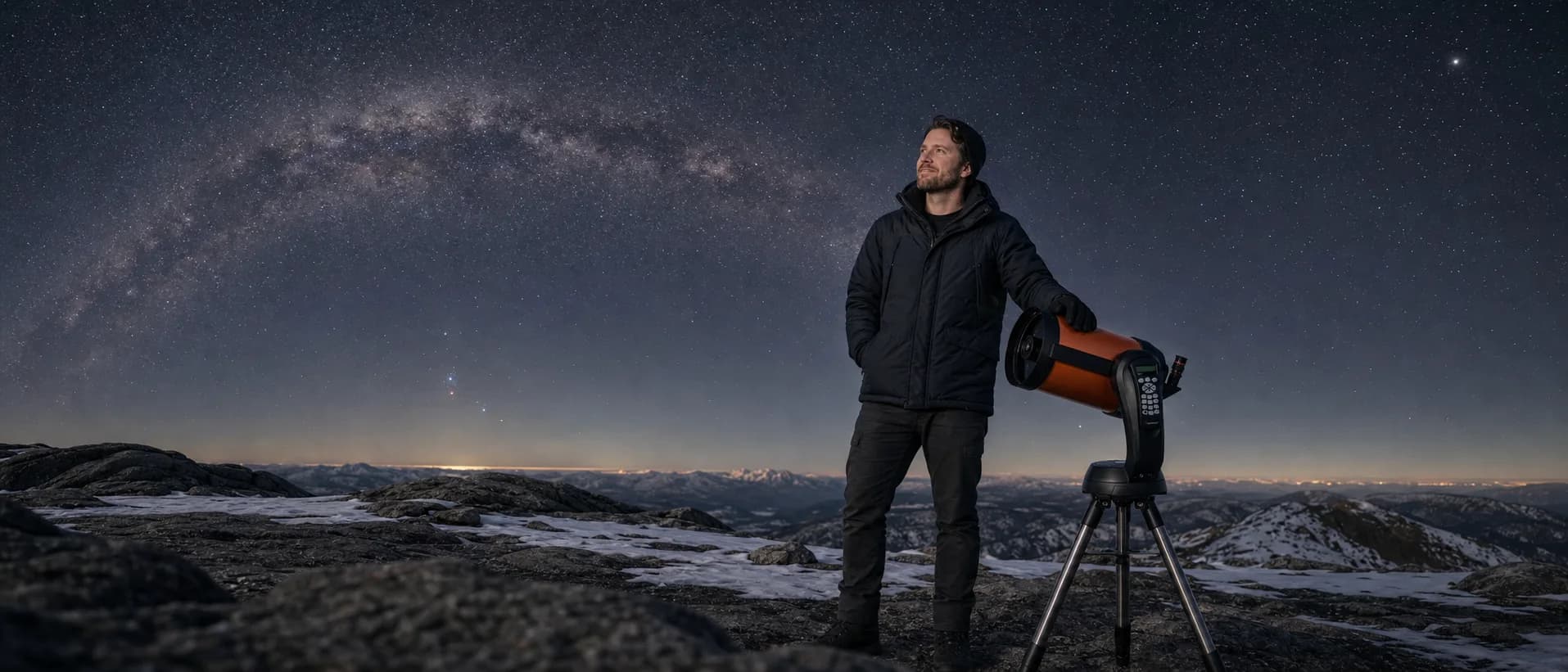

The Celestron NexStar 8SE scores 80 overall in our database, the highest of any GoTo telescope under $1,500 we track, and its 8-inch optics deserve the reputation. The honest part of this review is about everything bolted underneath those optics: a single-arm mount that owners consistently describe as the package's weak point. At $1,499, the 8SE is a strong buy for visual observers who want aperture with GoTo convenience, and the wrong buy for anyone whose real goal is deep-sky photography.
Quick Verdict
Celestron
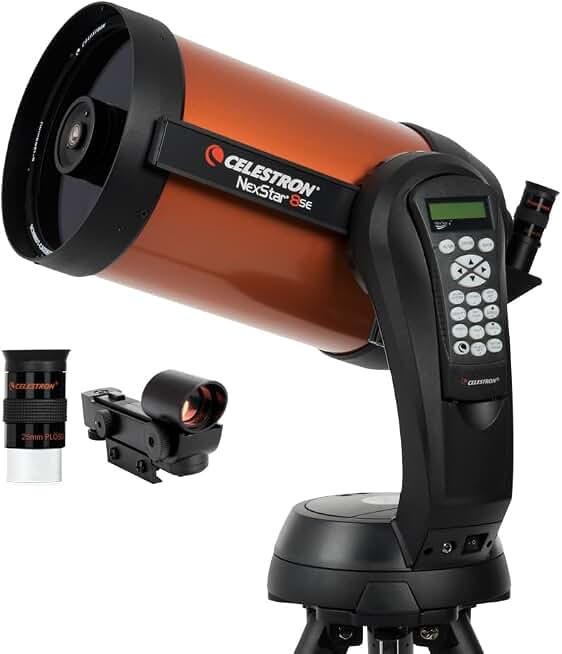
Celestron NexStar 8SEClassic looks, serious optics: the NexStar 8SE brings computerized GoTo precision to a proven 8-inch Schmidt-Cassegrain.
| Category | Score |
|---|---|
| Overall | 80/100 |
| Planetary | 71/100 |
| Deep-Sky | 61/100 |
| Astrophotography | 61/100 |
| Portability | 53/100 |
| Beginner-Friendliness | 52/100 |
| Value | 44/100 |
Buy it if you want the most portable 8 inches of aperture on the market, plan to observe visually (planets, the Moon, star clusters), and value GoTo for finding targets or sharing views at star parties.
Skip it if your goal is deep-sky astrophotography, you want maximum aperture per dollar (an 8-inch or 10-inch Dobsonian wins there), or you expect a tripod-mounted telescope to be steady at 300x out of the box.
Scores come from our 7-dimension scoring methodology, computed from verified specs and live Amazon data, not hands-on testing. Where owner experience matters, we cite it: this review draws on owner reports from r/telescopes and hands-on testing published by TelescopicWatch, the two sources Google currently ranks alongside the retail listings for this telescope.
The classic 8-inch GoTo package, best for visual observers.
Full Specifications
| Spec | NexStar 8SE |
|---|---|
| Optical design | Schmidt-Cassegrain (the C8 tube) |
| Aperture | 203mm (8-inch) |
| Focal length | 2032mm |
| Focal ratio | f/10 |
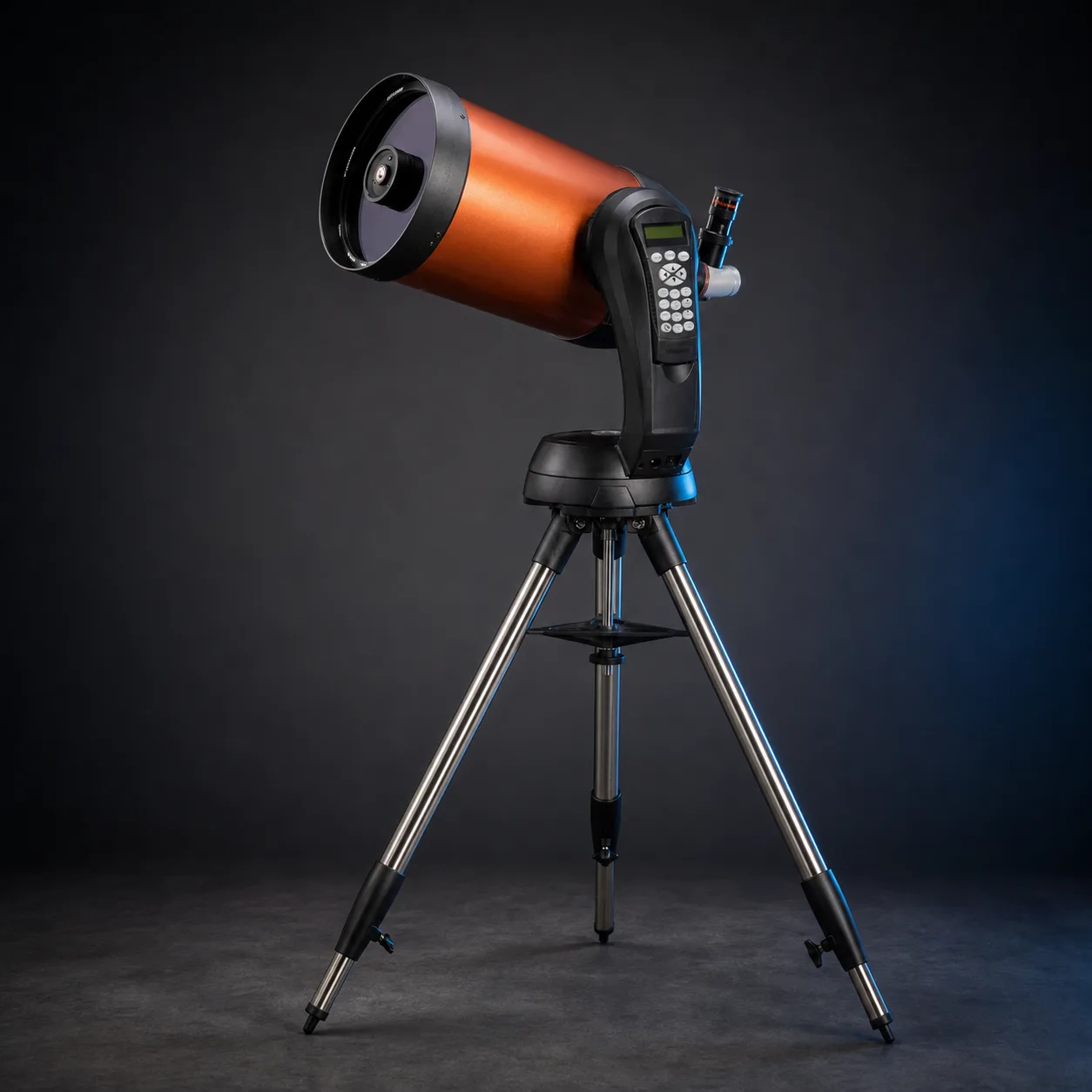
| Mount | Single fork arm, computerized alt-azimuth GoTo |
| Object database | 40,000+ objects |
| Included eyepiece | One 25mm Plossl (81x) |
| Finder | StarPointer red-dot |
| Weight | 14.5kg (32 lbs) total kit: 5.4kg tube, 5kg mount head, 4.1kg tripod (Celestron spec) |
| Power | 8x AA (in practice: external 12V supply or power bank) |
| Price | $1,499 (Amazon, prices change) |
| Amazon rating | 4.4 stars, 2,493 ratings |
The optical tube is Celestron's C8, a design in continuous production since 1970. A 203mm aperture gathers about 78 percent more light than a 6-inch telescope and roughly 65 times more than the naked eye. The trade-off of the Schmidt-Cassegrain design is a long 2032mm focal length folded into a 43cm tube: enormous reach for planets, a narrow native field of view for large nebulae.
Score Breakdown
- Planetary: 71. The best planetary score of any telescope under $1,500 in our database. 8 inches of aperture and 2032mm of focal length is a purpose-built combination for the Moon and planets.
- Deep-Sky: 61. The aperture pulls in every Messier object and resolves globular clusters. The narrow field of view and alt-az mount keep it from scoring higher.
- Astrophotography: 61. Genuinely good for planetary imaging. Not suited to long-exposure deep-sky work, explained below.
- Portability: 53. Middling in absolute terms, but this is the most portable full 8-inch package sold. It breaks into car-trunk-sized pieces in minutes.
- Beginner-Friendliness: 52. GoTo helps you find targets, but alignment, power management, and collimation are real learning curves. This is a first telescope for a committed beginner, not a casual one.
- Value: 44. You pay for the mount electronics and the folded optics. Pure aperture per dollar goes to Dobsonians, and the score reflects that honestly.
What Works Well
The optics carry the package. The C8 tube is one of the most proven optical designs in amateur astronomy, and owner sentiment is remarkably consistent: nobody argues with the glass. TelescopicWatch's hands-on testing rates the optical tube 5/5 even while criticizing the rest of the package. StarBright XLT coatings are standard.
It is the most portable 8 inches you can buy. Per Celestron's spec sheet, the whole kit is 14.5kg (32 lbs) split into three pieces, and no single piece weighs more than the 5.4kg (12 lb) optical tube. Owners who moved from 8-inch Dobsonians mention this constantly: the 8SE fits in a hatchback footwell, sets up in minutes, and actually leaves the house. A telescope that gets used beats a bigger one that stays home.
GoTo earns its keep in two situations. First, light-polluted skies where star-hopping is miserable because you can only see a handful of stars. Second, star parties and family use: align once, then queue up showpieces all night while the mount tracks them. One owner report that stuck with us: a suburban Los Angeles observer saw more through a GoTo 6SE than through their larger manual Dobsonian, simply because finding things was no longer the bottleneck.
The whole Messier catalog is reachable. With 203mm of aperture and a 40,000-object database, every Messier object and the Herschel 400 are realistic targets from reasonable skies.
What Falls Short
The mount is undersized for the tube. This is the single most repeated criticism across every source we reviewed. The C8 tube weighs about 5.7kg (12.5 lbs), which owners on r/telescopes point out sits at the practical payload limit of the single-arm mount before you add a diagonal and eyepiece. In practice that means visible vibration at high magnification: touch the focuser at 200x and the image shakes for a second or two before settling. One club equipment manager reported their NexStar SE loaners spent more time in maintenance than any other scope in the fleet, always for mount issues.
Zenith clearance is a real quirk. Point the tube straight up and the star diagonal can approach the mount base; owners running both a 6SE and 8SE report the 8-inch tube is the one that runs out of room. A 2-inch diagonal upgrade makes this worse.
One eyepiece in the box. A single 25mm Plossl gives you 81x, and that is it. Plan on at least one shorter eyepiece for planets and, eventually, a wider one for clusters. Our eyepiece calculator shows what any candidate eyepiece delivers on the 8SE's 2032mm focal length before you spend anything.
The AA battery compartment is a decoy. Eight AA batteries drain in a session or two of slewing. Owners treat an external 12V supply or a USB power bank with the right cable as a required accessory, not an option. Budget for it up front.
GoTo is not plug-and-play. Alignment takes a few minutes each session and rewards technique: level the tripod, use a wider eyepiece for alignment stars, expect targets to land slightly off-center and need a nudge. Owners disagree on how annoying this is; some call it a five-minute routine, others fight it. Either way, the computer does not exempt you from learning the sky's bright stars.
Collimation and image shift exist, quietly. Schmidt-Cassegrains need occasional collimation (three screws, done in minutes once learned, and far less often than a Newtonian needs it), and the moving-mirror focusing design produces slight image shift when you change focus direction. Both are characteristics of the design rather than defects, and neither is a reason to avoid the telescope. They are reasons to expect a short learning curve.
What You Can Actually See
This is where the 8SE justifies its score, with one honest caveat about expectations.
Planets are the headline. Saturn shows its rings cleanly, with the Cassini Division visible in steady seeing. Jupiter shows its two main cloud belts, the Great Red Spot when it faces Earth, and all four Galilean moons; on good nights the belts show structure. Mars in opposition season shows its polar cap and major dark markings. The practical magnification ceiling of an 8-inch aperture is around 300-400x, and the atmosphere usually caps you before the optics do.
The Moon is inexhaustible. At 2032mm of focal length, crater detail down to a few kilometers across is routine. If you observe nothing else all year, the Moon alone would keep this telescope busy.
Deep-sky is genuinely good, with adjusted expectations. Globular clusters are the 8SE's best deep-sky trick: M13 resolves into individual stars across its face rather than staying a fuzzy ball. Open clusters, the Orion Nebula, planetary nebulae like the Ring, and double stars all deliver. Galaxies are where beginners get disappointed, and owners say so bluntly: under suburban light pollution, most galaxies are faint gray smudges, not photographs. One Bortle 8 observer described Andromeda as a smear with no visible core glow. That is not the telescope's fault; it is physics plus streetlights. Under dark skies the same telescope shows spiral structure in the brightest galaxies.
If your heart is set on the photographic look of nebulae and galaxies without a photography rig, that is what smart telescopes are for, and it is a different product category with different compromises.
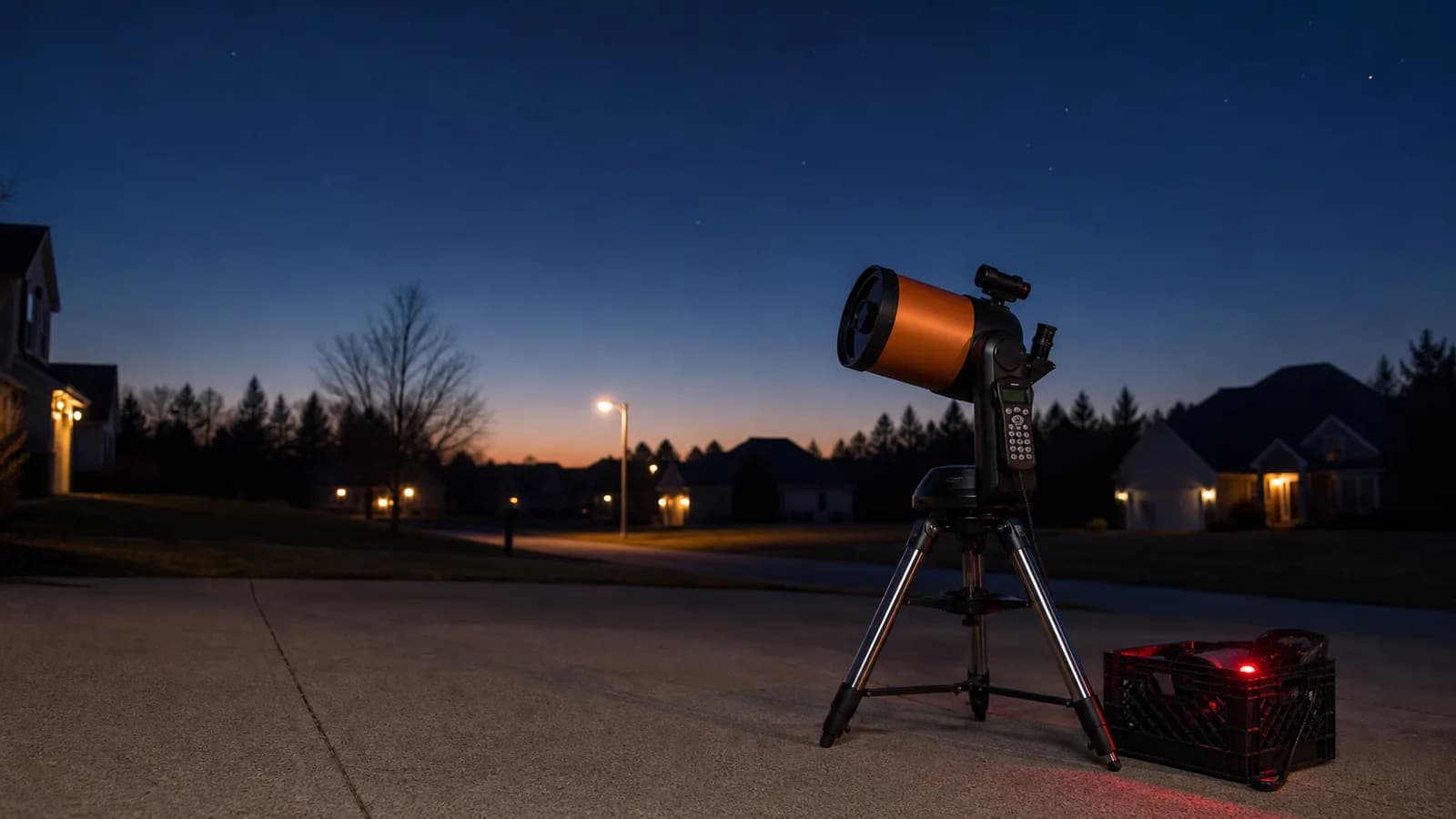
Astrophotography: Set Expectations Now
The 8SE scores 61 for astrophotography, and the number needs interpretation because it averages two very different answers.
Planetary and lunar imaging: yes. A planetary camera or even a phone adapter, a 2x Barlow, and stacking software (the standard free tools are AutoStakkert and Registax) produce genuinely impressive Jupiter and Saturn images with this telescope. The long focal length that limits wide-field work is exactly what planetary imaging wants, and tracking accuracy demands for planetary video capture are low.
Long-exposure deep-sky imaging: the wrong tool. The alt-az mount rotates the field as it tracks, which limits exposures to roughly 20-30 seconds before stars trail, and the f/10 focal ratio makes faint targets slow to expose. Owners who ask "can I add astrophotography later?" get the same community answer we will give you: visual observing and deep-sky imaging are effectively separate hobbies with separate gear. An equatorial wedge and a HyperStar f/2 conversion both exist for this tube, but by the time you have bought either, you have spent dedicated-astro-rig money on a workaround.
If imaging is the actual goal, start from our astrophotography guide instead of adapting the 8SE. If you want effortless deep-sky images at a fraction of the cost, a Seestar S50 does that job for $499.
The Value Math Nobody Runs
The value score of 44 looks harsh until you see what it measures: aperture per dollar, where Dobsonians dominate. But there is a second calculation that the review sites skip and sharp-eyed buyers on r/telescopes caught: the complete 8SE has repeatedly sold for less than Celestron's bare C8 optical tube costs on its own. When that pricing holds, the mount, tripod, GoTo electronics, finder, and eyepiece are effectively free. If you specifically want the C8 optics, the 8SE package is one of the cheapest ways to own them, wobble included.
Here is the realistic total cost of ownership, using typical street prices that will drift:
| Item | Typical cost |
|---|---|
| NexStar 8SE | $1,499 |
| 12V power supply or power bank | $40-100 |
| Planetary eyepiece (8-10mm) | $60-150 |
| Optional: f/6.3 focal reducer (wider views, faster imaging) | ~$170 |
| Realistic all-in | $1,600-1,900 |
Compare honestly: at that all-in figure you could have a 10-inch Dobsonian with money left over, if maximum aperture is the goal and you accept manual finding and a bulkier scope. The 8SE premium buys portability, tracking, and GoTo. Whether that trade is worth it is exactly the question the next two sections answer.
NexStar 8SE vs 6SE
Celestron
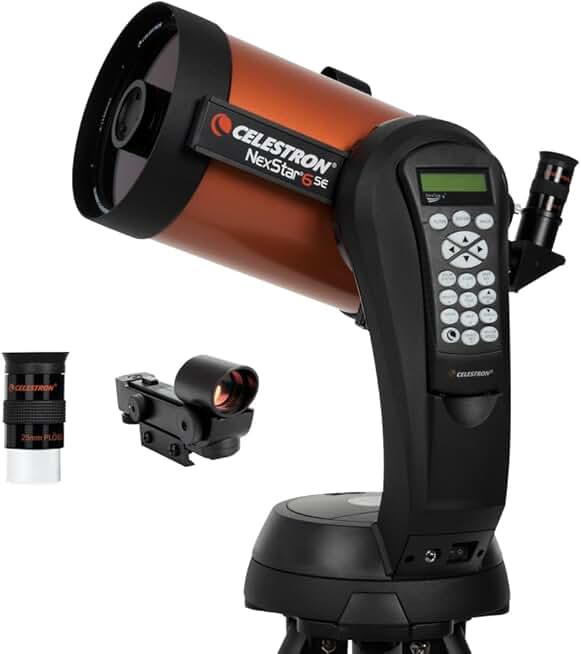
Celestron NexStar 6SESix inches of Schmidt-Cassegrain light-gathering power, automated GoTo precision, and a design proven over decades of clear nights.
The 6SE ($1,199, scores 78 overall) shares the identical single-arm mount and tripod, which is precisely the point: the mount that feels overloaded under the 8-inch tube is well matched to the 6-inch one. A hands-on side-by-side review that ranks for this exact question found the 8SE vibrates noticeably more when focusing, while the 6SE also keeps comfortable diagonal clearance at the zenith where the 8SE gets tight.
Aperture still matters: the 8SE gathers about 78 percent more light. In that same side-by-side test, M13 resolved into star arms in the 8-inch and stayed noticeably dimmer in the 6-inch, and a faint planetary nebula (NGC 7008) was found easily in the 8SE and nearly missed in the 6SE. Our scores agree: the 8SE leads on planetary (71 vs 66) and deep-sky (61 vs 57).
Choose the 8SE if dim targets and maximum planetary detail are the priority and you will tolerate a shakier, more deliberate observing experience. Choose the 6SE if you want the smoothest version of this package, a $300 saving toward accessories, and a mount operating comfortably within its limits.
The better-balanced package: same mount, better matched tube.
NexStar 8SE vs Evolution 8
Celestron
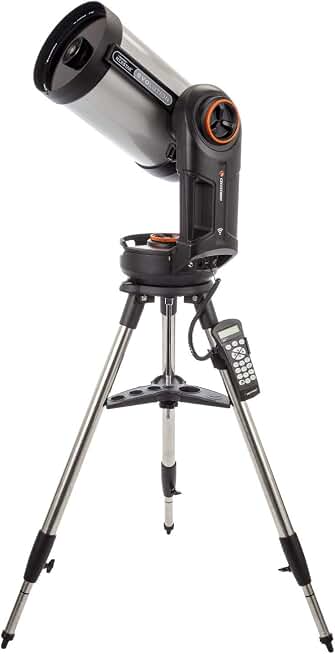
Celestron NexStar Evolution 8WiFi-enabled 8-inch SCT with a built-in battery and GoTo mount, ready to explore deep sky from your backyard
The NexStar Evolution 8 ($2,399, scores 73 overall) is the same C8 optics on the mount the 8SE arguably should have had: still a single fork arm, but a substantially beefier one with metal worm gears, a built-in rechargeable lithium battery that solves the power problem outright, WiFi control from the SkyPortal app, and a steadier tripod. Owners who upgraded describe the difference as night and day at high magnification, and community threads consistently recommend the Evolution to anyone who can stretch to it.
What holds it back in our scoring is weight and price: at 17.5kg for the mount-plus-tube package it gives back a chunk of the 8SE's portability advantage (portability 42 vs 53), and $900 more is real money that could otherwise buy a complete eyepiece collection.
Choose the Evolution 8 if this is a long-term telescope and the budget genuinely stretches; the mount problems in this review mostly disappear. Choose the 8SE if $1,499 is the ceiling, you prioritize the lightest 8-inch setup, and you can live with the wobble.
Should You Buy a Used 8SE?
The used market is unusually good for this telescope because it has been in production, essentially unchanged, for nearly two decades. Recent owner threads put fair used prices around $700-1,000 depending on condition and included accessories, against $1,499 new. The optics do not wear out; electronics and motors are the risk.
A practical buy-check, assembled from what experienced owners actually inspect:
- Run a full GoTo alignment and slew to three targets. You are testing the motors, the hand controller, and the drive base, which are the components that fail.
- Look through the corrector plate at an angle for scratches, fungus, or heavy internal dust. Light dust is normal and harmless.
- Check the small stuff is right. One buyer spotted a marketplace listing where the dovetail clamp knob was installed 180 degrees off, a hint the seller never really used the scope. Missing eyepiece, missing finder, or a battered tripod are all negotiation points.
- Ask what powered it. A scope that lived on AA batteries has had a harder electrical life than one on a proper supply.
The community reference for SE-mount quirks and fixes is nexstarsite.com, worth knowing about before you buy anyone's used unit.
Who Should Buy the NexStar 8SE
Buy the 8SE if: you observe visually, planets and the Moon excite you as much as deep-sky, your skies are light-polluted enough that GoTo beats star-hopping, you need a telescope that transports easily, and $1,499 plus about $150 in accessories fits the budget. For that buyer it is the best telescope in our database at the price, and the 80 overall score reflects it.
Buy something else if:
- You want maximum aperture per dollar for visual observing. An 8-inch or 10-inch Dobsonian delivers more light for less money on a steadier platform; our Dobsonian vs Newtonian explainer covers that route, and the community recommends it to beginners for good reason.
- Deep-sky photography is the goal. Start with the astrophotography guide; the 8SE's alt-az mount is the wrong foundation.
- You want images without the hobby's learning curve. A smart telescope at $349-499 photographs nebulae the 8SE can only show you as gray smudges, though it will never give you a real-time eyepiece view of Saturn.
- You want this exact package with the flaws fixed. The NexStar Evolution 8 is that product, for $900 more.
Still deciding between categories? Our telescope finder narrows the field from your budget and priorities in about a minute, and the best telescopes for planets page ranks the 8SE against every planetary performer we track.
