

The Celestron PowerSeeker 127EQ is not a good telescope, and you should not buy one new. It is a Bird-Jones reflector: a spherical mirror with a Barlow lens inside the focuser, sold as a 1000mm Newtonian in a tube less than half that long, on an equatorial mount too small to hold it steady. For not much more money, a tabletop Dobsonian like the Sky-Watcher Heritage 130P shows you more, works on the first night, and is the scope nearly every independent source tells beginners to buy instead.
Quick Verdict
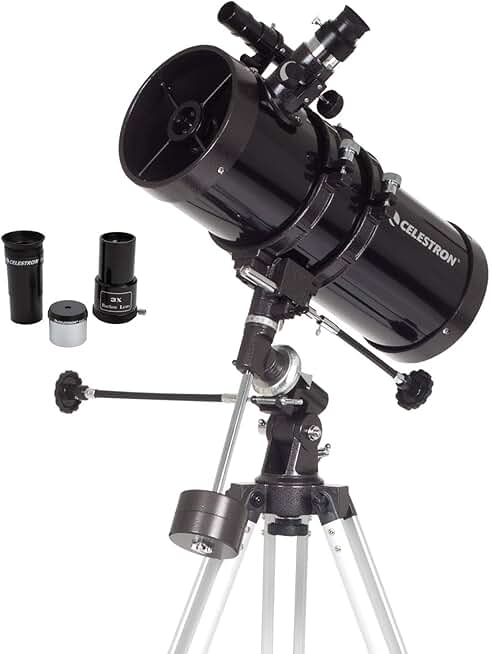
Celestron
Celestron PowerSeeker 127EQ127mm of light-gathering power on an equatorial mount, priced for first-time astronomers ready to explore the sky seriously.
| Category | Score |
|---|---|
| Overall | 58/100 |
| Value | 59/100 |
| Beginner-Friendliness | 39/100 |
| Deep-Sky | 29/100 |
| Planetary | 25/100 |
Skip it if you are buying a first telescope, which is who it is marketed to. Consider it only if you want a cheap, light equatorial head and steel tripod for a camera and do not care about the optical tube at all.
A disclosure that matters here: until August 2026 our scoring engine rated this telescope 74 overall and 88 for value, higher than the Heritage Dobsonians, and four of our guides recommended it. The engine read 127mm, 1000mm and "equatorial mount" off the spec sheet and had no way to see what the mirror is. We changed the methodology so it now accounts for optical execution, and the 127EQ dropped to the score above. We were wrong to recommend it.
This review is built from Celestron's own specification sheet, the hands-on teardown published by telescopicwatch, and owner reports on r/telescopes and Cloudy Nights. We have not owned one.
What the 127EQ Actually Is
Celestron sells the 127EQ as a "Newtonian Reflector" with a 127mm (5-inch) aperture, the diameter of the main mirror that collects the light, and a 1000mm focal length. Read further down the same spec sheet and two numbers do not fit together: the optical tube is 436mm long, and the optical design line says "Spherical Primary Mirror".
A normal Newtonian's tube is about as long as its focal length, because the mirror has to bring the light to a focus inside it. A 1000mm Newtonian in a 436mm tube is only possible if something stretches the focal length after the mirror. Celestron's own knowledgebase describes exactly that construction for its AstroMaster 114 line: "a Barlow lens built into the focuser... extends the focal length of the primary mirror and the telescope without adding physical length." That arrangement is called a Bird-Jones.
The design is not bad in principle. A carefully made Bird-Jones, with a real corrector lens placed just in front of the secondary mirror, can work. telescopicwatch took the 127EQ apart and found that is not what Celestron built:
- The "corrector" is a plain Barlow lens mounted in the focuser drawtube. It moves every time you focus, so its position relative to the mirror is never the one the correction needs.
- The primary mirror is fast and spherical. telescopicwatch puts its native focal ratio around f/3.5, far too fast for a spherical surface to bring light to a sharp point.
- The mirror is held in place with blobs of epoxy, which the reviewer believes stress the glass further.
The Focal-Ratio Rule That Exposes Every Cheap Reflector
Spherical mirrors are not automatically bad, and this is the part most "don't buy it" threads skip. A Cloudy Nights thread on the 127EQ makes the point well: the common 114mm/900mm Newtonian with a spherical mirror is a good telescope, and the Russian maker TAL produced excellent spherical-mirror Newtonians. What those scopes share is a slow focal ratio. At f/8 or longer, a sphere is so close to the ideal parabola that the difference barely matters.
The focal ratio is the focal length divided by the aperture. The faster the mirror (the lower that number), the further a sphere departs from a parabola and the softer the image. The 127EQ's spec-sheet f/7.87 is the figure after the Barlow; the mirror itself is the fast one.
That gives you two checks you can run on any budget reflector listing:
- Find the mirror type. If the manufacturer says parabolic, good. If it says spherical, look at the focal ratio.
- Compare tube length to focal length. If a "1000mm" reflector ships in a tube 40-60cm long, there is a Barlow in the focuser and a fast spherical mirror behind it. That is a Bird-Jones, whatever the box calls it.
By those checks, the AstroMaster 114EQ (1000mm, 395mm tube) and the StarSense Explorer LT 114AZ (1000mm, 610mm tube) are the same design as the 127EQ, and Celestron lists a spherical primary for both. They are not the step up they appear to be. Our types of telescopes guide and reflector vs refractor explainer cover the designs in more depth.
The Mount Is What Defeats Beginners
If the optics were the only problem, the 127EQ would merely be mediocre. Celestron describes the mount as a manual German equatorial mount, the EQ-1 in telescopicwatch's review. An equatorial mount is built to track the sky by turning one axis aligned with Earth's pole. That is useful for photography and for following planets at high power, but it has to be balanced, its single-axis tracking only works once the polar axis is roughly aligned with the pole, and the axes move in directions that confuse almost everyone the first time. One Cloudy Nights poster, describing a friend's 127EQ, says the mount is what actually defeats beginners.
The 127EQ makes that worse in two ways. telescopicwatch describes the EQ-1 as fairly well made but too small for a 127mm tube, unstable with the tube mounted, and supplied with a counterweight that is not heavy enough to balance it, so the reviewer had to keep the axes partly locked just to stop the telescope drifting on its own.
A Dobsonian is the opposite experience: a box that swivels left and right and a tube that tilts up and down. You push the tube toward what you want to see. There is nothing to align or balance, which is why our Dobsonian vs Newtonian guide recommends that route to most first-time owners.
The Accessories, and Why "450x" Is a Red Flag
| Accessory | Magnification on the 127EQ | What reviewers found |
|---|---|---|
| 20mm eyepiece with built-in image erector | 50x | A Kellner design whose erecting prism dims and softens the view, there so the box can claim daytime use |
| 4mm eyepiece | 250x | A Ramsden, an old design with a tiny eye lens and almost no eye relief |
| 3x Barlow | 150x with the 20mm, 750x with the 4mm | Plastic optics; telescopicwatch calls it useless |
| 5x24 finder | n/a | Stopped down to under 10mm of aperture and hard to align |
telescopicwatch ties the plastic Barlow to the "450x" magnification it says Celestron has claimed for the scope. Any magnification claim like that is a warning sign, on any listing. A practical rule is that the most useful magnification a telescope can deliver is about twice its aperture in millimeters, so roughly 250x for a perfect 127mm telescope on a steady night. Celestron's own spec sheet lists 300x as the "highest useful magnification", and the 127EQ's optics fall short of either figure. Our eyepiece calculator shows the magnification, field of view and exit pupil for any eyepiece on this scope, and it is a quick way to check a box claim before you buy anything. Between the finder and the wandering mount, telescopicwatch found it hard to point the 127EQ at much besides the Moon.
What You Can Actually See
Based on telescopicwatch's planet-by-planet notes and owner reports, and assuming you have managed to collimate the scope (see If You Already Own One, below):
- The Moon: the one target that works. Craters, mountains and the terminator are clear, though less crisp than through a scope with good optics.
- Jupiter: the four bright moons, and the two main cloud belts at low contrast. The Great Red Spot, an easy catch in most decent telescopes, is not sharp enough to pick out.
- Saturn: the rings are visible but fuzzy, with Titan and maybe one other moon. The Cassini Division, the gap in the rings, does not show.
- Mars: a blurry orange disc even near opposition, maybe with a hint of the polar cap.
- Venus: the phase is easy, surrounded by glare.
- Deep sky: the Orion Nebula looks reasonable, but the Trapezium stars inside it are mushy. Bright star clusters show up without crispness. Galaxies are hard to find and show no detail, most planetary nebulae blur away, and close double stars will not split.
Our view simulator shows what a 127mm aperture can show at a given magnification. Treat that as the best case: the simulator assumes the optics are working properly, and on the 127EQ they are not, so the real view will be softer.
Why It Has Over 10,000 Four-Star Reviews
As of October 2026, the 127EQ's Amazon listing carries 10,316 ratings averaging 4.1 stars. Several things push that rating up, and none of them is a hidden quality:
- Most buyers have never looked through a good telescope. A first-time owner has nothing to compare the view with, so a soft Jupiter with a couple of faint belts still feels like a success.
- The Moon works. It is bright enough to look decent through almost anything, and it is where most new owners start and stop.
- The erecting eyepiece makes daytime use easy. Point it at a distant tree or ship and you get an upright, magnified image, which is satisfying in the first week.
- It sells in enormous volume. It is cheap, it looks like a serious telescope, and mainstream "best telescope" roundups have listed it. One r/telescopes poster asked about it because Space.com had recommended it.
The hobby community's verdict is strongly negative. One r/telescopes commenter notes that "a lot of folks" classify the 127EQ as a "hobby killer", the PowerSeeker line is notorious enough to have its own warning subreddit, r/dontbuyapowerseeker, and telescopicwatch ranks it 13th of 13 in its $200 tier. It is not unanimous: one Cloudy Nights veteran points out that any scope can get a determined person started.
What to Buy Instead
telescopicwatch and the r/telescopes threads land on the same alternative: a tabletop Dobsonian with a parabolic mirror. Here are the numbers side by side, including Celestron's other 114mm reflectors at a similar price so you can see why they do not count.
| Telescope | Aperture | Mirror and design | Focal length vs tube | Mount | Weight | Price | Amazon rating |
|---|---|---|---|---|---|---|---|
| PowerSeeker 127EQ | 127mm | Spherical, Bird-Jones | 1000mm in a 436mm tube | Small manual EQ | 5.9kg | $199.95 | 4.1 (10,316) |
| AstroMaster 114EQ | 114mm | Spherical, Bird-Jones | 1000mm in a 395mm tube | Manual EQ | 6.0kg | $263.99 | 4.4 (1,446) |
| StarSense Explorer LT 114AZ | 114mm | Spherical, Bird-Jones | 1000mm in a 610mm tube | Manual alt-az, phone-guided | 4.7kg | $239.99 | 4.1 (1,460) |
| Heritage 130P | 130mm | Parabolic Newtonian, f/5 | 650mm, collapsible tube | Tabletop Dobsonian | 8.7kg | $269 | 4.5 (69) |
| Heritage 150P | 150mm | Parabolic Newtonian, f/5 | 750mm, collapsible tube | Tabletop Dobsonian | 9.3kg | $309 | 4.6 (74) |
The aperture numbers look close. The Heritage 130P collects only about 5 percent more light than the 127EQ's 127mm, and the 150P about 40 percent more. The difference is that their mirrors are the right shape and their mounts work, and our scores reflect it: 45 for planetary and 46 for deep sky on the 130P, against 25 and 29 on the 127EQ.
Sky-Watcher Heritage 130P: The Direct Replacement
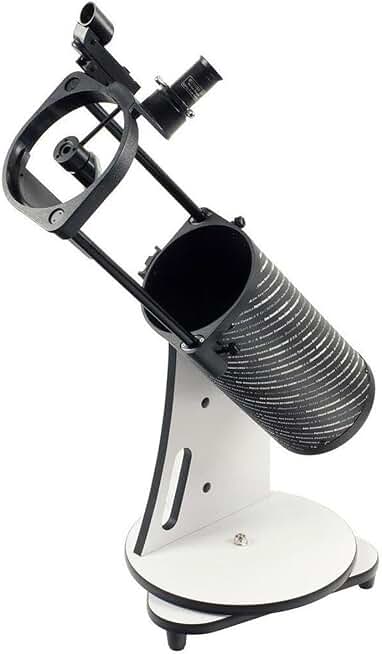
Sky-Watcher
Sky-Watcher Heritage 130PBig aperture, tabletop convenience: the Heritage 130P punches well above its price and size class.
The Heritage 130P is the scope r/telescopes commenters name in place of the PowerSeeker, and the one telescopicwatch recommends in its alternatives section. Sky-Watcher's spec sheet lists a borosilicate parabolic primary, 130mm at f/5, on a collapsible tube that shortens for storage. It currently sells for $269, against $199.95 for the 127EQ.
The f/5 focal ratio gives wide, bright views that suit star clusters, the Orion Nebula and sweeping the Milky Way. Because the mirror is parabolic, it also takes the high magnification that planets need, which the 127EQ never manages. It scores 67 overall in our database.
Who it is for: Anyone who was about to buy a 127EQ and can stretch a little. The extra money goes into the mirror and the mount, the two parts that matter.
The tradeoff: It needs a sturdy table, crate or stool, and there is no tracking; you nudge the tube to follow objects. It needs occasional collimation, which on a standard Newtonian takes a few minutes and does not involve taking the focuser apart.
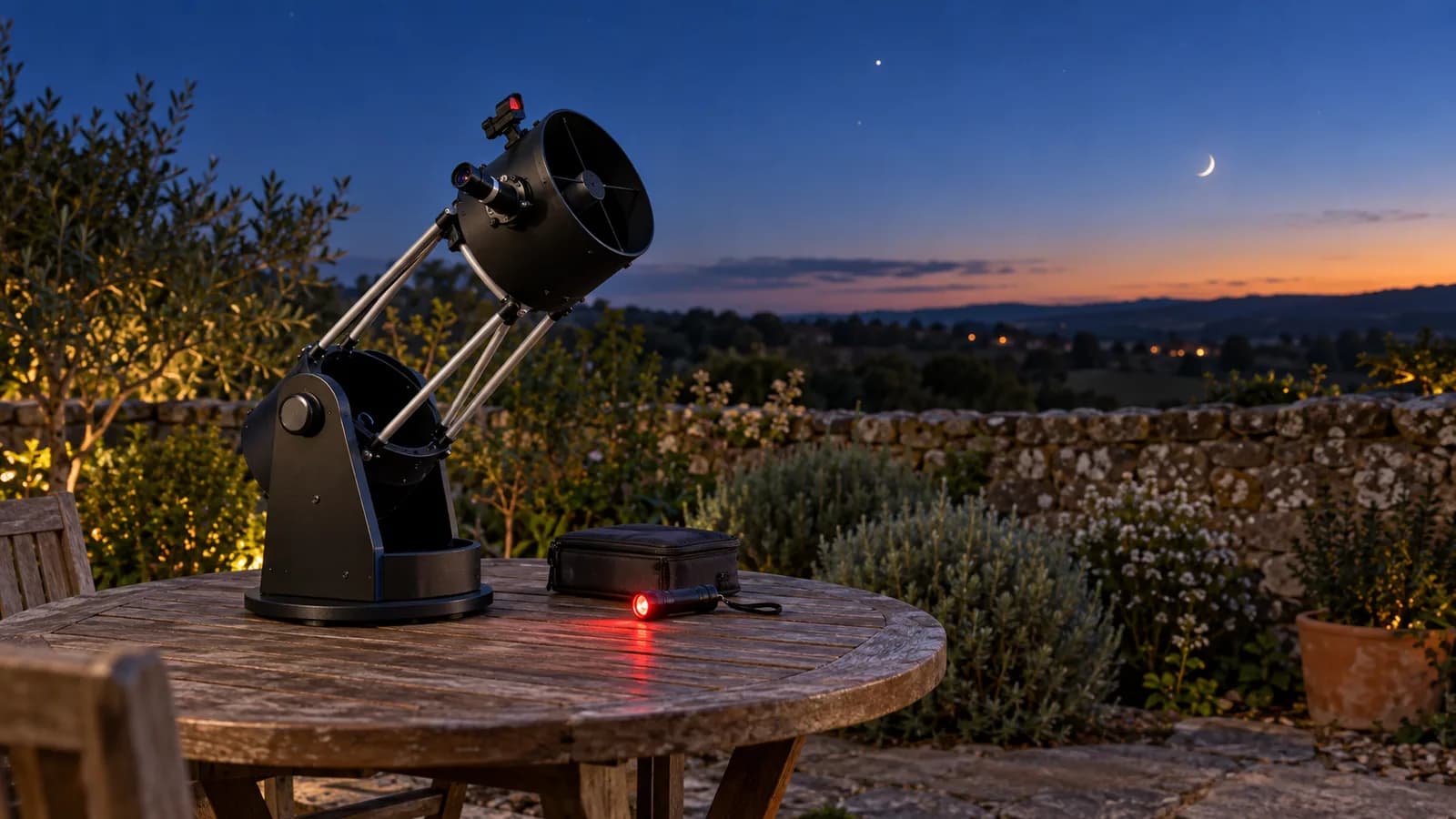
The parabolic tabletop Dob telescopicwatch and r/telescopes commenters name in the 127EQ's place.
Sky-Watcher Heritage 150P: More Aperture, Same Simplicity
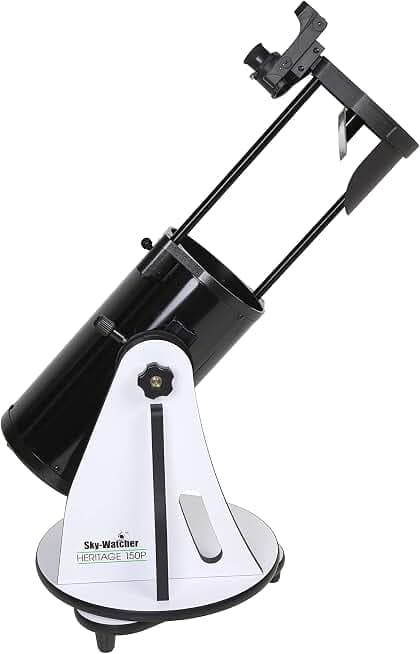
Sky-Watcher
Sky-Watcher Heritage 150PBig views, compact package: the Heritage 150P brings serious aperture to a tabletop Dobsonian under $400.
The Heritage 150P is the same idea with a 150mm parabolic mirror at f/5, for $309. It gathers about 40 percent more light than the 127EQ, which shows as fainter galaxies and more stars in globular clusters, and it scores 69 overall.
Who it is for: Buyers who can stretch past the 130P's price and want the most aperture they can get on a simple tabletop mount.
The tradeoff: The heaviest scope in the table, with the same table-and-no-tracking caveats as the 130P.
More mirror, the same push-and-look mount.
If you want the telescope to find things for you, the stretch option is the Sky-Watcher Virtuoso GTi 150P, a 150mm f/5 tube on a motorized GoTo mount for $402.31. It scores 77 overall. For more options in each budget, see our best telescopes under $300, best telescopes under $200 and best telescopes for beginners guides, or let the telescope finder narrow the list from your budget and goals.
Not ready to spend that much? The r/telescopes threads give two honest alternatives to buying any telescope under $200: a pair of 7x50 binoculars, which our binoculars vs telescope guide covers, or spending nothing yet. A free planetarium app like Stellarium, a local astronomy club with loaner scopes, and one drive to a dark sky will teach you more about what you want than a PowerSeeker will.
If You Already Own One
If you bought one recently, return it. That is the advice in the r/telescopes threads we read, and the poster who paid $125 for an open-box unit did exactly that.
If returning it is not an option, here is the honest salvage.
Collimation. Collimation means aligning the mirrors so they bring light to a sharp focus. On the 127EQ, telescopicwatch found it requires taking the focuser apart to remove the corrector, collimating, then reassembling everything, and that the adjustment screws strip easily. A commenter on that review describes a workaround: collimate as well as you can the normal way, then make the final adjustments on the secondary mirror's screws only, in small movements, until out-of-focus star images look round on both sides of focus. They report pinpoint stars and better lunar detail afterward, and they also say not to use eyepieces wider than 20mm because the edge of the field never sharpens.
The accessories. Replace the 4mm eyepiece and the plastic Barlow, or do not use them. A single decent eyepiece in the 9-12mm range (roughly 80-110x on this scope) is a sensible ceiling for optics this soft.
The mount and tripod. These are the main parts with lasting use. One telescopicwatch commenter bought the 127EQ specifically to carry a DSLR for wide-field photos, which the EQ head and steel tripod can do once the tube is off, since a camera is far lighter than the tube. Another took the lens out of the Barlow and used its housing as an extension tube.
Should You Buy a Used 127EQ?
No, not as a telescope. telescopicwatch's answer is "not even for $1", and the r/telescopes threads about $80 and $125 offers reach the same conclusion. A used unit has the same optics and the same mount as a new one, plus the chance that someone has already stripped the collimation screws.
The only reason to pay for one is the mount, if you specifically want a light manual equatorial head and tripod for a camera. Know that you are buying the mount, and price it accordingly.
