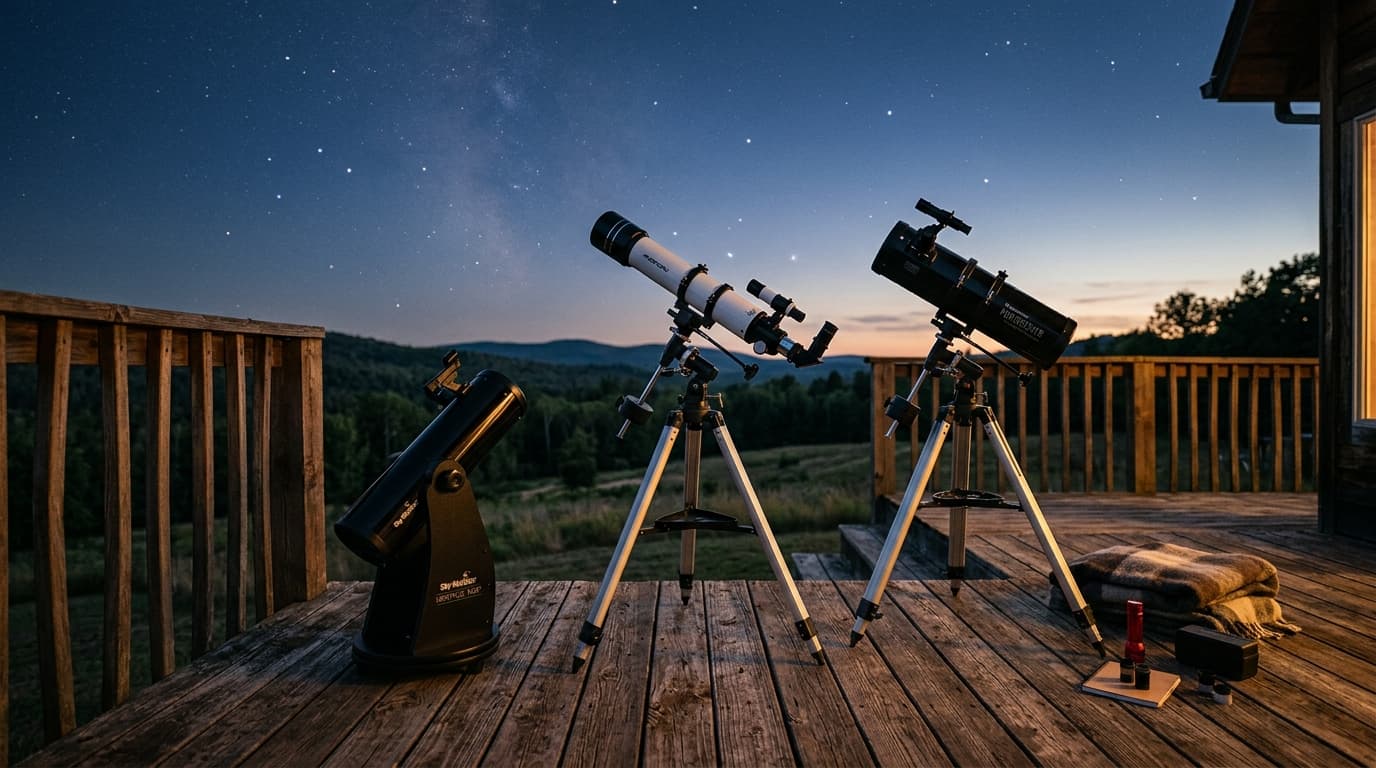

You can get a genuinely capable telescope for under $500 in 2026. The Celestron StarSense Explorer DX 130AZ is our top pick at $499.95: a 130mm parabolic Newtonian with Celestron's phone-guided star finding, the combination of real optics and real help that beginners actually need. If you want the telescope to find and track things for you, the Sky-Watcher Virtuoso GTi 150P delivers full GoTo on a 150mm tabletop Dobsonian for $402.31.
Every telescope on WhichScope is scored across 7 dimensions, and since August 2026 that includes optical execution: whether a reflector's mirror is parabolic or spherical, and whether its focal length is real or manufactured by a Barlow hidden in the focuser. That single change removed three former picks from this list, including the two that used to sit at the top. Here are the 7 best telescopes under $500 today, followed by what changed and why.
Quick Picks
| Telescope | Best For | Overall Score | Price |
|---|---|---|---|
| Celestron StarSense Explorer DX 130AZ | Best overall | 74 | $499.95 |
| Sky-Watcher Virtuoso GTi 150P | Best GoTo under $500 | 76 | $402.31 |
| Celestron Travel Scope 70 | Best under $100 | 69 | $89.99 |
| Celestron AstroMaster 102AZ | Best refractor | 72 | $252.52 |
| Celestron AstroMaster 130EQ-MD | Best for astrophotography | 74 | $330.99 |
| Sky-Watcher Heritage 150P | Best Dobsonian | 68 | $309 |
| Sky-Watcher Heritage 130P | Best Dobsonian under $350 | 67 | $269 |
How We Chose These
We filtered to active, in-stock telescopes under $500 and ranked by overall score, then curated for a mix of telescope types so there is a strong recommendation whether you want a simple grab-and-go refractor, an app-guided reflector, a GoTo scope, or a tabletop Dobsonian.
Earlier versions of this guide ranked purely by value score, which measures capability per dollar. That is exactly how two Bird-Jones reflectors ended up at the top of it: on a spec sheet, 114mm of aperture and a 1000mm focal length for under $250 is spectacular value, and the engine could not see that the focal length was fake and the mirror the wrong shape. It can now. Value still matters and still feeds the overall score, but it no longer gets to headline a list on its own.
Our Top Picks
1. Celestron StarSense Explorer DX 130AZ: Best Overall
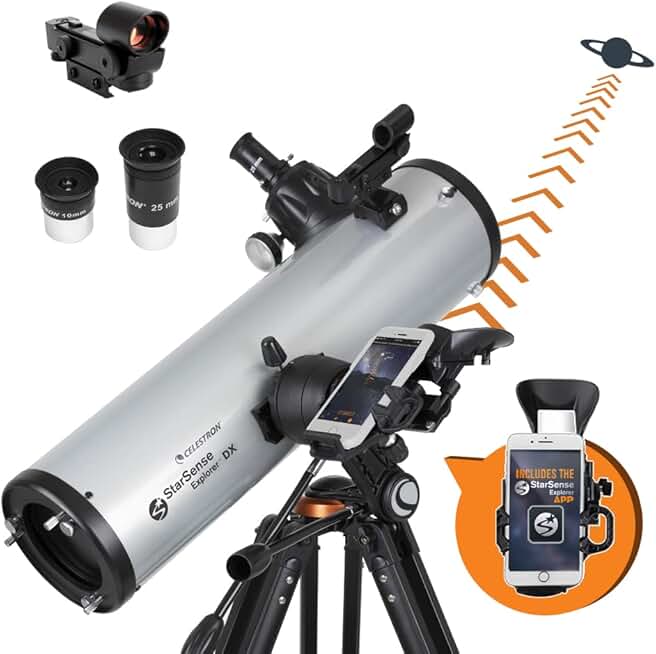
Smart phone-powered star finding meets a capable 130mm reflector, making the night sky genuinely accessible for beginners.
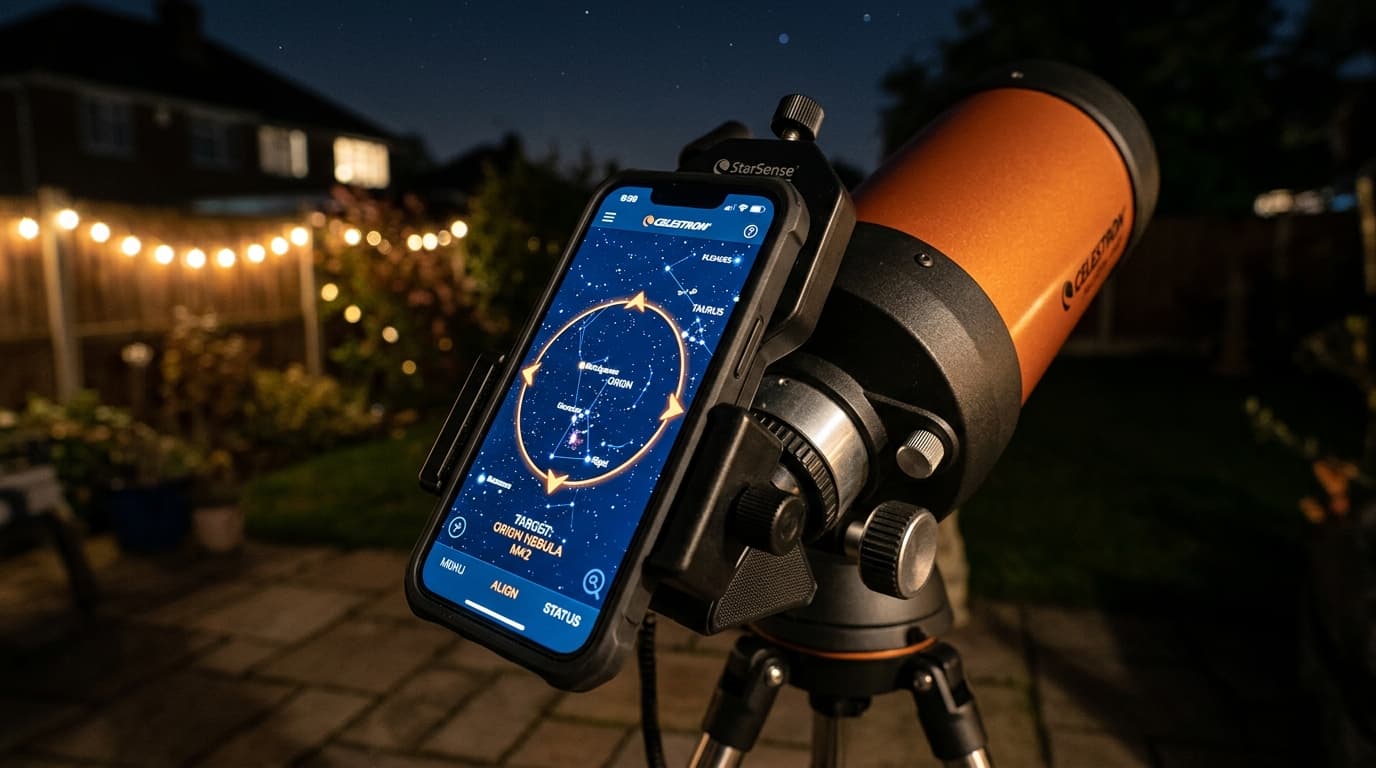
The DX 130AZ is the StarSense Explorer scope we can recommend without an asterisk. Celestron's spec sheet lists a parabolic primary mirror, 130mm across at f/5 with a 650mm focal length in a 635mm tube, which is to say a real Newtonian with the right mirror, not the Bird-Jones construction of the cheaper StarSense models. Dock your phone, and the app uses its camera to solve the sky and draw arrows to any target; you push the telescope until they say stop. It is not GoTo, you do the moving, but it ends the "I cannot find anything" problem that kills most beginners' interest.
130mm of properly figured aperture shows the Orion Nebula with structure, the Andromeda Galaxy's core, dozens of clusters, Saturn's rings with the Cassini Division on a steady night, and Jupiter's belts with real contrast. The alt-azimuth mount has slow-motion controls on both axes and a full-height steel tripod. At 8.16kg it is a one-trip carry. 1,550 Amazon reviews averaging 4.1 stars.
Who it is for: Beginners who want real aperture and help finding things in one purchase, anyone who was about to buy the LT 114AZ and should buy this instead.
The tradeoff: No motorized tracking; objects drift out of view at high magnification and you nudge the scope every minute or so. The app needs a recent smartphone. Newtonians need occasional collimation. For the same money the Virtuoso GTi below trades the app for real GoTo and 150mm of aperture.
A 130mm parabolic mirror with phone-guided finding. The StarSense to buy.
2. Sky-Watcher Virtuoso GTi 150P: Best GoTo Under $500
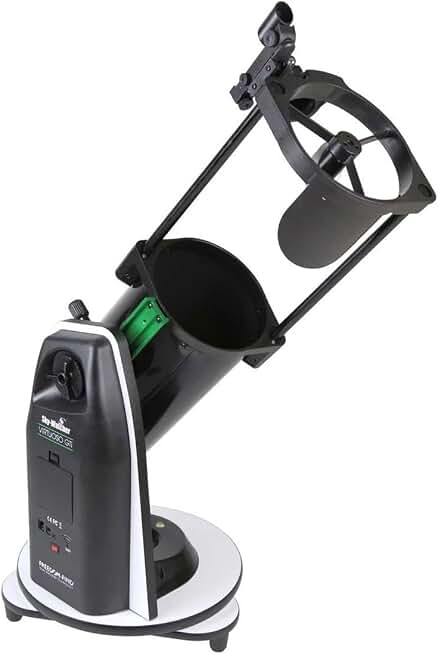
Sky-Watcher
Sky-Watcher Virtuoso GTi 150PGoTo Dobsonian power in a tabletop package, with Wi-Fi control and the freedom to push around manually.
If you want the telescope to find objects for you, the Virtuoso GTi 150P is the most capable GoTo you can buy under $500, and it is not the one most listicles name. It puts the same 150mm f/5 collapsible optical tube format as the Heritage 150P on a motorized tabletop Dobsonian base with built-in WiFi. Align using one of four methods in the free SynScan Pro app, pick any of more than 10,000 objects, and the scope slews to it and tracks it. Sky-Watcher's Freedom Find dual encoders let you push the tube by hand like an ordinary Dob without losing alignment, which is the feature that makes a GoTo Dob still feel like a Dob.
150mm of aperture is the real story: about 75 percent more light-gathering than a 114mm scope, enough for globular clusters to start resolving into stars and for galaxies to show shape rather than smudge. At 11.7kg it wants a sturdy table. 52 Amazon reviews averaging 4.2 stars, a small sample, but Sky-Watcher's Heritage and Virtuoso lines have long track records in the community.
Who it is for: Beginners who want hands-off finding and tracking, anyone who was considering the Celestron 114LCM and wants 75 percent more light with an honest mirror for a little more money.
The tradeoff: Tabletop mount means you supply the table. Runs on 8 AA batteries or an external 12V supply that is not included; budget for the supply. Alignment takes a couple of minutes each session. Tracks in alt-azimuth, so it is not an astrophotography platform beyond the Moon and planets.
150mm GoTo Dobsonian with WiFi control. The GoTo to buy under $500.
3. Celestron Travel Scope 70: Best Under $100
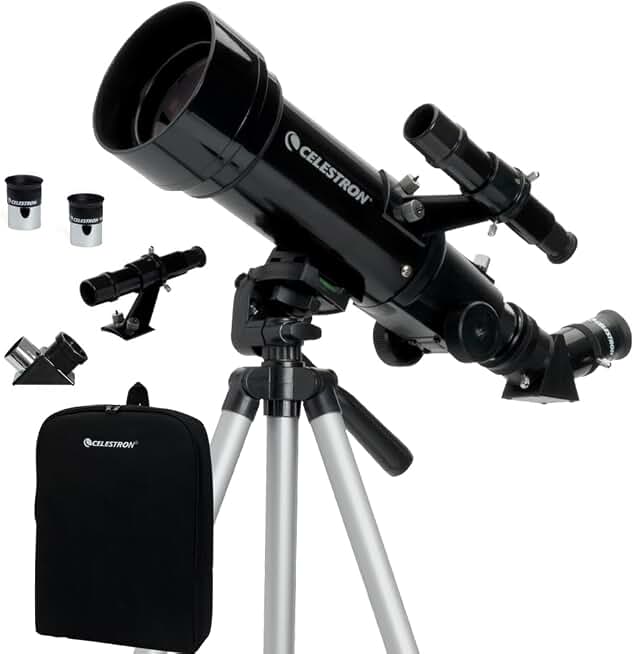
A capable 70mm grab-and-go refractor that earns its place in any beginner's kit without breaking the bank.
At $89.99, the Travel Scope 70 is the safest first purchase in astronomy. It is a 70mm achromatic refractor with a 400mm focal length, wide fields of view, and sharp lunar images. Saturn's rings are visible (small but there), and Jupiter shows its two main cloud bands. It is the most-reviewed telescope in our database by a wide margin.
The entire package weighs under 2kg and fits in the included backpack. No setup complexity, no collimation, no electronics. Point it at the sky and look.
Who it is for: Anyone testing the waters, travelers, or parents buying a first telescope for a kid. Also covered in our best telescopes for beginners guide.
The tradeoff: 70mm of aperture is physically limited. Faint nebulae and galaxies will be invisible. This is a gateway telescope, not a long-term one.
The safest first telescope purchase under $100.
4. Celestron AstroMaster 102AZ: Best Refractor
Celestron
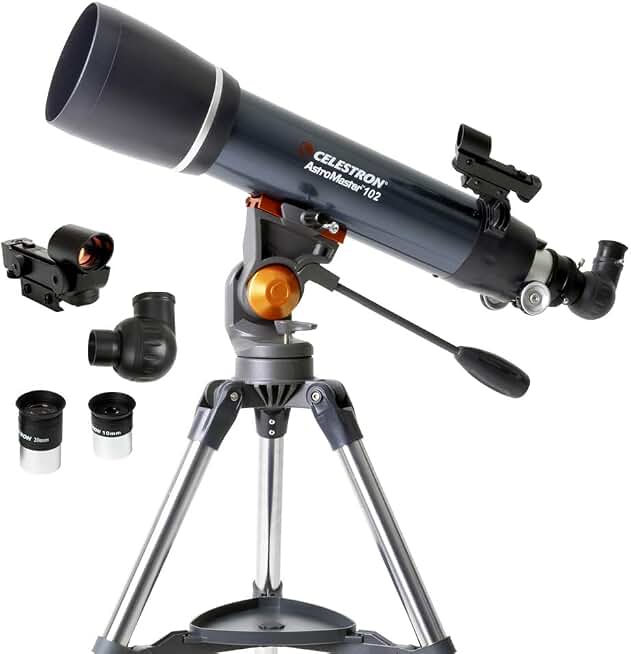
Celestron AstroMaster 102AZA capable 102mm refractor that gets you outside and observing on your first night out
If you want a refractor with more capability than a 70mm but do not need GoTo, the AstroMaster 102AZ puts 102mm of aperture on a simple alt-az mount for $252.52. Refractors are maintenance-free (no collimation), produce high-contrast views, and 102mm resolves significantly more detail than 70mm. This is a real step up from budget scopes, and it is our top pick in the under $300 guide.
With 351 Amazon reviews at 4.3 stars, it is well regarded. The f/6.5 focal ratio is reasonably fast for a refractor, giving decent wide-field views.
Who it is for: Observers who want refractor simplicity with enough aperture to show real detail on planets and brighter deep-sky objects.
The tradeoff: No GoTo, no tracking. At 5.8kg, it is heavier than budget refractors. Achromatic optics show some color fringing on bright objects at high magnification, a limitation of every achromat in this price range.
102mm refractor, nothing to collimate, well under $300.
5. Celestron AstroMaster 130EQ-MD: Best for Astrophotography
Celestron
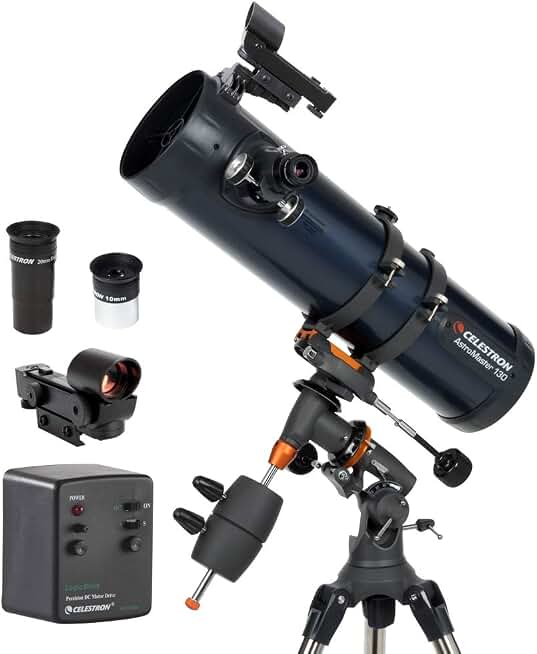
Celestron AstroMaster 130EQ-MD130mm of light-gathering power with motorized tracking, built for beginners ready to go beyond the Moon
The 130EQ-MD is the only telescope under $500 on this list with motorized tracking on an equatorial mount, which makes it the best budget option for anyone who wants to try astrophotography. The motor drive compensates for Earth's rotation, keeping objects centered during exposures. Combined with 130mm of aperture at f/5, it is a workable starter for lunar, planetary, and basic tracking experiments at $330.99.
One caveat that we now score explicitly: Celestron's spec sheet lists a spherical primary mirror, and at f/5 that costs you some sharpness at high power and at the edge of the field. It is a true Newtonian (650mm focal length in a 552mm tube, no corrector in the focuser), so it is nothing like the Bird-Jones scopes we warn about below, but a parabolic 130mm would be sharper. For imaging the Moon and planets and for learning an equatorial mount it remains the right tool at this price.
Who it is for: Beginners who know they want to try astrophotography and want a scope that supports it from day one.
The tradeoff: Equatorial mounts are harder to set up than alt-az (you need to polar align). The motor drive tracks but does not GoTo, so you still find objects manually. The spherical f/5 mirror limits high-power sharpness. At 7.7kg, it is not a grab-and-go scope. Amazon reviews average 4.0 stars, lower than others on this list.
The only motorized EQ mount under $500.
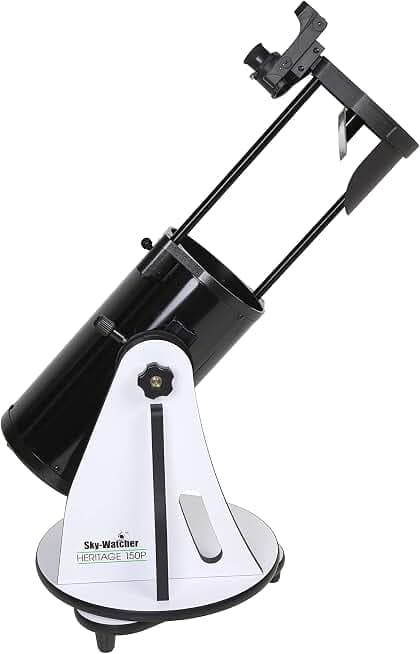
6. Sky-Watcher Heritage 150P: Best Dobsonian
Sky-Watcher
Sky-Watcher Heritage 150PBig views, compact package: the Heritage 150P brings serious aperture to a tabletop Dobsonian under $400.
The Heritage 150P puts 150mm (6 inches) of parabolic-mirror aperture on your table for $309. That is as much light-gathering as anything on this list, and the Dobsonian mount is the simplest design in astronomy. Push it where you want it to point, look through the eyepiece.
The collapsible tube makes it surprisingly compact for storage. Amazon reviewers give it 4.6 stars across 74 reviews, the highest rating on this list. The f/5 focal ratio provides wide-field views ideal for deep-sky sweeping, and because the mirror is parabolic, planets are sharp at high power too.
Who it is for: Observers who want maximum aperture per dollar and enjoy a hands-on, manual approach to finding objects. Anyone who does not need the Virtuoso GTi's motors.
The tradeoff: No electronics, no tracking. Requires a sturdy table. Newtonians need occasional collimation. Not ideal if you want the telescope to find things for you.
150mm of parabolic aperture on a tabletop Dob. Maximum light per dollar.
7. Sky-Watcher Heritage 130P: Best Dobsonian Under $350
Sky-Watcher
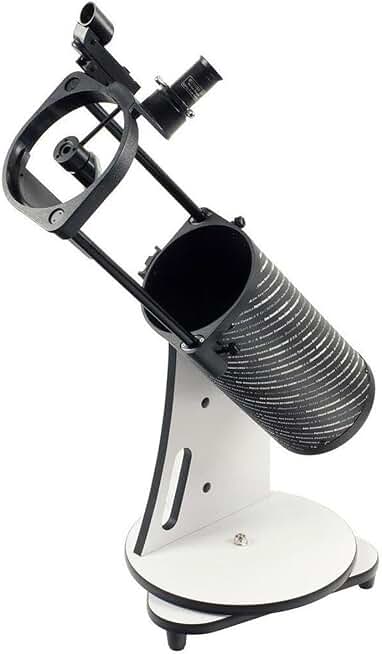
Sky-Watcher Heritage 130PBig aperture, tabletop convenience: the Heritage 130P punches well above its price and size class.
The Heritage 130P is the smaller sibling of the 150P and the scope that r/telescopes has recommended to beginners for a decade. A 130mm parabolic mirror at f/5 on a collapsible tabletop Dobsonian for $269: it gathers well over three times the light of a 70mm refractor, shows the Orion Nebula with structure and Saturn's rings cleanly, and has nothing hidden in the focuser. It is the telescope every honest review of the PowerSeeker 127EQ ends by recommending instead.
At 8.69kg it needs a sturdy table or a milk crate. 69 Amazon reviews averaging 4.5 stars, a small sample but consistently high. The included 25mm and 10mm eyepieces give 26x and 65x.
Who it is for: Budget buyers who want maximum honest aperture, anyone choosing between this and a Bird-Jones reflector at a similar price.
The tradeoff: No tracking, no electronics. The 150P gives you noticeably more on faint targets for the extra money. Needs a table.
130mm parabolic Dobsonian. The beginner scope the community actually recommends.
What Changed, and Why Three Scopes Left This List
Three telescopes that used to be picks here are gone: the StarSense Explorer LT 114AZ (formerly "best value overall"), the 114LCM (formerly "best GoTo"), and the PowerSeeker 127EQ (formerly "most aperture per dollar"). All three are Bird-Jones designs. Celestron's own spec sheets describe each as "Spherical Primary Mirror" and list optical tubes of 395mm to 610mm for a nominal 1000mm focal length; the missing length is manufactured by a Barlow lens inside the focuser. Hands-on reviewers who have taken these apart report that the corrector moves with the focuser, so the correction is never quite right, that collimating means removing it first, and that no amount of care fixes a fast spherical primary; owners on r/telescopes describe the same experience.
The hobby community has said this for years. r/telescopes calls the PowerSeeker a "hobby killer" and maintains a subreddit warning people off it. Our engine could not see it, because it scored aperture and focal length from the spec sheet. It now applies an optical-execution factor, documented on our methodology page, and the three scopes dropped from 74-81 to 60-68. The 114LCM still scores 68 on the strength of real GoTo electronics; if you want GoTo, the Virtuoso GTi 150P above gives you that plus 150mm of honest aperture.
What $500 Buys vs $200 vs $1,000
Under $100: A 70-80mm refractor on a basic tripod. Good for the Moon, basic planetary views, and bright star clusters. No GoTo, no tracking. Lightweight and portable. The Travel Scope 70 is the benchmark here.
$200-$300: A 102mm refractor or, stretching slightly, a parabolic 130mm tabletop Dobsonian. This is where real aperture begins. See our best telescopes under $300 guide for detailed picks in this range.
$300-$500: App-guided finding on a parabolic 130mm (DX 130AZ), GoTo on a 150mm Dobsonian (Virtuoso GTi 150P), motorized equatorial tracking (130EQ-MD), or a 150mm manual Dob (Heritage 150P). This range delivers serious capability. Smart telescopes such as the ZWO Seestar S30 also land here when in stock, handling alignment, tracking, and stacking through a phone app.
$500-$1,000: The DWARFLAB DWARF 3 smart telescope (see our DWARF 3 review), Celestron's NexStar SE GoTo scopes, and larger Dobsonians. If you can stretch your budget, see our best telescopes under $1,000 guide for the full range.
