Comparison
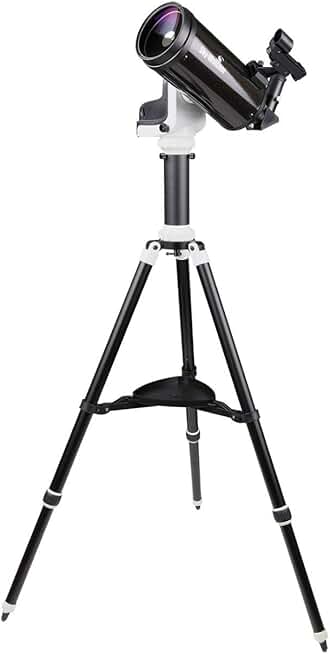
Sky-Watcher SkyMax 102 vs ZWO Seestar S50
Performance Profile
Score Comparison
ZWO Seestar S50 is currently unavailable at Amazon. Prices mentioned in the comparison below may be out of date.
Our Take
The choice between these telescopes hinges on whether you want a traditional eyepiece instrument or a smart telescope that captures images to your phone. The Sky-Watcher SkyMax 102 is a conventional Maksutov-Cassegrain with twice the aperture of the ZWO Seestar S50, giving it a decisive advantage for observing the Moon and planets through an eyepiece. The ZWO, by contrast, is a smart telescope; it has a built-in camera and processes stacked images on a tablet or phone rather than offering direct eyepiece viewing. This design makes it more capable at deep-sky imaging and far more portable at 2.5kg.
The fundamental difference is aperture paired with purpose. The SkyMax's 102mm mirror gathers substantially more light than the Seestar's 50mm lens, supporting higher magnification for lunar and planetary detail. The Seestar's short focal length and camera sensor are optimized for wide-field deep-sky imaging, where its automated stacking produces images that improve with exposure time. Choose the Sky-Watcher SkyMax 102 if you want to look through a telescope at bright objects and prefer traditional observing.
Choose the ZWO Seestar S50 if you want to image faint galaxies and nebulae, value simplicity, or need something genuinely portable. The SkyMax demands a sturdy tripod and setup time; the Seestar fits in a backpack.
Key Differences
Why choose Sky-Watcher SkyMax 102
- 102mm aperture gathers more light than 50mm
Why choose ZWO Seestar S50
- 3.5kg lighter and more portable
- Faster f/5 for wider field of view
- Higher Overall score (90 vs 77)
- Higher Value score (71 vs 60)
- Higher Astrophoto score (71 vs 50)
- Higher Portability score (86 vs 69)