Comparison
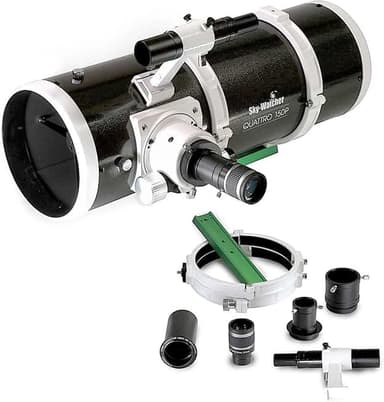
Celestron StarSense Explorer DX 5" SCT vs Sky-Watcher Quattro 150P Imaging Newtonian
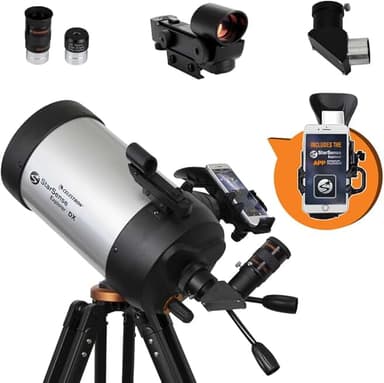
VS
Performance Profile
Score Comparison
Celestron StarSense ExplorerSky-Watcher Quattro 150P
Overall
68
63
Value
56
46
Beginner
38
34
Astrophoto
42
39
Portability
59
57
Planetary
56
48
Deep Sky
45
47
Our Take
The Celestron StarSense Explorer DX 5" SCT edges out the Sky-Watcher Quattro 150P Imaging Newtonian with a five-point overall advantage and superior scores across most categories. However, the choice ultimately depends on your priorities. The single most important differentiator is aperture versus focal ratio. The Celestron's 127mm aperture pairs with a longer f/9.8 focal length, delivering superior planetary detail and contrast.
The Sky-Watcher's larger 150mm aperture and fast f/4 design favor wide-field deep-sky observation and wide-angle imaging. The Celestron also includes automated StarSense tracking, which meaningfully improves the beginner experience; the Sky-Watcher requires manual tracking. The Celestron StarSense Explorer DX 5" SCT suits observers prioritizing planetary work, ease of use, and compact transportation. The Sky-Watcher Quattro 150P Imaging Newtonian better serves those chasing faint nebulae and galaxies who prioritize light-gathering power and don't mind manual tracking.
For most amateur astronomers starting out, the Celestron StarSense Explorer DX 5" SCT is the stronger recommendation. Its automated tracking removes a significant learning curve, its optics deliver exceptional planetary views, and its lower price preserves budget for eyepieces and accessories.
Key Differences
Why choose Celestron StarSense Explorer
- $85 cheaper
- 1.0kg lighter and more portable
- Has tracking capability for astrophotography
- 1,550 Amazon reviews vs 17
Why choose Sky-Watcher Quattro 150P
- 150mm aperture gathers more light than 127mm
- Faster f/4 for wider field of view
Specifications
SpecCelestron StarSense ExplorerSky-Watcher Quattro 150P
Optical Specs
Aperture127mm150mm
Focal Length1250mm600mm
Focal Ratiof/9.8f/4
Optical DesignSchmidt-CassegrainSchmidt-Cassegrain
Mount & Tracking
Mount TypeAlt-AzAlt-Az
GoToNoNo
TrackingYesNo
Physical
Weight6.62kg7.67kg
Included Accessories
FinderRed dot finder6x30 optical finder
Focuser-Dual-speed
Pricing & Reviews
Price$580$665
Amazon Rating4.1 stars3.8 stars
Reviews1,55017
Try these telescopes in our Eyepiece Calculator:
Related Comparisons
Celestron NexStar 127SLT vs Sky-Watcher Quattro 150P Imaging NewtonianSky-Watcher Quattro 150P Imaging Newtonian vs SVBONY SV550 80mm APO TripletCelestron NexStar 5SE vs Celestron StarSense Explorer DX 5" SCTCelestron NexStar 127SLT vs Celestron StarSense Explorer DX 5" SCTCelestron NexStar Evolution 9.25 vs Sky-Watcher Quattro 150P Imaging NewtonianCelestron NexStar Evolution 9.25 vs Celestron StarSense Explorer DX 5" SCT