Comparison
Celestron StarSense Explorer DX 102AZ vs Telescope, 150EQ Newtonian Reflector Telescope for Adults Astronomy Beginners

VS
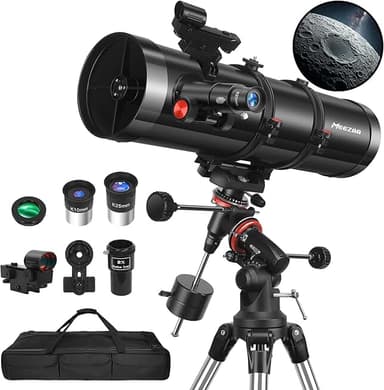
Performance Profile
Score Comparison
Celestron StarSense ExplorerTelescope, 150EQ Newtonian
Overall
69
79
Value
60
75
Beginner
41
40
Astrophoto
49
71
Portability
59
49
Planetary
44
50
Deep Sky
49
57
Our Take
The 150EQ Newtonian wins overall with an 80/100 score versus 69/100, delivering significantly better value across most observing categories. The single most important differentiator is aperture; the 150EQ's 150mm mirror collects roughly 216% more light than the Celestron's 102mm refractor, translating to substantially brighter views of deep-sky objects and finer planetary detail. The Celestron StarSense Explorer DX 102AZ suits observers prioritizing portability and ease of setup; its 6.4kg weight and alt-azimuth mount make it genuinely travel-friendly, though its performance suffers accordingly.
The 150EQ Newtonian Reflector suits serious beginners willing to invest in a stationary observatory setup, rewarding them with superior astrophotography potential (71 versus 49) and deeper deep-sky exploration (57 versus 49). Choose the 150EQ unless portability is your driving constraint. At $300, you're getting a larger, faster scope optimized for visual astronomy and imaging.
The Celestron appeals primarily to hikers and travelers who need a telescope that fits in a car trunk; for stationary backyard use, the 150EQ's larger mirror and 11 percent price advantage make it the clear choice for amateur astronomers serious about performance.
Key Differences
Why choose Celestron StarSense Explorer
- 7.0kg lighter and more portable
- 1,550 Amazon reviews vs 219
Why choose Telescope, 150EQ Newtonian
- 150mm aperture gathers more light than 102mm
- $100 cheaper
- Faster f/4.3 for wider field of view
- Higher Value score (75 vs 60)
- Higher Astrophoto score (71 vs 49)
- Higher Amazon rating (4.5 vs 4.1 stars)
Specifications
SpecCelestron StarSense ExplorerTelescope, 150EQ Newtonian
Optical Specs
Aperture102mm150mm
Focal Length660mm650mm
Focal Ratiof/6.5f/4.3
Optical DesignAchromat Refractor-
Mount & Tracking
Mount TypeAlt-AzEquatorial
GoToNoNo
TrackingYesYes
Physical
Weight6.44kg13.47kg
Included Accessories
FinderStarPointerRed dot finder
Pricing & Reviews
Price$430$330
Amazon Rating4.1 stars4.5 stars
Reviews1,550219
Try these telescopes in our Eyepiece Calculator:
Related Comparisons
Celestron StarSense Explorer DX 102AZ vs SVBONY SV550 80mm APO TripletCelestron AstroMaster 114EQ vs Telescope, 150EQ Newtonian Reflector Telescope for Adults Astronomy BeginnersCelestron StarSense Explorer DX 130AZ vs Telescope, 150EQ Newtonian Reflector Telescope for Adults Astronomy BeginnersCelestron AstroMaster 130EQ vs Telescope, 150EQ Newtonian Reflector Telescope for Adults Astronomy BeginnersHSL 150EQ Astronomical Reflector Telescope for Adults high Powered vs Telescope, 150EQ Newtonian Reflector Telescope for Adults Astronomy BeginnersSky-Watcher Sky-Watcher EvoGuide 50DX – 50mm Guide Scope APO Doublet Refractor – vs Telescope, 150EQ Newtonian Reflector Telescope for Adults Astronomy Beginners